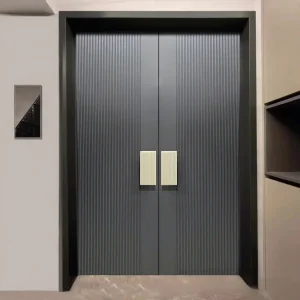
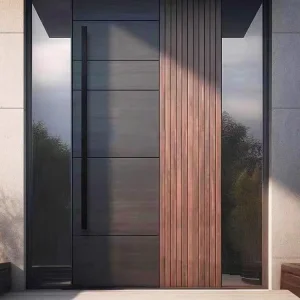
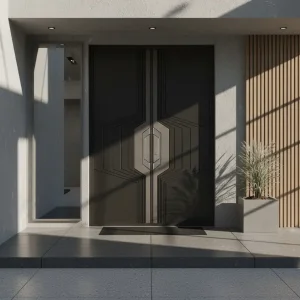
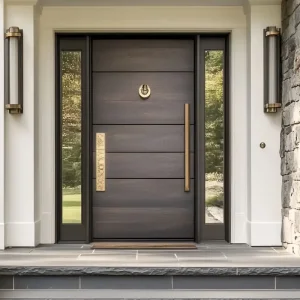
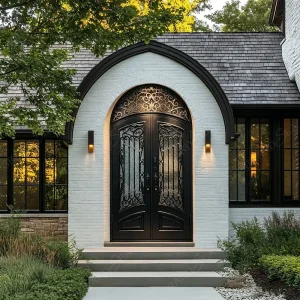
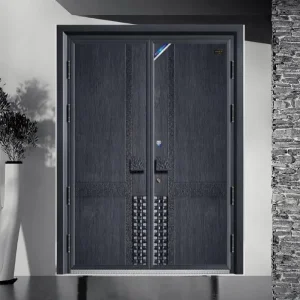
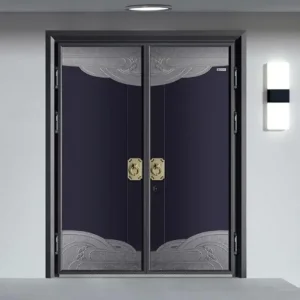
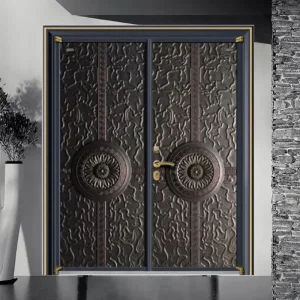
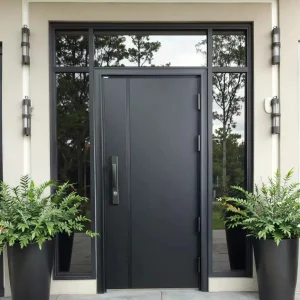
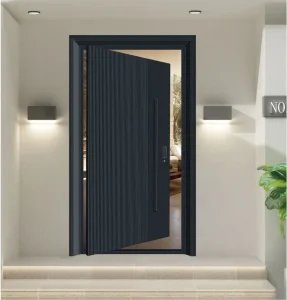
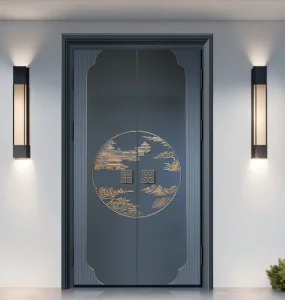
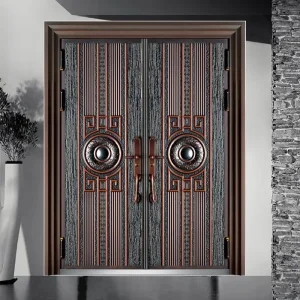
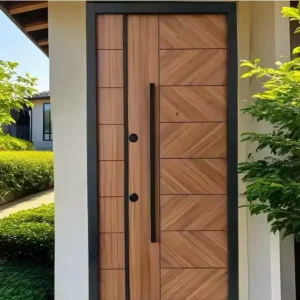
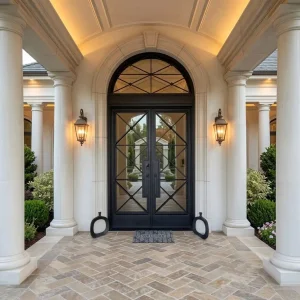
Explore our certified flagship structural pivot doors, cast aluminum armours, and thermal-break entrance systems tailored for extreme weather resilience.
A authoritative analysis on structural wind load, thermal bridge isolation, salt-spray corrosion resistance, and water tightness in luxury exterior entrances.
In modern architectural design, an entry door serves as both the defining aesthetic focal point of a luxury residence or commercial building and the primary defense boundary against physical intrusion and environmental degradation. As global climate patterns evolve toward higher frequencies of extreme storm surges, hurricane-force winds, UV radiation exposure, and drastic temperature swings, conventional timber and entry-level steel doors consistently fail to provide long-term reliability. DERCHI, operating from its state-of-the-art 180,000 m² manufacturing ecosystem in Foshan, China, has pioneered advanced material physics and mechanical design to produce entry door systems capable of exceeding international building code demands.
Understanding weather resistance requires analyzing four core physics vectors: structural deflection under dynamic pressure, thermal energy transmission through the frame-leaf interface, galvanic and atmospheric corrosion rates of metallic elements, and continuous elasticity of sealing polymers. By integrating aerospace-grade 6063-T5 aluminum alloys, multi-chambered polyamide (PA66) thermal break strips, PVDF fluorocarbon coatings, and multi-point perimeter locking hardware, DERCHI manufactures entry doors engineered for a 30-year operational life cycle with zero structural degradation.
How DERCHI bridges structural alloy engineering, surface chemistry, and mechanical seal design.
High-tensile aluminum extrusions paired with 6mm–12mm solid sand-cast aluminum front plates. Provides maximum impact resistance against airborne debris and physical intrusion without warp or rust.
Glass-fiber reinforced polyamide 66 thermal barrier strips isolate the exterior frame from the interior core, preventing thermal bridging and driving overall frame U-values down to 1.6 W/(m²·K).
AkzoNobel or PPG 3-coat PPG fluorocarbon finishes resist 3,000 hours of accelerated salt spray testing (ASTM B117 standard), preventing color fading, chalking, or salt corrosion in marine zones.
Continuous co-extruded EPDM foam gaskets form a multi-stage airlock around the door leaf. Maintains elastic memory across temperature variations from -40°C to +80°C.
Why procurement directors and global architectural firms choose DERCHI’s vertically integrated Foshan manufacturing hub.
Foshan, Guangdong, represents the global capital of architectural aluminum extrusion and building hardware manufacturing. DERCHI leverages this unique geographic ecosystem by operating a vertically integrated 180,000 m² smart manufacturing plant. Unlike western assemblers who source sub-components from disparate third parties, DERCHI executes profile extrusion, precision CNC machining, thermal break crimping, surface fluorocarbon powder coating, double-glazed unit (DGU) glass assembly, and final pre-hanging testing completely in-house.
Real-world environmental adaptations engineered to meet regional building requirements.
Challenge: Salt fog corrosion, high humidity, and tropical storm wind pressure.
DERCHI Solution: SUS316 marine-grade hardware, 3-coat fluorocarbon PVDF finishing, and dual water-barrier drainage thresholds meeting AS2047 coastal requirements.
Challenge: Extreme sub-zero temperatures, snow accumulation, and severe thermal pressure.
DERCHI Solution: Triple-glazed Low-E insulated glass units (Argon gas filled), 34mm PA66 thermal breaks, and heat-reflective internal foils keeping interiors warm.
Challenge: Ambient temperatures over 50°C, direct UV oxidation, fine dust penetration.
DERCHI Solution: Heavy cast aluminum armour plates with UV-stabilized powder coatings, multi-point dust-sealing gaskets, and solar-heat blocking glazing matrix.
Direct comparison of technical parameters across DERCHI weather-resistant entry door platforms.
| Door System Platform | Core Structural Build-Up | Thermal U-Value Range | Wind Load Resistance | Water Tightness Rating | Certifications |
|---|---|---|---|---|---|
| Thermal Break Aluminum | 6063-T5 profile + PA66 thermal bar + PU core | 1.6 – 2.2 W/(m²·K) | Up to 3,000 Pa (AS2047 N6) | 600 Pa Pa (Class 9A) | CE, AS2047, ISO9001 |
| Cast Aluminum Armour Door | 8-12mm solid cast plate + steel reinforced skeleton | 1.8 – 2.4 W/(m²·K) | Up to 3,500 Pa | 550 Pa | CE, Security Class RC3/RC4 |
| Glass Heavy Pivot Entry Door | Structural pivot frame + 42mm laminated DGU glass | 1.4 – 2.0 W/(m²·K) | Up to 2,800 Pa | 450 Pa | CE, SGCC, AS/NZS 2208 |
| Stainless Steel Security Entry | SUS304/316 skins over steel grid & rockwool core | 2.0 – 2.6 W/(m²·K) | Up to 4,000 Pa | 500 Pa | UL Fire-Rated 90 Min, CE |
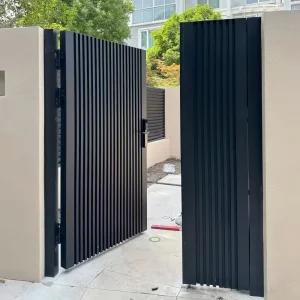
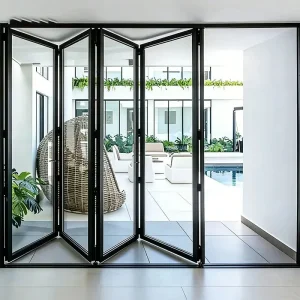
Explore our bespoke architectural courtyard gates, bi-fold doors, and explosion-proof security entrance solutions.
Expert insights on certification compliance, maximum leaf dimensions, structural wind loading, and logistics.
DERCHI incorporates a pressure-equalized three-tier gasket system combined with concealed internal drainage channels. Water that breaches the primary outer seal is collected in a stepped aluminum threshold track and guided outward via one-way check valves under positive wind pressure.
Using our heavy-duty internal steel skeleton and German floor-pivot hardware rated up to 500 kg, DERCHI can manufacture single pivot leaves up to 2,000 mm in width and 4,000 mm in height while maintaining smooth, effortless manual operation and perfect seal compression.
Yes. DERCHI doors undergo independent laboratory testing to comply with Australian AS2047 standards (N6 rating for ultimate limit state wind pressures up to 3,000 Pa) as well as European CE EN 14351-1 structural standards. Official test documentation is issued with all project quotes.
For coastal environments within 1 km of ocean shorelines, we prescribe 70% Kynar 500 PVDF fluorocarbon coatings or marine-grade anodizing (25+ microns). Both options pass the 3,000-hour continuous salt spray test (ASTM B117) without surface degradation or color shift.
Our in-house design engineering department provides complimentary 2D CAD shop drawings, elevation details, and 3D BIM models within 24–48 hours of receiving project schedules. Every opening is assigned a unique tag matching site architectural drawings.