Explore our top-tier certified entry door products engineered for high structural integrity, acoustic dampening, and extreme weather resilience.
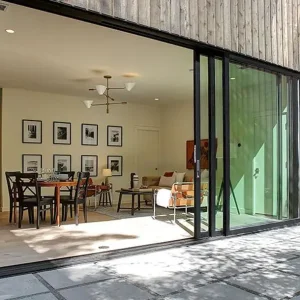
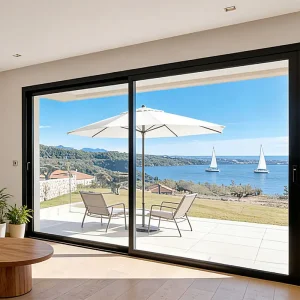
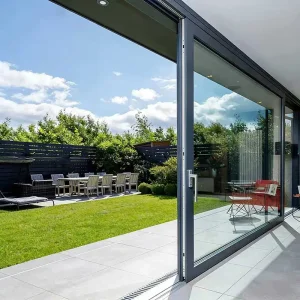
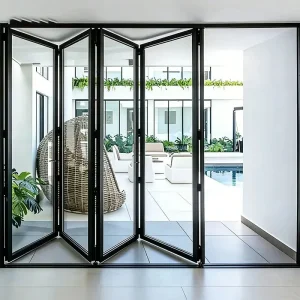
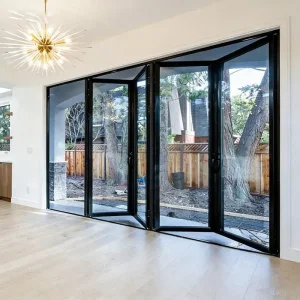
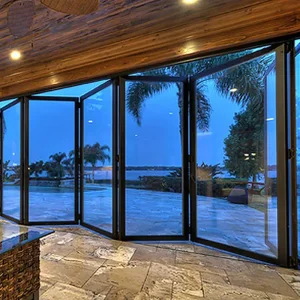
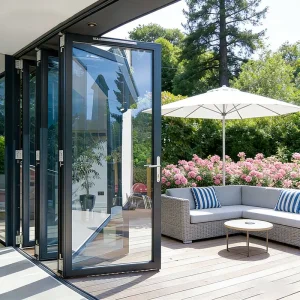
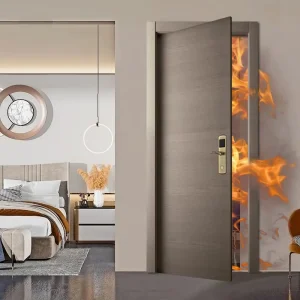
In contemporary B2B architecture, entry doors have evolved from basic physical barriers into highly sophisticated, multi-functional thermal envelopes and grand design icons.
International building codes (such as ASHRAE 90.1, IECC, and European Passive House standards) mandate aggressive thermal insulation metrics. Modern entry door manufacturers must integrate structural polyamide (PA66GF25) thermal breaks and Low-E argon-filled glazing assemblies to reduce energy loss.
With climate volatility increasing globally, entry door systems in coastal regions require rigorous testing for wind load deflection (up to 3,000 Pa) and dynamic water resistance under hurricane conditions, adhering to NFRC, AS2047, and CE certifications.
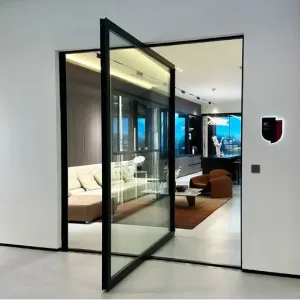
Commercial lobbies and luxury estates demand oversized entrance openings. Oversized structural pivot doors with heavy-duty German floor pivots supporting up to 500kg leaf weights are replacing standard hinged double-door configurations.
Discover why procuring from DERCHI’s 180,000 m² Foshan facility provides overseas developers with unmatched cost efficiency, engineering flexibility, and rapid delivery cycles.
Unlike trading agencies or component assemblers, DERCHI operates a fully integrated ecosystem in Foshan. From raw 6063-T5 aluminum billet extrusion to precision multi-axis CNC milling, fluorocarbon (PVDF) spray lines, and automated insulating glass synthesis, every process stays under strict ISO 9001 quality control. This minimizes intermediary markups and guarantees dimensional tolerance down to ±0.5 mm.
Chinese factory efficiency allows custom sample production within 12-18 days and full project container fulfillment within 25-35 days. By utilizing Foshan’s dense hardware and raw material supply chain, custom molds for unique architectural profiles are developed in half the lead time required by European manufacturers.
Compare structural properties, thermal insulation values, acoustic sound reduction, and application suitability across DERCHI's key entry door material categories.
| Door Material Platform | Core Structural Build-Up | Thermal U-Value Range | Acoustic Rating (STC/Rw) | Wind Load / Water Resistance | Recommended Application |
|---|---|---|---|---|---|
| Thermally Broken Aluminum | 6063-T5 alloy with 24-34mm PA66GF25 polyamide insulation barrier & PU infill | 1.4 – 1.8 W/(m²·K) | 35 dB – 42 dB | Up to 3,000 Pa (AS2047 N6 / Hurricane Zone) | Luxury modern villas, coastal estates, mid-rise commercial entrances |
| Cast Aluminum Art Doors | 6mm – 12mm solid sand-cast relief panels fused to heavy structural sub-frames | 1.8 – 2.2 W/(m²·K) | 32 dB – 38 dB | Up to 2,400 Pa structural load | Grand villa main gates, classical mansions, private courtyard entrances |
| Insulating Glass Pivot Doors | Structural aluminum frame holding 28mm – 42mm Low-E laminated/tempered IGUs | 1.2 – 1.6 W/(m²·K) | 38 dB – 45 dB | Up to 2,800 Pa wind resistance | Modern architectural lobbies, luxury retail facades, daylight-centric homes |
| Armored Stainless Steel | 1.5mm – 2.0mm SUS304 / SUS316 skin over steel honeycomb & rockwool core | 2.0 – 2.5 W/(m²·K) | 36 dB – 40 dB | Maximum forced-entry anti-prying resistance | High-security residential entrances, bank vaults, commercial service doors |
SEO Information Gain Insight: Selecting the correct door platform relies heavily on regional climate criteria. For instance, high-humidity coastal zones require PVDF-coated thermally broken aluminum to avoid salt-spray galvanic corrosion, while cold climates necessitate multi-chamber PA66GF25 thermal breaks with triple-seal EPDM weatherstripping.
DERCHI customizes door engineering specs to comply with geographic climate demands and regional structural building codes worldwide.
Code Compliance: NFRC thermal performance & ASTM E1886/E1996 hurricane impact resistance.
Engineering Adaptation: SentryGlas® (SGP) laminated glass interlayers engineered for High-Velocity Hurricane Zones (HVHZ) in Florida and the Gulf Coast, paired with American multi-point smart locking systems.
Code Compliance: AS2047 & AS1288 structural fenestration standards.
Engineering Adaptation: Tested to AS2047 N6 pressure ratings (water penetration resistance > 450 Pa). Profile anodizing thickness > 25 microns to withstand extreme coastal salt air and severe UV exposure.
Code Compliance: Extreme thermal expansion & dust ingress standards.
Engineering Adaptation: High SRI (Solar Reflectance Index) AkzoNobel PVDF coatings to handle ambient exterior temperatures exceeding 50°C. Double dust-barrier perimeter brush seals prevent fine desert sand intrusion.
Code Compliance: CE Marking, EN 14351-1, and PAS 24 burglar resistance.
Engineering Adaptation: Ultra-low U-factor profile designs (Uf < 1.2 W/m²K) utilizing triple glazing with warm-edge spacers, fully aligned with European energy efficiency targets.
Discover how smart automation, structural pivot hardware, and sustainable materials are reshaping modern architectural entrance design.
Modern entry door manufacturers are integrating concealed electromechanical multi-point locks compatible with 3D facial recognition, biometric fingerprint sensors, smartphone Bluetooth/NFC apps, and home automation systems (KNX, Zigbee) directly into profile frame cavities.
Traditional side hinges are giving way to heavy-duty hydraulic floor pivots. Modern pivot hardware allows massive leaves up to 2000mm in width and 4000mm in height to operate effortlessly with a opening force of under 15 Newtons, featuring soft-closing damper speed adjustments.
Sustainability is driving adoption of low-VOC fluorocarbon finishes and infinitely recyclable 6063-T5 aluminum alloys. Advanced wood-grain heat-transfer technology allows metal doors to capture the aesthetic warmth of organic timber without deforestation or warping issues.
From initial architect drawings to container shipping, our structured 5-step engineering process eliminates site installation errors and project delays.
Clients submit architectural schedules, opening dimensions, target wind load pressures, and thermal requirements. DERCHI engineers conduct structural feasibility checks within 24 hours.
Our drafting team generates detailed CAD shop drawings, section profiles, anchorage details, and glass specs for architectural review and sign-off before manufacturing begins.
Aluminum extrusion profiles undergo automated CNC milling, corner crimping, structural thermal strip insertion, and quality inspection across 5 inline checkpoints.
Finished door assemblies undergo air infiltration, water tightness, and smooth hardware operation testing in factory mock-up rigs prior to disassembly and packaging.
Door leaves are wrapped in protective film, fitted with EPE corner guards, packed in 5-layer corrugated cartons, and secured inside fumigation-free plywood crates for global sea freight.
Each shipment includes opening-numbered installation guides, anchor torque specifications, and direct video call support from our senior installation engineers.
Inspect our automated profile machining centers, powder coating lines, and assembly workshops virtually from anywhere in the world.
Expert answers to common technical queries regarding entry door manufacturing, custom options, shipping protection, and compliance.
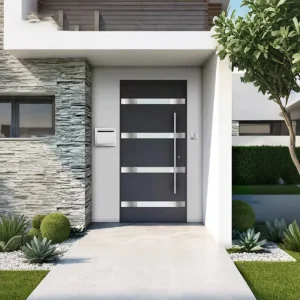
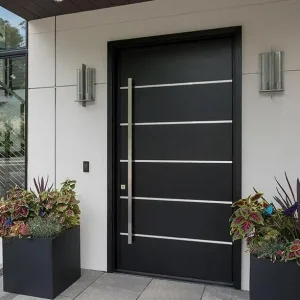
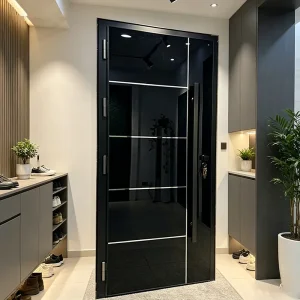
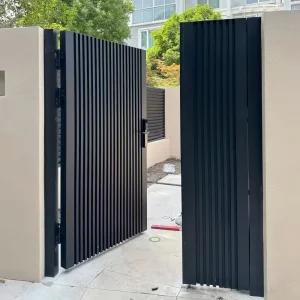
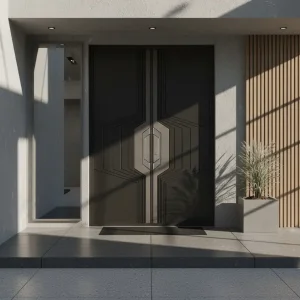
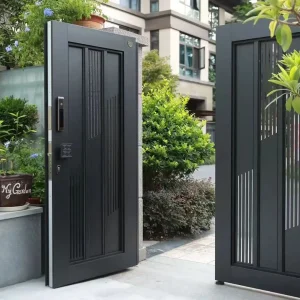
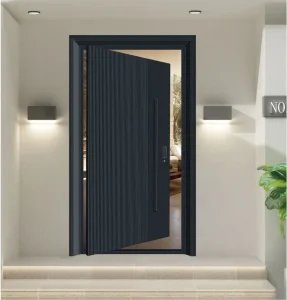
From smart-lock integrated pivot entrance doors to luxury cast aluminum villa main gates, discover our specialized architectural entry collection.
Submit your door schedule, project location, and opening specs. Our engineering team will return custom CAD section drawings, test certificates, and factory pricing within 24 hours.
