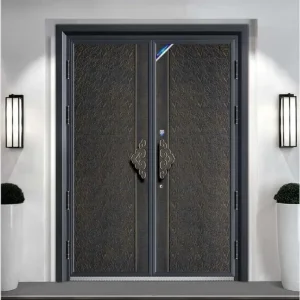
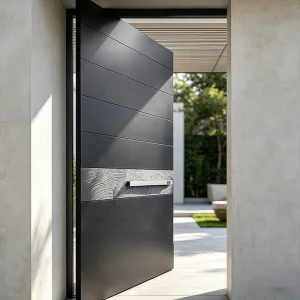
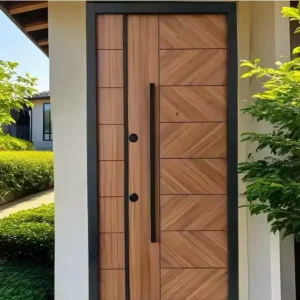
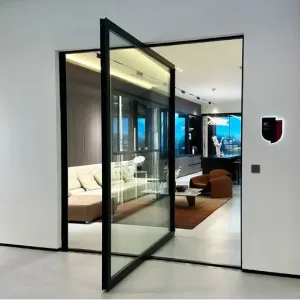
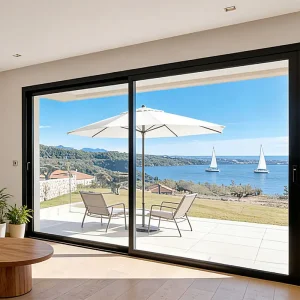
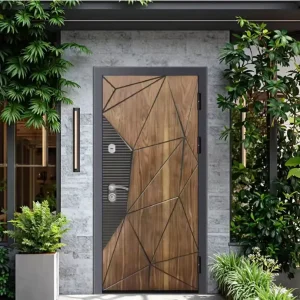
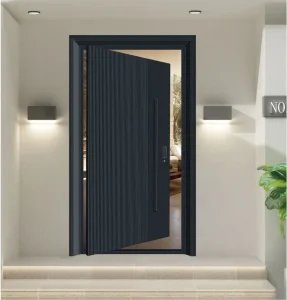
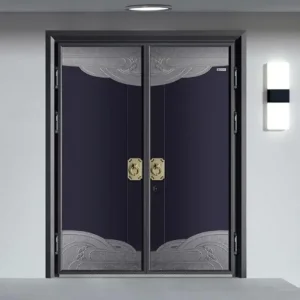
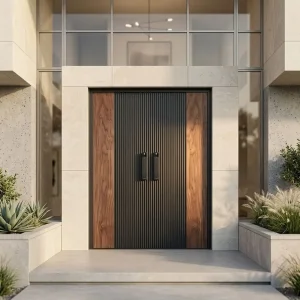
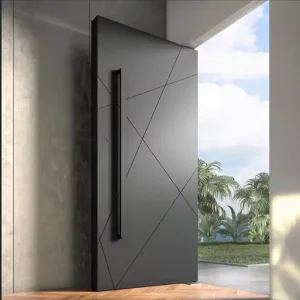
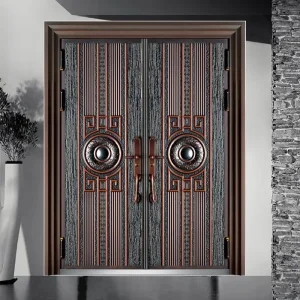
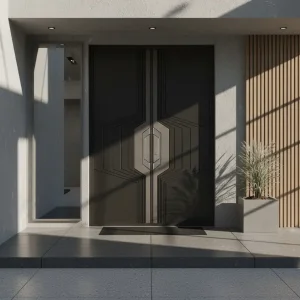
As global climate volatility intensifies and regional building codes mandate extreme weather resiliency, the market demand for custom wind-resistant entry doors has shifted from a niche architectural luxury to a structural necessity. Commercial developers, facade engineers, and high-end villa builders worldwide are prioritizing envelope integrity under extreme wind loads.
Tropical storms in the Caribbean, Gulf Coast (Miami-Dade HVHZ), South Pacific, and coastal East Asia now regularly generate dynamic wind pressures exceeding 5,000 Pascals (Pa). Standard entrance systems suffer structural racking, frame deflection, and water ingress under these conditions.
Modern luxury design demands massive pivot doors up to 2,000mm in width and 4,000mm in height. Engineered structural integrity must prevent leaf sagging and lateral flex without adding excessive operational weight that compromises hardware longevity.
Wholesale procurement requires multi-jurisdictional certifications including North American NFRC/ASTM E1300, Australian AS2047 N6 cyclonic standards, and European EN 12210 Class C5 ratings for wind load resistance.
Designing a wind-resistant entry door system capable of maintaining structural equilibrium during high-velocity wind events requires advanced materials science, finite element analysis (FEA), and precision manufacturing tolerances.
Wind force acting upon a building envelope creates positive pressure on the windward side and severe negative suction pressure on the leeward side. Deflection must be constrained below $L/175$ or $L/300$ depending on building design codes to prevent structural sealant failure or glass popping.
The basic velocity pressure $q_z$ is governed by the standard aerodynamic formula:
Where $V$ represents maximum gust wind speed (m/s), $K_z$ is the velocity pressure exposure coefficient, $K_{zt}$ is the topographic factor, and $K_d$ is the wind directionality factor. DERCHI doors are engineered to survive calculated pressures up to 6,000 Pa (equivalent to Category 5 hurricane wind speeds exceeding 250 mph).
To achieve optimal strength-to-weight ratios, wholesale manufacturing relies on four primary structural platforms:
Select the ideal material platform for your project based on tested structural attributes, wind resistance thresholds, thermal values, and maintenance lifecycles.
| Door Platform | Core Construction | Wind Load Rating | Impact Resistance | Thermal U-Value | Optimal Application |
|---|---|---|---|---|---|
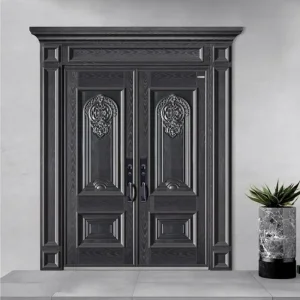
| Cast Aluminum Armour Door | 6-12mm Solid Cast Panel + Galvanized Steel Sub-Frame | Up to 5,500 Pa (TAS 202) | Large Missile Impact Level D (TAS 201) | 1.9 - 2.4 W/(m²·K) | Luxury Coastal Villa Main Gates, High-Security Estates |
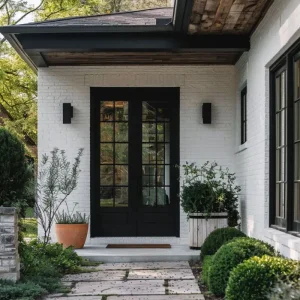
| Thermally Broken Aluminum Pivot | 6063-T5 Multi-Chamber Frame + PA66 Polyamide Strips | Up to 4,800 Pa (AS2047 N6) | Medium Impact Laminated Glass Optional | 1.4 - 1.8 W/(m²·K) | Modern Architectural Entrances, Commercial Lobbies |
| Stainless Steel Security Entry | 1.5-2.0mm SUS304/316 Skins + Steel Honeycomb / Rockwool | Up to 6,000 Pa (EN 12210 C5) | Highest Anti-Prying & Ballistic Grade | 2.0 - 2.5 W/(m²·K) | High-Risk Urban Residences, Commercial Back-of-House |
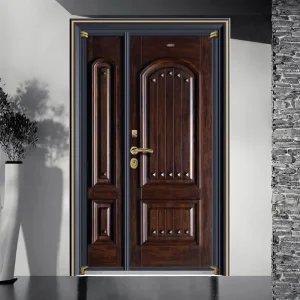
| Double Steel & MDF Composite | Dual Sheet Steel Structure + High-Density Acoustic MDF Core | Up to 3,500 Pa | Standard Dynamic Security Impact | 1.8 - 2.2 W/(m²·K) | Multi-Family Residential Developments, Hotel Suites |
Wind-resistant entrance systems must adapt to varying environmental stresses across global microclimates—ranging from salt spray corrosion to high daily thermal cycles.
Projects located within High-Velocity Hurricane Zones (HVHZ) mandate compliance with Miami-Dade Protocols TAS 201 (Impact Test), TAS 202 (Criteria for pressure testing), and TAS 203 (Cyclic pressure loading). DERCHI supplies reinforced aluminum pivot and double entry doors utilizing multi-point locking systems with concealed stainless steel shoot-bolts that maintain gasket engagement under continuous cycle reversal.
Northern Australian coastal developments encounter extreme cyclonic winds (Region C and D under AS/NZS 1170.2). Entrance systems demand an N6 ultimate limit state wind pressure rating (> 4,400 Pa) combined with stringent water penetration testing (up to 700 Pa). Heavy cast aluminum double doors with continuous EPDM triple seal gaskets eliminate air leakage and water siphoning under heavy downpours.
In UAE, Saudi Arabia, and Qatar, wind resistance is compounded by extreme ambient temperatures (exceeding 50°C) and violent sandstorms. Outer door leaf surfaces expand rapidly relative to interior skins. Thermally broken multi-chamber profiles prevent thermal bowing (bimetallic distortion) while specialized PVD or anodized surface coatings protect against sand abrasion and UV degradation.
Coastal developments along the North Sea require entrance systems that combine high structural wind load ratings (EN 12210) with near-zero air infiltration and exceptional thermal performance. Thermally broken aluminum doors featuring triple-glazed Low-E argon filled units deliver U-values below 1.2 W/(m²·K), satisfying Passive House standards without sacrificing structural rigidity.
With a 180,000 square meter vertically integrated manufacturing campus in Foshan, China, DERCHI provides turn-key structural door engineering for international distributors, real estate developers, and construction procurement teams.
Our in-house engineering team converts architectural elevations into fully annotated shop drawings, structural section details, calculation reports, and BIM blocks within 48 hours of initial enquiry.
Equipped with 5-axis CNC machining centers, fully automated German powder coating lines, and automated glazing robot cells to maintain tolerances within ±0.5mm across high-volume production runs.
Every custom door leaf is protected with PE protective film, wrapped in high-density EPE foam, corner-armored, sealed inside 5-layer corrugated cartons, and anchored within fumigation-free plywood crates.
A wind-resistant door requires structural frame stiffness (high moment of inertia profiles), dynamic multi-point locking hardware that anchors top, bottom, and side frame edges, impact-laminated safety glass, and continuous elastomeric gaskets (EPDM) engineered to prevent water siphoning under suction pressures.
Our prototype models undergo laboratory chamber testing following ASTM E330, TAS 202, and AS2047 protocols. Doors are subjected to positive and negative static air pressure differentials, cyclic wind loading, and water spray under pressure to establish certified DP load caps (up to DP100).
Yes. DERCHI oversized aluminum pivot doors integrate heavy-duty floor spring systems capable of supporting 500kg leaves alongside dynamic drop-down perimeter seals and interlocking vertical stiles that seal automatically upon hardware engagement.
Standard architectural sample orders require 12 to 18 days. Commercial batch production runs typically complete within 25 to 35 days following CAD shop drawing seal and deposit confirmation.
Extruded aluminum profiles receive Qualicoat-certified fluorocarbon (PVDF) spray coatings or high-micron anodizing that endure 3,000+ hours of continuous salt spray testing under ISO 9227 standards without blistering.
We accommodate both single-unit luxury villa custom doors and multi-container commercial development orders. Project volume pricing scales based on profile extrusion setups and glass schedules.
Yes. Full compliance documentation packages—including ISO 9001 quality certificates, CE declarations, AS2047 test evidence, and mill material certificates—are included with export paperwork for seamless site inspection.
Every order is supplied with customized opening-numbered assembly diagrams, anchor bolt torque specifications, structural sealant compatibility guides, and real-time video engineering support.