Exceeding international building safety codes through advanced timber fire-cores, structural aluminum, and precision manufacturing.
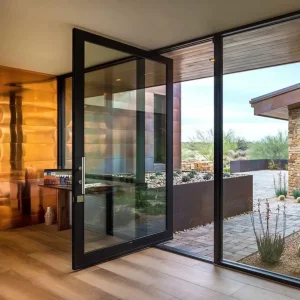
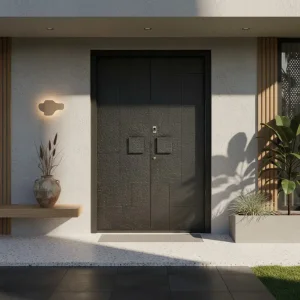
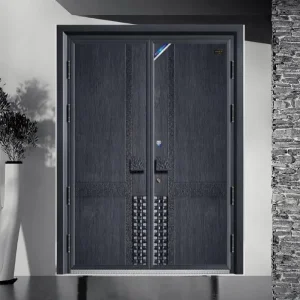
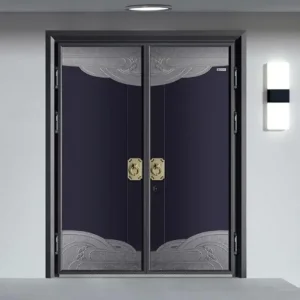
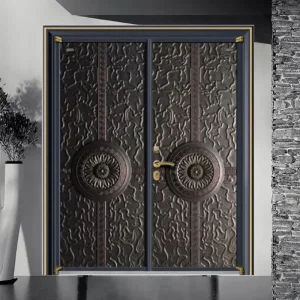
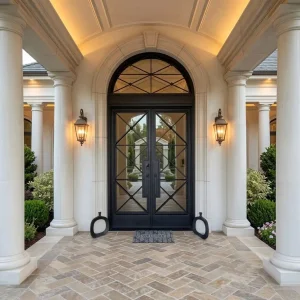
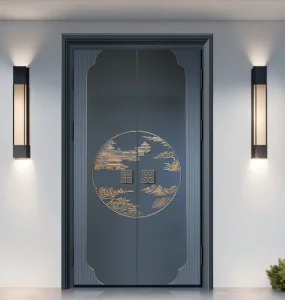
In modern architectural engineering, the specification of custom solid wood fire doors represents a sophisticated balance between high-end aesthetic warmth and uncompromising life-safety performance. Unlike standard interior joinery, a fire-rated solid timber door assembly is an active fire containment system engineered to prevent flames, lethal thermal radiation, and toxic combustion gases from breaching structural compartments for defined durations—typically 30, 60, 90, or 120 minutes (FD30 to FD120, or UL 20 to UL 90 minutes).
Information Gain Key Takeaway: Solid wood fire doors do not prevent timber from burning; rather, they rely on the predictable charring rate physics ($\beta_0$) of dense hardwoods combined with non-combustible mineral cores to create a protective insulating layer that maintains structural integrity under extreme heat exceeding 1,000°C.
When natural timber is subjected to standard fire curve testing (such as ISO 834 or UL 1709), the outer wood layer undergoes thermal decomposition (pyrolysis) at approximately 300°C. This process forms a surface layer of charcoal. Char has a exceptionally low thermal conductivity (roughly one-sixth that of unburned wood), effectively acting as an insulating blanket that slows the heat penetration into the unburned interior core.
The standard rate of charring ($\beta_0$) for specified high-density timber species is mathematically factored during door leaf design:
By engineering door leaf thickness—combining solid hardwood stiles and rails with mineral fiber composite cores—OEM suppliers ensure that after 60 to 90 minutes of intense fire exposure, sufficient unburned core cross-section remains to withstand mechanical impact, thermal expansion pressure, and hose-stream forces.
A deep dive into the multi-layered composition of certified custom solid wood fire door assemblies.
Utilizing high-density mineral silicate boards sandwiched between solid timber stiles, laminated strand lumber (LSL), and natural hardwood veneers. Eliminates core warping while guaranteeing dimensional stability under thermal differential.
Concealed intumescent perimeter strips expand up to 18–25 times their original volume when temperatures hit 180°C. This seals frame gaps against superheated smoke, poisonous carbon monoxide, and direct flame leap.
Integration of ceramic glass and multi-laminate intumescent gel glass (Class EI). Glazing retains integrity (E) and insulation (I), preventing radiant thermal energy transmission into escape corridors.
Combining automated German CNC tooling with strict global fire certification standards.
Navigating global building regulations requires detailed awareness of regional testing protocols. As an international custom solid wood fire door supplier, our factory designs profiles specifically engineered to pass the distinct stress tests mandated across major continental codes:
| Standard / Code | Jurisdiction | Testing Protocol Highlight | Key Performance Metrics |
|---|---|---|---|
| UL 10B / UL 10C NFPA 252 |
North America (USA, Canada) | Positive pressure furnace test followed immediately by high-impact hose-stream test. | 20, 45, 60, 90 Minutes ratings. Structural latch integrity under thermal expansion. |
| BS 476 Part 22 BS EN 1634-1 |
United Kingdom, Europe, Middle East | Cellulose or hydrocarbon fire curve evaluating Integrity (E), Insulation (I), and Radiation (W). | FD30, FD60, FD90, FD120. Surface temperature rise limited to $\le 140^\circ\text{C}$ average. |
| Civil Defense (MOI Certifications) |
GCC (UAE, Saudi Arabia, Qatar) | Audited factory production control (FPC) with third-party periodic testing (Intertek / Warringtonguard). | High acoustic insulation (STC 35+) combined with tropical thermal/humidity warpage resistance. |
| AS 1905.1 NCC Code |
Australia & New Zealand | Fire-resistant door sets evaluation incorporating self-closing and latching verification. | FRL -/60/30 up to -/120/30. Strict smoke leakage rating (Sa & Sm seals). |
In standard negative pressure testing (historic standard), air leaks into the furnace through peripheral door frame gaps. Modern international codes mandate positive pressure testing (UL 10C / EN 1634-1), where the neutral pressure plane is set below the door head level. This forces superheated fire gases outward against the door seals, making advanced intumescent gaskets and rigid frame anchoring mandatory to pass certification.
sourcing solid wood fire doors directly from Tier-1 Chinese manufacturing bases like Foshan provides developers, contractors, and architectural hardware importers with distinct structural and economic advantages:
Raw timber undergoes multi-stage automated steam kiln drying down to an exact 8%–12% Moisture Content (MC). This prevents bowing, splitting, and frame binding when deployed in desert or high-humidity regions.
All hinge mortises, lock cases, flush bolts, and drop seals are pre-milled in-factory to sub-millimeter precision. Reduces on-site installation labor costs by up to 65%.
Co-located within Foshan's hardware ecosystem, guaranteeing direct access to fire-rated handles, concealed hydraulic closers, electromagnetic hold-opens, and acoustic gaskets under one purchase order.
Different building typologies require distinct design modifications to solid wood fire doors. Our factory provides custom ODM/OEM solutions tailored for specialized commercial and high-end residential applications:
Guestroom entry doors demand high acoustic dampening alongside certified fire ratings. Our custom solid wood assemblies integrate acoustic mineral cores and drop-down bottom seals achieving up to STC 42 dB acoustic isolation while providing FD60 fire protection. Finished in book-matched Walnut, Teak, or Crown-Cut Oak veneers.
High-end residential projects often demand grand entrance pivot doors or oversized double doors. We engineer structural steel-reinforced timber cores up to 3000mm in height that incorporate electronic access control mortise locks, biometric readers, and automatic drop seals without compromising UL positive pressure compliance.
Preserving historic aesthetics while meeting modern life-safety codes requires replicating traditional raised-and-fielded panel profiles. Utilizing 5-axis 3D carving, our factory matches classical profiles with certified fire-rated mineral substrates beneath authentic solid hardwood facings.
As smart building automation and net-zero carbon goals reshape architectural design, the fire door industry is undergoing rapid technical evolution. DERCHI's technical engineering department focuses on four primary R&D pillars:
Transitioning from standard phenol-formaldehyde resins to non-toxic, zero-VOC bio-based binders derived from agricultural waste, achieving net-zero carbon lifecycle metrics for LEED v4 certified projects.
Embedding micro-sensor arrays within the core structure to relay real-time localized temperature readings, smoke concentration, and door latch status to building management systems during emergency events.
Developing nanostructure vacuum-insulated mineral cores that reduce total door leaf thickness from 55mm down to 42mm for FD90 ratings, allowing ultra-slim architectural profiles.
Expert answers to common engineering, compliance, and custom ordering questions.
Yes. Decorative veneers up to 1.5mm thick (such as Oak, Walnut, Mahogany, or Teak) or fire-retardant polyurethane paint coats applied during factory manufacturing do not compromise the fire core. However, surface finishes applied on-site must utilize certified intumescent or low-flame-spread lacquers compliant with BS 476 Part 6/7 Class 1 standard.
Under UL 10C and BS EN 1634-1 certifications, our factory can supply custom double door assemblies up to 2400mm wide by 3000mm high. Leaves exceeding these dimensions require specialized structural steel internal framing and heavy-duty pivot hardware engineered per project requirements.
All timber is kiln-dried to 8%–12% Moisture Content. Leaf cores are fully encapsulated in moisture-barrier foils, edge-sealed, and packaged in airtight plastic wrapping before being vacuum-packed inside heavy-duty plywood crates with silica desiccant gel bags.
Only hardware tested and certified under UL, CE, or Intertek fire standards can be used. This includes stainless steel ball-bearing hinges, mortise lock cases with intumescent bedding jackets, surface-mounted or concealed hydraulic overhead closers, and drop-down threshold acoustic/smoke seals.
Explore our complete range of certified armor, cast aluminum, and multi-material security door solutions.