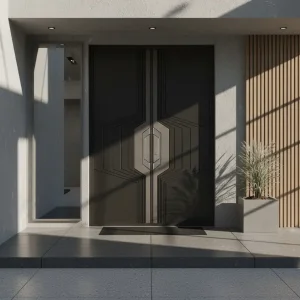
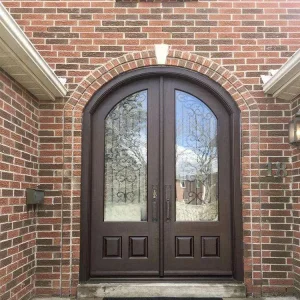
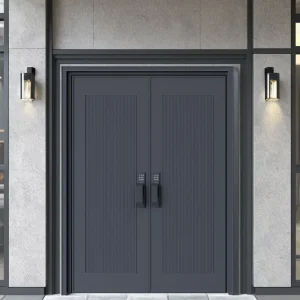
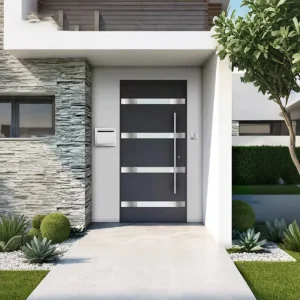
Direct manufacturer solutions tested for hurricane resistance, thermal insulation, and anti-theft security.
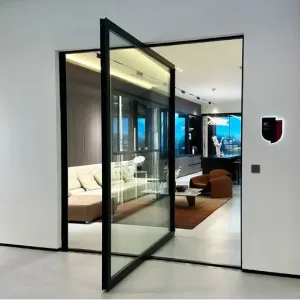
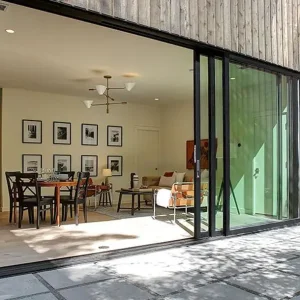
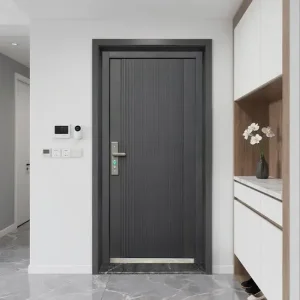
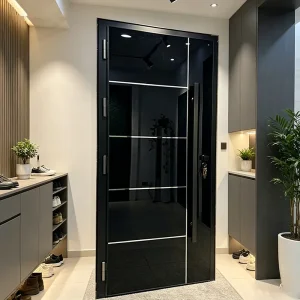
Understanding how architectural glass specs, thermal break framing, and structural hardware impact unit cost and long-term ROI.
The choice of glass accounts for 35% to 55% of the total door unit cost. Premium modern front doors utilize Low-E double or triple glazing with argon gas infill. Standard tempered unit prices start at lower tiers, while high-performance laminated glass featuring double-silver or triple-silver Low-E coatings, SentryGlas® (SGP) interlayers for hurricane ratings, and switchable electrochromic privacy glass significantly adjust the final price vector.
Structural integrity depends heavily on profile engineering. Thermally broken 6063-T5 aluminum alloy frames equipped with PA66GF25 polyamide thermal barrier strips prevent thermal bridging. Deep profile depth (100mm to 150mm) and wall thickness (2.0mm to 3.0mm) increase material cost but deliver superior U-factors (<0.24 BTU/h·ft²·°F) and resistance to frame warping under high solar radiation.
Modern glass entry doors—especially oversized pivot systems carrying up to 500 kg (1,100 lbs)—require precision heavy-duty floor pivots, multi-point lock systems, biometric smart locks, and motorized soft-closing mechanisms. German-engineered hardware (e.g., Dormakaba, GU, Siegenia) adds upfront expenditure but reduces warranty call-backs to virtually zero.
| Glass Entry Door System Type | Typical Size Range (W × H) | Estimated Direct Factory Price (FOB) | Thermal & Structural Performance | Ideal Architectural Application |
|---|---|---|---|---|
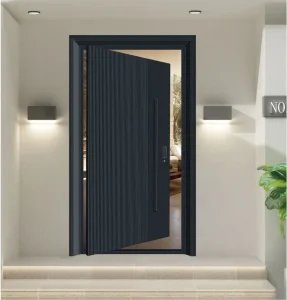
| Standard Insulated Glass Pivot Door | 1200 × 2400 mm | $450 – $850 / set | U-value: ~1.8 W/m²K, Double Low-E Tempered | Modern suburban villas, contemporary homes |
| Hurricane Impact Glass Entrance Door | 1400 × 2800 mm | $950 – $1,800 / set | DP+70, SGP Laminated Impact Glass, NFRC/FBC | Coastal developments, tropical hurricane zones |
| Smart Electrochromic Glass Entrance Door | 1600 × 3200 mm | $1,600 – $3,200 / set | PDLC Privacy Glass, Smart Home Integration | Luxury estates, commercial headquarters, penthouses |
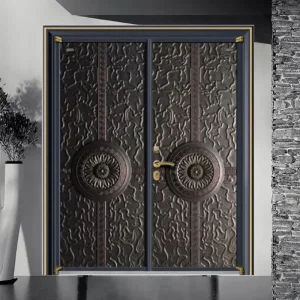
| Oversized Cast Aluminum + Glass Villa Gate | 2000 × 4000 mm | $2,200 – $4,500 / set | Armored frame, 12mm Solid Cast + Double Glazing | High-security residential estates, royal villas |
How next-generation material science and smart engineering are revolutionizing glass entry door technology.
By replacing the traditional gas-filled air gap with an ultra-thin high-vacuum cavity (0.2mm), VIG achieves thermal insulation values equivalent to solid brick walls (U-factor ≤ 0.60 W/m²K). This technological leap allows ultra-slim glass door profiles without sacrificing extreme energy efficiency requirements in Passive House standards across Northern Europe and North America.
Building-Integrated Photovoltaics (BIPV) are transforming entry doors into clean energy generation surfaces. Transparent solar cell technology embedded directly within tinted glass sidelights and transom panels captures solar radiation, powering smart locks, LED architectural perimeter lighting, and motorized opening mechanisms completely off-grid.
Next-gen electrochromic glass systems utilize machine learning algorithms to adjust light transmission based on sun angle, exterior temperature, and indoor HVAC load. Integrated seamlessly with biometric face-recognition sensors embedded inside the thermal break profile, entry doors now act as autonomous building security nodes.
Designing glass entry systems that meet global engineering codes, extreme climate loads, and commercial durability requirements.
For coastal developments and high-rise commercial entrances, wind deflection calculations are paramount. Direct China suppliers working on global projects provide doors tested under AS2047 N6 and ASTM E1300 / E1886 specifications.
By incorporating SentryGlas® (SGP) laminated glass interlayers, structural glass front doors withstand missile impact tests (TAS 201/203 HVHZ requirements for Florida/Caribbean zones), ensuring the envelope remains unbreached during category-5 severe storm conditions.
Urban luxury developments demand strict sound reduction. Glass door assemblies engineered with asymmetric glass pane thickness (e.g., 8mm outer + 12mm Argon space + 6mm inner) combined with multi-channel EPDM rubber compression gaskets achieve acoustic attenuation ratings up to STC 42 dB.
Concurrently, multi-chambered aluminum extrusion cavities filled with high-density polyurethane (PU) foam eliminate internal thermal convection loops, yielding superior overall building envelope performance.
How Foshan’s integrated door manufacturing ecosystem delivers high-precision custom doors at optimized landed costs.
Operating out of 180,000 m² industrial bases, top-tier Chinese door suppliers utilize 5-axis CNC machining centers to process aluminum profiles with a tolerance of ±0.5mm. Laser-cutting technology guarantees seamless corner miter joints, flush-mounted smart lock cavities, and perfect pivot alignment prior to assembly.
Foshan is the world’s premier capital for architectural hardware, aluminum extrusion, and structural glass. Sourcing directly from Foshan suppliers cuts intermediate trading markups, shortens raw material lead times to under 10 days, and gives global buyers direct access to custom die creation for proprietary profile designs.
Every custom glass front door undergoes 100% factory pre-assembly testing before packaging. Water tightness, air infiltration under positive pressure, zero-deflection hinge testing, and electronic lock syncing are verified and video-documented for overseas buyers prior to crate sealing.
Navigating overseas purchasing, ocean freight logistics, customs tariffs, and site installation risks.
Shipping large-format glass doors internationally requires export-grade protective packaging. High-value glass components are secured in fumigation-free, fully enclosed A-frame plywood crates with high-density EPE corner foam buffers and anti-moisture desiccant packs. Outer crates feature tilt and shock indicator sensors, reducing ocean transit damage rates below 0.2%.
Procuring directly from verified China suppliers yields 40% to 60% savings compared to purchasing through local North American or European distributors. To bridge local support gaps, leading factories provide complete engineering packages: shop drawings in CAD/BIM formats, step-by-step installation manuals, and live video call technical assistance for field installation crews.
Meeting exact regional building standards across North America, Australia, Europe, and the Middle East.
Glazing units carry Safety Glazing Certification Council (SGCC) markings per ANSI Z97.1 and CPSC 16 CFR 1201 standards. Full window and door thermal assemblies conform to NFRC testing protocols for SHGC, U-factor, and visible light transmittance (VLT).
Profiles and hardware are verified against AS2047 requirements, passing rigorous water penetration, air deflection, and structural loading tests up to N6 ratings, alongside AS1288 compliance for glass thickness calculations in human impact areas.
Factory production control follows ISO 9001 quality systems. Glass entry products carry CE marking under EN 14351-1, covering air permeability, watertightness, acoustic rating, and structural resistance under Eurocode guidelines.
Addressing essential technical, pricing, and manufacturing inquiries from architects, builders, and developers.
Overall price is dictated by four main components: (1) Glass specification (e.g., standard tempered vs. triple-pane Low-E, smart electrochromic privacy glass, or hurricane-proof SGP laminated glass); (2) Frame profile depth & metal finish (thermally broken 6063-T5 aluminum, fluorocarbon PVDF coating, or wood-grain transfer); (3) Hardware and opening mechanism (heavy-duty German pivot hinges, multi-point lock systems, electronic biometrics); and (4) Dimensional size (oversized pivot doors requiring internal steel structural reinforcing cost more per square meter than standard hinged leaf doors).
Yes. Premium custom glass entry doors utilize fully tempered outer glass sheets combined with laminated inner security panes featuring PVB or SGP (SentryGlas®) interlayers. Laminated security glass does not shatter upon impact; it holds together even under repeated heavy blows. Coupled with multi-point stainless steel locking systems that lock at top, middle, and bottom simultaneously, these doors offer anti-burglary protection comparable to solid steel armor doors.
Pivot doors historically faced challenges with sill weatherproofing. However, modern engineered designs solve this with drop-down automatic bottom weather seals, dual-layer EPDM rubber gaskets, and hidden drain channels within the thermal break frame. When closed, internal compression locks push the leaf firmly against continuous perimeter seals, achieving water tightness ratings exceeding 300 Pa and air permeability compliant with global building codes.
Standard custom door production spans 25 to 35 calendar days following technical drawing (CAD) approval and deposit confirmation. For specialized custom dies, non-standard RAL powder coat finishes, or complex electrochromic glass orders, lead times may extend to 40 days. Air sampling or prototype production typically takes 12 to 18 days.
Yes. Professional suppliers maintain dedicated in-house engineering departments. Upon receiving your architectural schedule or rough opening dimensions, engineers generate detailed 2D CAD shop drawings (wall attachment details, section depths, sill drainage details) and 3D BIM Revit blocks for seamless integration into master construction projects.
Discover tailored entrance solutions engineered for diverse structural requirements and aesthetic designs.