Engineered to NFRC, AS2047, and European CE standards. Direct factory supply from Foshan manufacturing base.
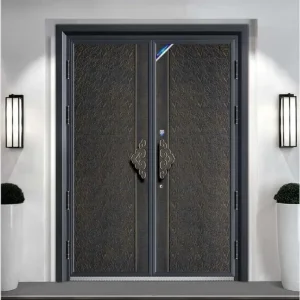
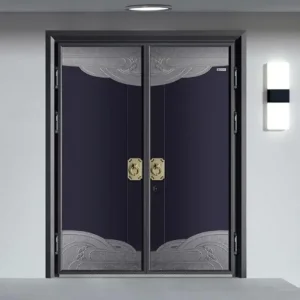
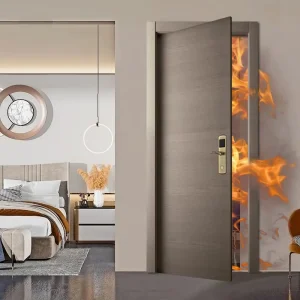
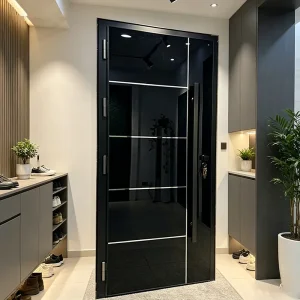
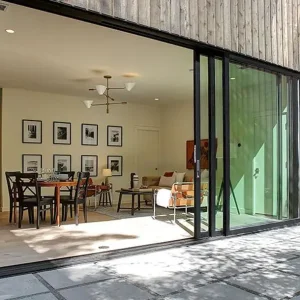
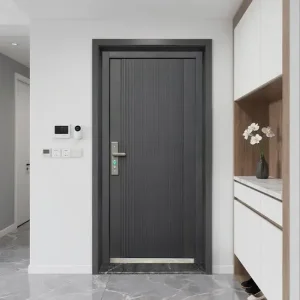
In modern architectural engineering, the perimeter security threshold has undergone a fundamental paradigm shift. Historically, security doors relied heavily on monolithic mild steel structural assemblies. While providing mechanical resistance, traditional steel doors suffer severe operational drawbacks: high structural weight leading to hinge sag, susceptibility to electrochemical corrosion in coastal microclimates, and complete failure in thermal isolation metrics due to high thermal conductivity ($k \approx 50 \text{ W/m}\cdot\text{K}$).
As global building energy codes tighten—such as the European Union’s Energy Performance of Buildings Directive (EPBD) and North American ASHRAE 90.1 energy standards—architects and general contractors are demanding entrance solutions that achieve high physical security (RC2 to RC4 burglary resistance according to EN 1627) without compromising thermal envelope performance. This shift has elevated China Aluminum Security Door Manufacturers to the forefront of global architectural procurement.
By leveraging 6063-T5 and 6061-T6 aluminum alloys combined with Polyamide PA66-GF25 thermal breaks, modern architectural aluminum security doors reduce system structural mass by up to 45% compared to all-steel counterparts while achieving thermal U-values lower than 1.6 W/m²·K and resistance against 3000 Pa wind loads.
Furthermore, the integration of intelligent access technology (smart biometric locks, facial recognition sensors, and automated multi-point drop bolts) demands dimensional tolerance precision that legacy fabrication methods cannot sustain. Premium Chinese manufacturers have addressed this by integrating 5-axis CNC machining, automated robotic welding, and automated powder coating lines into unified manufacturing bases.
Foshan is home to Asia's densest concentration of high-grade primary aluminum smelters. Direct access to 6063-T5 billet casting ensures precise chemical composition (Si 0.2–0.6%, Fe 0.35%, Mg 0.45–0.9%), delivering a tensile strength $\sigma_b \ge 160 \text{ MPa}$ and yield strength $\sigma_{0.2} \ge 110 \text{ MPa}$.
In-house vertical fluorocarbon (PVDF) and automated electrostatic powder coating lines achieve finish thicknesses between 40µm and 120µm. Certified to Qualicoat Class 2 standards, surfaces withstand over 3,000 hours of continuous salt spray testing without blistering.
Utilizing high-speed CNC milling centers, corner-crimping machines with dual-component structural adhesives, and computerized gasket insertion, framing tolerances are maintained within $\pm0.5 \text{ mm}$ across oversized 4-meter leaf profiles.
Comparative analysis of structural core build-ups for architectural specifiers and procurement teams.
| Door System Platform | Core Structural Build-Up | Thermal U-Value Range | Acoustic Rating (Rw / STC) | Burglar Resistance Rating | Primary Application Scenario |
|---|---|---|---|---|---|
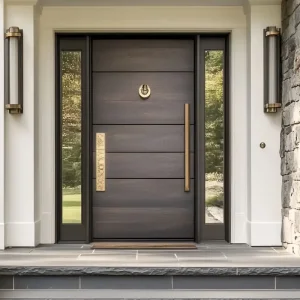
| Thermally Broken Aluminum | 6063-T5 profile + 24mm PA66-GF25 thermal strip + high-density PU foam infill | 1.2 – 1.8 W/m²·K | 35 – 42 dB | EN 1627 RC2 / RC3 | Modern residential villas, high-wind coastal openings |
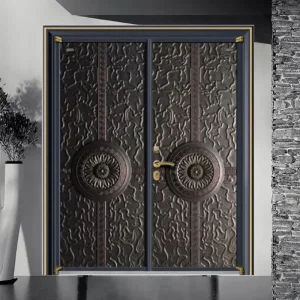
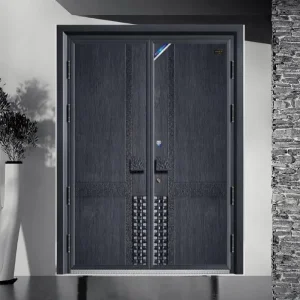
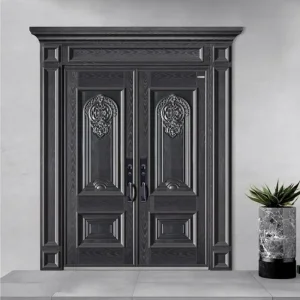
| Heavy Cast Aluminum | 6mm–12mm solid sand-cast relief armor plate + structural aluminum sub-frame | 1.8 – 2.4 W/m²·K | 32 – 38 dB | EN 1627 RC3 / RC4 | Luxury estate main entry gates, royal & classical residences |
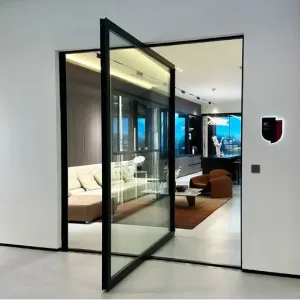
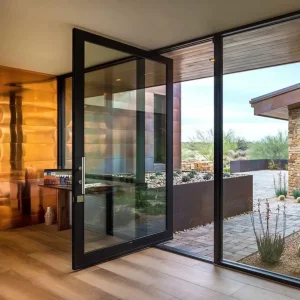
| Glass Infill Security Pivot | Reinforced perimeter aluminum profile + 10mm Temp + 1.52PVB + 10mm Low-E IGU | 1.4 – 2.0 W/m²·K | 38 – 44 dB | EN 1627 RC2 | Architectural daylight lobbies, luxury villa pivot entrances |
| Armored Steel-Aluminum Hybrid | Galvanized steel internal skeleton + 2.0mm SUS304 skin + Cast aluminum surface armor | 1.6 – 2.2 W/m²·K | 40 – 45 dB | EN 1627 RC4 / Explosion Proof | High-security commercial facilities, extreme climate zones |
Large pivot doors represent one of the most demanding challenges in door engineering. When leaf dimensions exceed $1500 \text{ mm} \times 3000 \text{ mm}$, traditional side-hung hinges suffer exponential rotational moments that deform the frame jamb. DERCHI's custom aluminum pivot systems utilize heavy-duty offset floor pivot hardware rated up to $500 \text{ kg}$ carrying capacity.
To counteract thermal bowing—a physical phenomenon where solar radiation heats the exterior aluminum face (up to $70^\circ\text{C}$) while the interior face remains at air-conditioned temperatures ($22^\circ\text{C}$)—our engineering department incorporates anti-bi-metal expansion strips within the thermal break cavity. This allows differential expansion without structural deflection or binding of the multi-point locking rods.
In Florida (Miami-Dade HVHZ) and Atlantic coastal zones, security entrance doors must withstand cyclic wind pressures exceeding $\pm70 \text{ PSF}$ and large missile impact testing (ASTM E1886/E1996). Our heavy-duty aluminum pivot and entrance systems integrate laminated hurricane glass (SentryGlas® interlayers) and reinforced internal core gussets designed to comply with Florida Building Code (FBC) criteria.
Under Australian Standard AS2047, window and door assemblies undergo rigorous testing for structural deflection (P2 pressure), air infiltration (75 Pa), and water penetration resistance (up to 450 Pa static pressure). DERCHI aluminum security doors are specifically engineered with EPDM continuous weatherboard gaskets and concealed drainage paths to achieve N6 structural performance ratings.
In high-ambient desert climates (Dubai, Riyadh, Kuwait), doors face extreme UV degradation and fine particulate abrasion. We implement quad-sealed frame gaskets to prevent dust infiltration (IP65 equivalent casing seal) and employ high-solar-reflective PVDF coatings with low solar heat gain coefficient (SHGC < 0.22) glass configurations.
European residential and commercial markets require certified burglary protection under EN 1627 alongside ultra-low thermal transmittance ($U_w \le 1.2 \text{ W/m}^2\cdot\text{K}$). Our thermal break security ranges integrate German-manufactured multi-point hook locks (GU / KFV) and double-side anti-drill hardened steel plates within the lock gear housing.
The convergence of modern architecture and digital technology is driving three major innovation vectors in aluminum security door manufacturing:
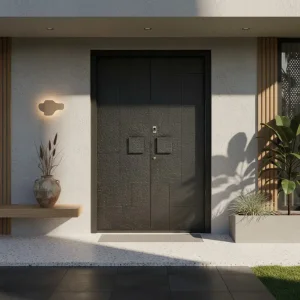
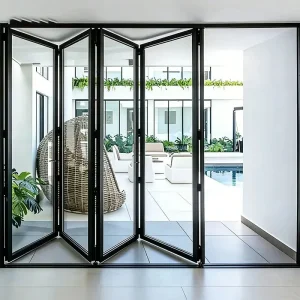
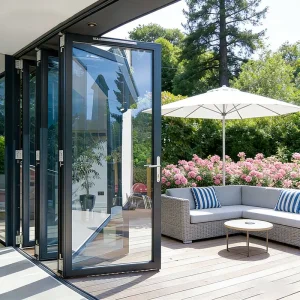
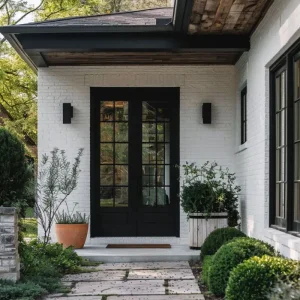
Precision-crafted bi-fold, pivot, French, and cast aluminum double entrance solutions for commercial and residential projects.
Direct technical answers from senior door systems engineers regarding export compliance, manufacturing limits, and freight safety.
