Engineered to comply with EU structural standards, CE marking, and anti-corrosion specifications for Atlantic coastal environments.
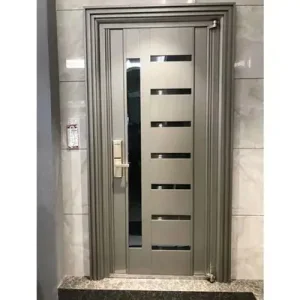
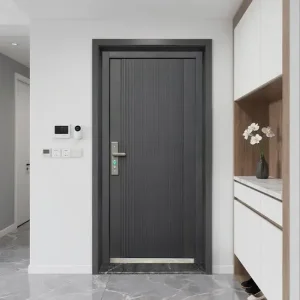
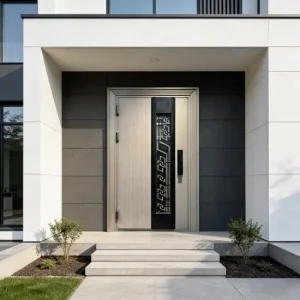
An in-depth evaluation of structural demands, maritime microclimates, and thermal performance mandates in contemporary Iberian construction.
Portugal’s construction and architectural ecosystem is undergoing an extraordinary evolution. Driven by a surge in high-end luxury residential developments in the Algarve, comprehensive urban rehabilitation across historical districts in Lisbon (Chiado, Avenida da Liberdade) and Porto (Ribeira, Foz do Douro), as well as expansive resort initiatives along the Comporta and Silver Coast (Costa de Prata) corridors, the demand for high-specification entrance systems has reached an unprecedented peak. Within this landscape, high-grade stainless steel entry doors have emerged as the premier specification choice for lead architects, structural engineers, and general contractors seeking to bridge compromise-free security with structural permanence.
Unlike standard aluminum or timber entrance structures, stainless steel door systems—specifically those crafted from austenitic AISI 304 and marine-grade AISI 316 alloys—offer superior yield strength, thermal stability, and forced-entry deterrence. However, exporting and installing high-performance door systems into Portugal requires a sophisticated understanding of regional macro-environmental pressures and regulatory frameworks.
“Sourcing exterior entrance systems for coastal Iberian structures demands a dual focus: absolute resistance against micro-abrasive Atlantic salt spray (C5-M corrosion rating) and compliance with strict EU Energy Performance of Buildings Directive (EPBD) directives via thermal-break core engineering.”
From an environmental standpoint, Portugal’s climate profile presents unique material challenges. Under the Köppen climate classification, the country spans Mediterranean zones (Csa/Csb) characterized by hot, dry summers and wet winters, combined with severe Atlantic maritime salinity along its 1,794 kilometers of coastline. Standard steel doors without specialized passivized pre-treatments or PVD coatings rapidly succumb to atmospheric pitting and galvanic corrosion. Concurrently, strict local energy building codes—governed by the REH (Regulamento de Desempenho Energético dos Edifícios de Habitação)—mandate low thermal transmittance coefficients (U-values below 1.4 W/m²K), requiring factory suppliers to engineer multi-chambered polyamide thermal breaks within heavy stainless steel profiles.
Discover how modern design codes, high-tech access control, and advanced metallurgy are driving next-generation entryway specifications.
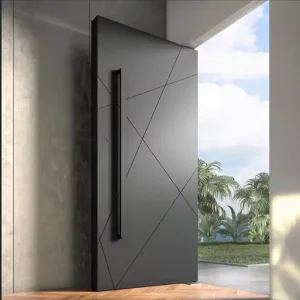
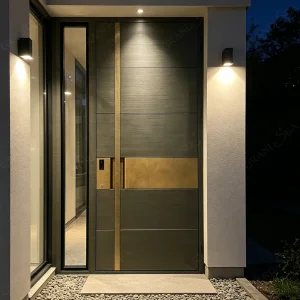
Contemporary villa architecture in Quinta do Lago, Vale do Lobo, and Cascais favors expansive, monolithic main entrances. Single-leaf pivot doors utilizing reinforced SUS316 internal steel skeletons allow door leaves up to 2.5 meters wide and 4.0 meters high, carrying weights up to 600 kg. High-precision German-engineered floor hydraulic pivots ensure zero deflection and effortless opening torque.
Traditional solid metal doors act as thermal bridges, resulting in internal surface condensation during cold Atlantic winter nights. DERCHI’s advanced thermal break technology utilizes 24mm to 34mm poly-acrylic thermal strips (PA66 GF25) separating the exterior and interior steel skins, preventing energy transfer and optimizing HVAC efficiency in passive house designs.
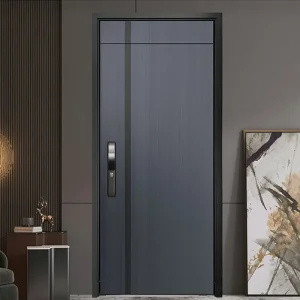
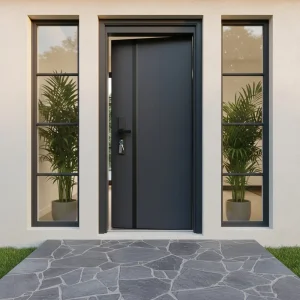
High-net-worth real estate buyers expect seamless, keyless access. Modern stainless steel doors serving Portugal feature concealed motorized multi-point locks (such as Ekey fingerprint recognition, 3D facial scanning, and KNX/Loxone smart-home automation connectivity), ensuring defense against anti-drilling and anti-picking while maintaining a minimalist aesthetic.
Bridging high-capacity industrial automation with meticulous European quality management.
Global procurement teams, architectural specifiers, and Portuguese distributors often navigate complex trade-offs between local European craft shop pricing and Asian manufacturing volume. DERCHI eliminates this compromise by operating a 180,000 m² Industry 4.0 smart manufacturing campus in Foshan, China—the global hub of architectural metal fabrication.
Equipped with German Trumpf 3D fiber laser cutters and 6-axis KUKA automated welding robots, DERCHI processes SUS304 and SUS316 steel sheets (1.5mm to 3.0mm thickness) with micro-tolerances within ±0.1mm. Automated seam welding produces flawless continuous joints without heat distortion, creating seamless door skins essential for luxury architectural finishes.
Every batch of raw stainless steel imported into our facility undergoes SPECTRO optical emission spectrometry to verify nickel and chromium content (ensuring >18% Cr and >8% Ni for SUS304; >16% Cr, >10% Ni, >2% Mo for SUS316). Finished door leafs are subjected to 1,500-hour continuous salt spray chamber testing, meeting strict C5-M marine rating standards before export.
Procuring custom architectural entrance doors directly from our factory hub yields a 35% to 45% cost efficiency compared to Western European regional assembly shops, while providing total customization freedom. Our standardized export workflow ensures absolute precision:
Review detailed performance specifications, security ratings, and material builds engineered for Portuguese commercial and residential applications.
| Series Category | Material Core Build | Thermal U-Value | Acoustic Insulation | Security Level | Recommended Portugal Application |
|---|---|---|---|---|---|
| Luxury Coastal Villa Pivot | SUS316 Marine Grade (2.0mm) + PA66 Thermal Break + PU Core | 1.1 – 1.3 W/(m²·K) | 42 dB (Rw) | RC4 / RC5 | Algarve, Cascais, Quinta do Lago Oceanfront Estates |
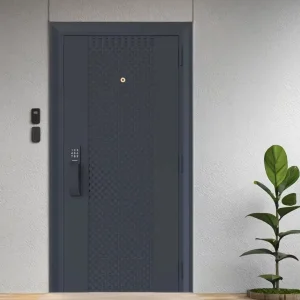
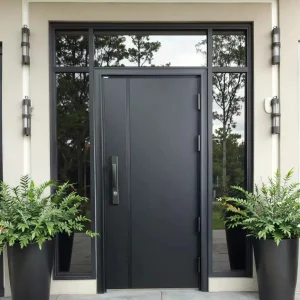
| Armored Security Entrance | SUS304 Double Skin (1.5mm) + Internal Manganese Steel Grid | 1.4 – 1.6 W/(m²·K) | 38 dB (Rw) | RC3 / RC4 | Lisbon & Porto Private Residences, High-Security Villas |
| Acoustic & Thermal Security | SUS304 Outer + MDF Acoustic Core + High-Density Rockwool | 1.3 – 1.5 W/(m²·K) | 45 dB (Rw) | RC3 | Urban Luxury Apartments & Boutique Hotels in Lisbon Center |
| EI60 / EI120 Fire-Rated Steel | Fire-Resistant SUS304 + Perlite Mineral Core + Intumescent Seals | 1.6 – 1.8 W/(m²·K) | 35 dB (Rw) | EI60 / EI120 | Commercial Lobbies, Public Facilities & Multi-Family Entrances |
Customized door solutions tailored to regional microclimates and heritage context across Portuguese districts.
In coastal Algarve towns such as Quinta do Lago, Vale do Lobo, Lagos, and Vilamoura, properties face constant exposure to high salt mist, intense UV radiation, and severe Atlantic wind loads. DERCHI supplies customized SUS316 marine-grade stainless steel pivot doors treated with PVD titanium vacuum plating and triple EPDM weather-sealing. This prevents surface oxidation while resisting wind pressure up to 3,000 Pa.
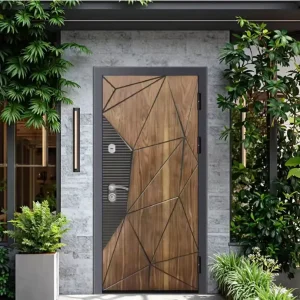
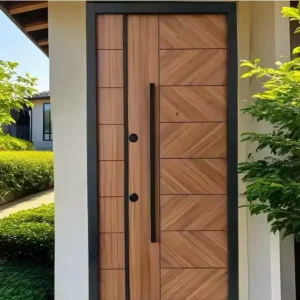
Renovating classic buildings in Lisbon’s Baixa/Chiado or Porto’s historical center requires strict visual integration with heritage facades alongside high security and thermal efficiency. Our factory provides custom stainless steel doors with simulated wood-grain thermosetting transfer finishes or custom cast bronze panel overlays, satisfying municipal urban conservation guidelines while upgrading burglar protection to EN 1627 RC4 standards.
For secluded luxury estates in Sintra, Cascais, and Estoril, privacy and forced-entry protection are paramount. We engineer multi-point armored steel doors featuring bulletproof laminated glass inserts (EN 1063 BR4/BR6 standards), anti-prying concealed heavy-duty hinges, and integrated motorized drop seals to deliver quiet, impenetrable defense.
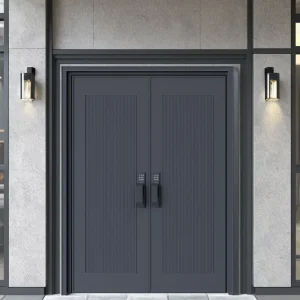
High-traffic commercial headquarters, boutique hotels, and industrial tech parks in industrial centers like Setúbal, Aveiro, and Braga require fire-rated and high-frequency opening durability. Our fireproof pivot and double-leaf stainless doors comply with EU EI60/EI120 fire barrier certification, tested for over 500,000 continuous opening cycles.
Technical and logistical insights for Portuguese architects, developers, and project managers.
For projects within 5 km of the ocean (such as Algarve oceanfront villas or Cascais estates), we specify high-grade AISI 316 stainless steel containing 2–3% Molybdenum. Combined with PVD (Physical Vapor Deposition) titanium coating or PVDF electrocoating, our door leaf assemblies withstand over 1,500 hours of continuous salt spray testing under ISO 9227 standards without pitting or micro-corrosion.
Yes. DERCHI doors incorporate continuous multi-chamber polyamide thermal break profiles (PA66 GF25) filled with high-density polyurethane (PU) insulation cores. Combined with triple EPDM perimeter seals and Low-E double/triple glazing, our systems achieve overall thermal transmittance U-values down to 1.1 W/(m²·K), fully complying with Portugal’s REH and RECS energy standards.
Our armored stainless steel door series are tested according to European EN 1627–1630 standards, achieving resistance classes from RC3 up to RC5. Features include multi-point motorized locking bolts, anti-drill manganese hardplates protecting the lock casing, anti-lift hinge pins, and heavy-duty structural steel internal cores.
Production time takes approximately 25 to 35 days from technical CAD shop drawing sign-off. Direct ocean shipping from Shenzhen/Guangzhou ports to Portugal (Lisbon or Leixões/Porto) generally takes 28 to 34 days. We provide full CE declaration of performance (DoP), commercial invoices, packing lists with opening numbers, and HS code documentation for fast clearance.
Absolutely. We specialize in custom architectural engineering. Our production lines manufacture single-leaf pivot doors up to 2.5 meters in width and 4.0 meters in height. Each leaf is custom balanced with floor hydraulic pivot assemblies rated to hold up to 600 kg while maintaining lightweight operating force.
We offer a comprehensive library of architectural finishes: Brushed Hairline Satin, Mirror Polish, PVD Titanium Coating (Gold, Rose Gold, Champagne, Black Titanium), Micro-Cement Textured Finishes, Thermosetting Wood-Grain Transfer, and Custom Antique Bronze/Copper hand-patinated surfaces.
Yes. Upon receiving your door schedules or architectural elevation drawings, our engineering team issues comprehensive 2D CAD shop drawings, anchoring details, structural sill drainage sections, and BIM/Revit files within 24 to 48 hours for stamping and verification.
Every single door leaf is wrapped in scratch-resistant protective film, fitted with heavy-duty EPE foam corner protectors, vacuum-sealed, encased in a 5-layer corrugated box, and mounted in a fumigation-free solid plywood crate designed for forklift unloading.
Factory-direct security, pivot, armored, and fire-rated door collections built for export to Portugal.