Engineered for Los Angeles coastal microclimates, high-security luxury estates, and strict California Title 24 energy code compliance.
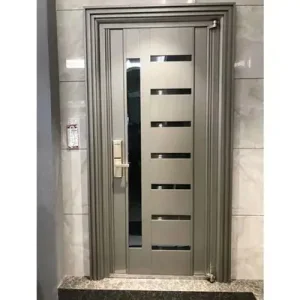
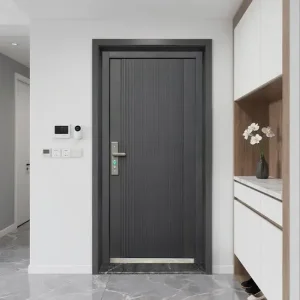
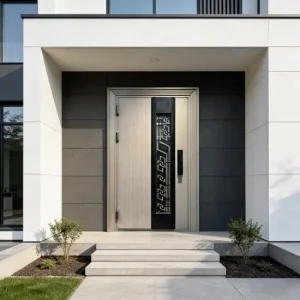
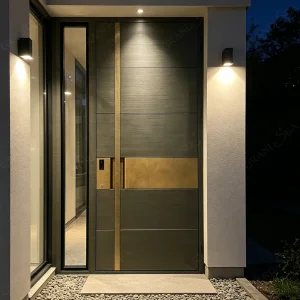
A Comprehensive Technical Whitepaper on Structural Requirements, Thermal Performance, and Supply Chain Integration for Greater Los Angeles.
From beachfront properties in Santa Monica, Malibu, and Palos Verdes to intense thermal exposure in the San Fernando Valley, entry doors in Los Angeles require extreme atmospheric resilience. High marine salt-spray accelerates galvanic corrosion, making marine-grade SUS316 and specialized PVD titanium coatings imperative for long-term structural integrity.
California's Building Energy Efficiency Standards (Title 24 Part 6) demand exceptionally low thermal transmittance (U-factor ≤ 0.20 to 0.24) and optimized Solar Heat Gain Coefficients (SHGC). Modern stainless steel entrance systems must incorporate polyamide thermal breaks and high-density polyurethane cores to prevent thermal bridging during hot SoCal summer days.
Properties situated within Los Angeles County Wildland-Urban Interface (WUI) zones (e.g., Calabasas, Pasadena foothills) must comply with strict CAL-FIRE ignition-resistant construction standards. Furthermore, high-profile residential developments in Bel Air and Hidden Hills require heavy-duty anti-burglary armored cores with multi-point automated locking.
Understanding structural deflection, metallurgy, and thermal break engineering for multi-family and ultra-luxury residential projects.
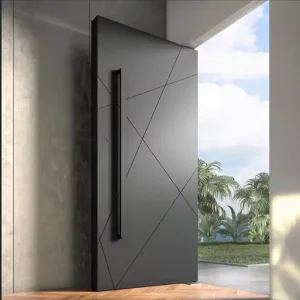
The Los Angeles architectural landscape is experiencing a structural evolution toward oversized front entryways. Modern luxury residences frequently feature pivot leaves exceeding 1.8 meters in width and 3.5 meters in height. Traditional wooden or unreinforced aluminum doors suffer from seasonal warpage, seal degradation, and frame sag under these physical scales. High-tensile stainless steel, when combined with precision structural engineering, provides the structural modulus necessary to maintain zero deflection over decades of operation.
| Technical Parameter | SUS304 Standard Stainless | SUS316 Marine-Grade Steel | DERCHI Thermal Break SUS System |
|---|---|---|---|
| Tensile Strength (MPa) | ≥ 520 MPa | ≥ 620 MPa | ≥ 680 MPa (Reinforced Core) |
| Corrosion Resistance (ASTM B117) | 500 Hours Salt Spray | 1,500 Hours Salt Spray | 3,000+ Hours (PVD Nano-Coated) |
| Thermal U-Factor (W/m²·K) | 3.5 – 4.2 (Non-Thermal) | 3.4 – 4.0 (Non-Thermal) | 1.4 – 1.8 (Title 24 Compliant) |
| Maximum Leaf Mass Capacity | 250 kg | 350 kg | Up to 800 kg (Heavy Duty Floor Pivot) |
| Acoustic Attenuation (STC Rating) | 28 dB | 30 dB | 42 dB+ (Multi-Chambered Acoustic Core) |
| Fire Endurance (UL 10C / NFPA 252) | 20 Minutes | 45 Minutes | 60 – 120 Minutes Certified |
How DERCHI’s 180,000 m² automated production base in Foshan delivers European-tier structural quality at competitive scale for California developers.
DERCHI operates 5-axis CNC laser cutting centers and robotic continuous welding stations capable of maintaining frame tolerances within ±0.3 mm across massive door assemblies. By eliminating manual weld seam variations, structural integrity against forced entry and wind-load deflection (tested to 3,000 Pa) is guaranteed.
Navigating shipping to the Port of Los Angeles (POLA) or Port of Long Beach (POLB) requires rigorous export packaging engineering. Each door leaf undergoes five-layer protective film wrapping, EPE corner shielding, and custom heavy-duty plywood crating to survive trans-Pacific ocean transit with zero finish degradation.
From initial architectural shop drawings to final jobsite delivery in Southern California.
Our specialized engineering team generates detailed AutoDesk CAD profiles, anchor attachment schedules, and BIM Revit models within 48 hours of schedule submission to ensure seamless integration with U.S. architectural specs.
We provide physical physical finish swatches (brushed, mirror, wire-drawn, dark bronze PVD) along with structural thermal break corner samples directly to Los Angeles architecture firms for client presentation and sign-off.
DERCHI provides complete installation torque specs, perimeter flashing guides, and real-time video installation support aligned with Pacific Standard Time (PST) working hours for local installation crews.
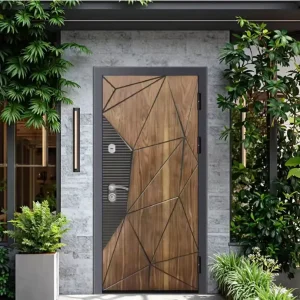
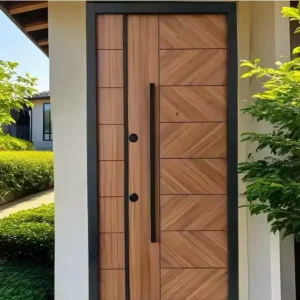
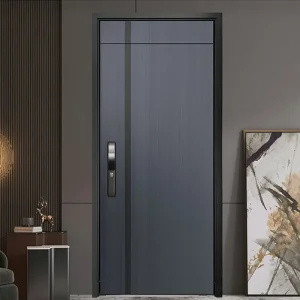
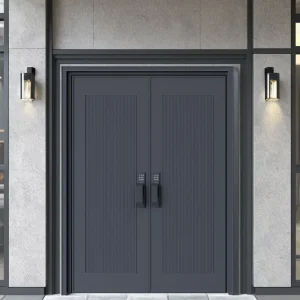
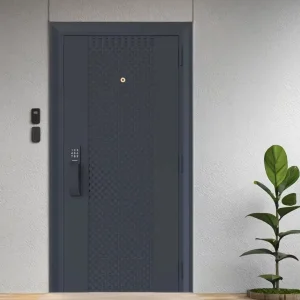
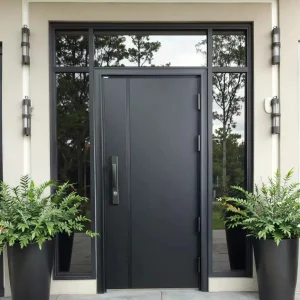
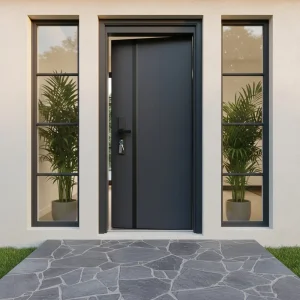
Explore our complete range of specialized entrance systems, fire-rated apartment doors, and luxury pivot entries.
Detailed technical answers from DERCHI Senior Structural & Compliance Engineers.
DERCHI stainless steel doors intended for California are manufactured using a dual-chambered structural profile isolated by high-performance polyamide (PA66GF25) thermal break strips. The internal core is pressure-injected with high-density polyurethane insulation (45 kg/m³), achieving certified U-factors as low as 0.20 Btu/h·ft²·°F (1.14 W/m²K). This satisfies the stringent prescriptive and performance pathways of California Title 24 Part 6.
For installations within 5 miles of the Pacific Ocean coastline, we exclusively recommend marine-grade SUS316 or SUS316L stainless steel. SUS316 contains 2-3% Molybdenum, which drastically increases resistance to pitting and crevice corrosion caused by airborne chlorides and salt fog. We also apply nano-scale PVD (Physical Vapor Deposition) coatings to further seal the surface, backed by a 15-year warranty against atmospheric corrosion.
Yes. Our engineering plant specializes in custom oversized pivot systems. We can fabricate single leaf sizes up to 2.2 meters wide by 4.5 meters tall. These doors utilize specialized German heavy-duty hydraulic floor pivots with weight ratings up to 800 kg (1,760 lbs), featuring integrated 90° hold-open functions and adjustable soft-closing control.
Production time for customized stainless steel entry systems takes approximately 25 to 35 business days following CAD shop drawing approval. Ocean freight from our Foshan facility direct to the Port of Los Angeles (POLA) typically takes 16 to 22 transit days. We coordinate full FOB, CIF, or DDP (Delivered Duty Paid) shipping to your jobsite.
Our stainless steel door systems can be factory-prefitted with concealed motorized multi-point locks (e.g., Winkhaus, GU, or Somfy integrations). These support biometric fingerprint recognition, facial recognition scanning, smartphone Bluetooth/Wi-Fi control, and integration with home automation systems like Crestron, Control4, or Lutron.
Contact our structural engineering team today to receive a complete technical quotation, complimentary AutoDesk CAD shop drawings, and certified performance test summaries for your project.
