Engineered to satisfy stringent Japanese Industrial Standards (JIS A 4702), offering exceptional acoustic isolation, structural integrity under high wind loads, and superior thermal efficiency.
Japan’s residential and commercial architectural sectors are experiencing a monumental transition driven by the Ministry of Land, Infrastructure, Transport and Tourism (MLIT). With the compulsory enforcement of Zero Energy House (ZEH) standards and enhanced CASBEE (Comprehensive Assessment System for Built Environment Efficiency) ratings, exterior building envelopes require radically lower thermal transmittance coefficients (U-values).
Traditional Japanese wooden entry doors and non-insulated metal frames are rapidly being replaced by advanced 6063-T5 thermally broken aluminum profiles paired with multi-chamber polyamides (PA66GF25). This technical revolution guarantees that entry doors maintain indoor microclimates during harsh Hokkaido winters and hot, humid Kantō summers.
Given Japan’s high seismic activity (Nankai Trough and Pacific Ring of Fire exposure), architectural doors must possess high frame deformation tolerance without jam risk during seismic events. Modern entry doors exported to Japanese contractors undergo rigorous inter-story displacement tests.
By embedding flexible structural EPDM perimeter gaskets, heavy-duty floor pivots with multi-axis clearance, and high-tensile steel reinforcements inside the aluminum chambers, next-generation entry doors remain operational even after severe structural racking, providing vital escape routes for occupants.
Certified air tightness (Grade A-4), water tightness (Grade W-5), and wind resistance (Grade S-6 / up to 3000 Pa) tailored specifically to Japanese building codes.
Fluoropolymer PVDF surface coatings (AkzoNobel / PPG) withstand coastal salt-fog spray tests exceeding 3,000 hours in Okinawa and Shonan coastal zones.
Seamless integration with Japanese smart home systems (FamiLock, Smart Control Key protocols, fingerprint biometrics, and facial recognition access control).
Providing quantitative information gain for architectural specifiers, developers, and general contractors in Japan.
| Entry Door Material Platform | Core Structural Build-Up | Thermal U-Value Range | Acoustic Reduction | Seismic Displacement Rating | Optimal Japanese Application |
|---|---|---|---|---|---|
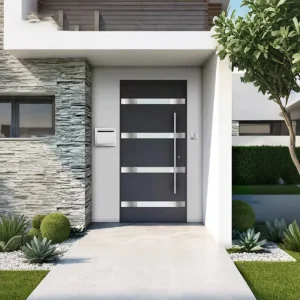
| Thermally Broken Aluminum | 6063-T5 Extrusion + 24mm PA66GF25 Insulation Strip | 1.4 – 1.8 W/(m²·K) | 35 dB – 42 dB | 1/150 Structural Shift | Modern Tokyo Villa Main Entrance, ZEH Housing |
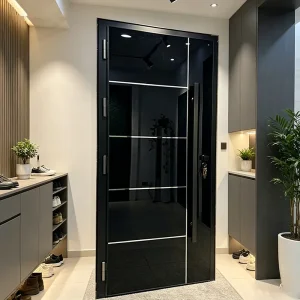
| Cast Aluminum Art Doors | 8mm - 12mm Solid Sand-Cast Decorative Relief Panel | 1.8 – 2.2 W/(m²·K) | 32 dB – 38 dB | 1/200 Structural Shift | Suburban Luxury Estates, Heritage Gateways |
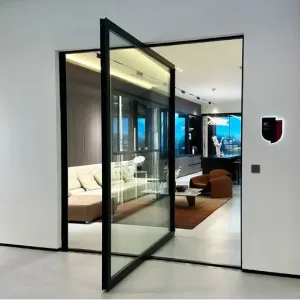
| Panoramic Glass Pivot Doors | Structural Steel-Reinforced Frame + Triple Low-E Argon Glass | 1.1 – 1.5 W/(m²·K) | 38 dB – 45 dB | 1/120 Flexible Pivot Hinge | Commercial Lobbies in Osaka, Boutique Hotels |
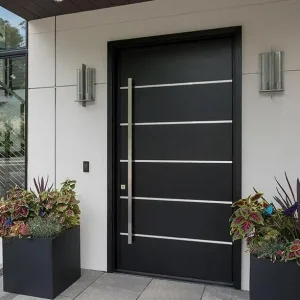
| SUS304 / SUS316 Stainless Steel | 1.5mm Stainless Skin + High-Density Rockwool Core | 2.0 – 2.5 W/(m²·K) | 30 dB – 36 dB | Rigid Anti-Prying Frame | High-Security Bank Entrances, Coastal Okinawa Villas |
Combining German CNC precision processing with scale efficiency from our 180,000m² Foshan manufacturing campus to support Japanese projects.
Custom ultra-slim thermal break pivot doors configured with concealed multi-point locks, offering maximum daylight entrance, contemporary aesthetics, and strict noise reduction against urban street traffic.
Engineered cast aluminum doors and heavy-duty hurricane impact doors equipped with marine-grade 316 stainless steel hardware, triple weatherstripping, and high-pressure water drainage thresholds.
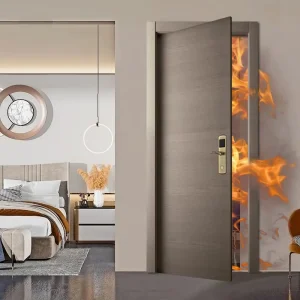
Custom wood-grain fluorocarbon heat-transfer entry door finishes that emulate classic Japanese Sugi (Cedar) and Hinoki (Cypress) aesthetics while offering non-warping, fire-resistant aluminum frames.
Eliminating traditional thick double-chamber insulated glass, DERCHI is integrating 8.3mm ultra-thin Vacuum Insulated Glass into entry door side-lights, achieving thermal U-values lower than 0.6 W/(m²·K)—matching solid insulated wall performance.
Japanese architects can instantly import parametric DERCHI Revit BIM files. Real-time online FEA (Finite Element Analysis) simulates wind load deflection and thermal stress prior to factory extrusion, accelerating approval cycles by 60%.
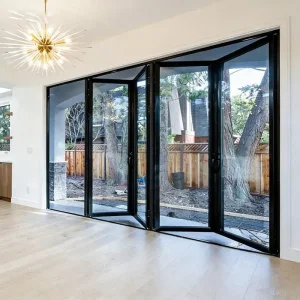
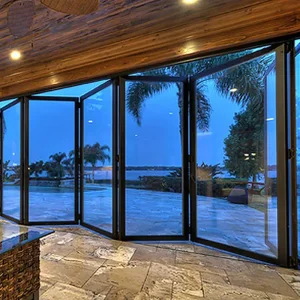
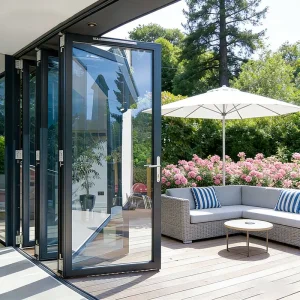
Explore our certified pivot, bi-fold, entry, and interior aluminum systems engineered for residential and commercial deployments.
Streamlined ocean freight logistics directly from Foshan/Shenzhen to Yokohama, Tokyo, Osaka, Kobe, and Nagoya ports with full Japanese customs documentation (CO, Form E, packing lists).
Each door leaf is wrapped in multi-layer protective EPE foam, corner-armored, and fully enclosed in solid fumigation-free plywood crates, keeping transit claim rates below 0.3%.
Dedicated English and Japanese-speaking sales engineers provide instant drawing reviews, installation manuals, and real-time video guidance during on-site installation in Japan.
DERCHI entry door systems are engineered using high-grade 6063-T5 aluminum extrusions and multi-chamber thermal break profiles that meet and exceed JIS A 4702 requirements for air tightness (Grade A-4), water tightness (Grade W-5), and wind pressure resistance (Grade S-6). Complete third-party test laboratory reports are provided alongside project quotations for Japanese building inspector verification.
We custom-engineer oversized architectural pivot entry doors up to 2,000mm in width and 4,000mm in height. These systems utilize heavy-duty German-made floor pivots rated for leaf weights up to 500kg, incorporating internal steel anti-warping tension rods to guarantee smooth one-finger operation and zero sagging over time.
Yes. Our CNC machining process custom-prepares lock pockets to seamlessly integrate Japanese smart electronic mortise locks (such as FamiLock or Smart Control Key modules), as well as global biometric solutions (facial recognition, fingerprint scanners, keypad, and Bluetooth/Wi-Fi smart locks).
Sample doors for showroom evaluation or performance mock-up testing are manufactured within 12–18 days. Full project orders take approximately 25–35 days post drawing sign-off. We accept single-unit orders for luxury custom villas as well as bulk container production for real estate developments.
We utilize Technoform PA66GF25 thermal breaks up to 34mm depth combined with triple-pane Low-E glass units filled with 90% Argon gas and warm-edge spacers. This configuration lowers door system U-values to as low as 1.1 W/(m²·K), fully satisfying strict Japanese ZEH standards.
Contact our technical engineering team today to receive complimentary CAD shop drawings, custom project quotes, and comprehensive certification documentation tailored to Japanese building codes.
Send Inquiry Now