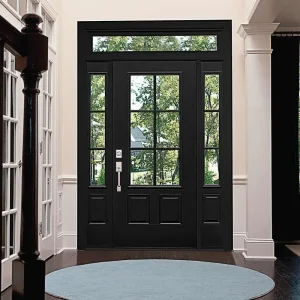
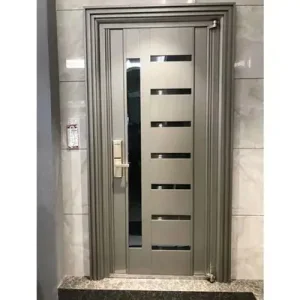
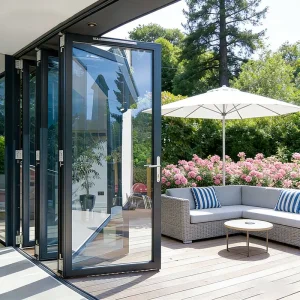
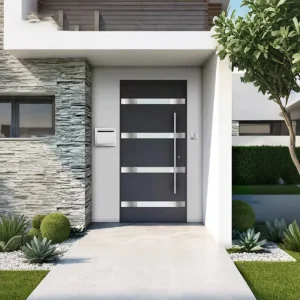
Engineered for extreme thermal resistance, air tightness, structural wind loads, and modern architectural aesthetics.
Why modern architectural specifications demand integrated insulating glass technology over traditional single-pane and non-thermally broken frames.
In contemporary architectural design, the building facade is no longer treated merely as a structural divider between indoors and outdoors. It operates as a complex, high-performance energy membrane. As global energy building codes—such as Europe's Energy Performance of Buildings Directive (EPBD), North America's ASHRAE 90.1, and Australia's National Construction Code (NCC)—tighten requirements for Net-Zero Energy Buildings (NZEB), fenestration systems must undergo radical technological iterations. Among these components, insulated glass doors play a decisive role in curbing HVAC energy consumption, mitigating thermal bridging, preventing interior condensation, and achieving superior sound isolation.
Historically, standard commercial entrance doors relied on single-sheet tempered glass set into hollow aluminum profiles. While structural safety was achieved, these legacy assemblies suffered from severe thermal conductivity. In cold climates, heat rapidly leaked outward, leading to interior frost accumulation and high heating utility costs. In tropical or desert regions, solar radiant heat penetrated freely, overloading chillers and creating microclimate discomfort near entrance vestibules.
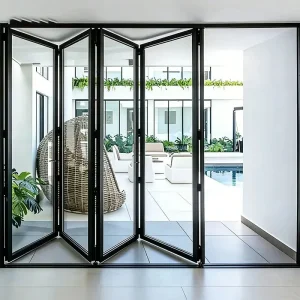
As a premier Insulated Glass Door Manufacturer and Supplier, DERCHI has bridged this historical performance gap. By integrating multi-layered Insulating Glass Units (IGUs) containing low-emissivity (Low-E) soft coatings, inert gas infills (such as Argon or Krypton), warm-edge spacer bars, and precision polyamide (PA66-GF25) thermal break extrusions, DERCHI delivers architectural entry doors, large-format bi-fold doors, and heavy-duty pivot doors that maintain flawless optical clarity while drastically dampening thermal transfer.
Understanding how general contractors, facade consultants, and commercial developers evaluate supply chain risk, compliance verification, and performance durability.
Driven by strict NFRC thermal performance indexing, Florida Building Code (FBC) High-Velocity Hurricane Zone (HVHZ) impact requirements, and Title 24 energy mandates.
Focused heavily on overall U-factor metrics, CE EN14351-1 certification, Passivhaus standards, and strict acoustic dampening for urban residential developments.
Strict compliance with AS2047 (Windows and External Glazed Doors) and AS1288 glass selection standards under high solar radiation and extreme cyclonic conditions.
A comprehensive look at the structural, glass science, and metallurgical innovations built into every DERCHI door assembly.
DERCHI insulating glass units feature dual-seal perimeter technology combining primary polyisobutylene (PIB) for gas barrier integrity and structural silicone (Dow Corning 983) for mechanical strength.
Extruded from high-purity 6063-T5 aluminum alloy, profiles incorporate multi-cavity geometries fitted with 24mm to 34mm PA66-GF25 reinforced glass-fiber polyamide thermal breaks.
Hardware logic engineered in partnership with top European brands (Siegenia, Hoppe, Sobinco) combined with DERCHI heavy-duty stainless steel pivot hinges.
Compare performance parameters across DERCHI's primary insulated glazing configurations for informed specification decisions.
| Glazing Platform | Glass Build-Up Specs | Thermal U-Value | SHGC Range | Acoustic Rating | Max Panel Size | Structural Wind Load |
|---|---|---|---|---|---|---|
| Double Glass Standard IGU | 6mm Low-E + 12A + 6mm Tempered | 1.8 - 2.2 W/(m²·K) | 0.30 - 0.45 | 32 - 35 dB | 1600 × 3200 mm | 2400 Pa (N4) |
| Triple Glass High-Thermal IGU | 6mm Low-E + 12A + 4mm + 12A + 6mm Low-E | 0.8 - 1.2 W/(m²·K) | 0.22 - 0.32 | 36 - 40 dB | 1800 × 3600 mm | 3600 Pa (N6) |
| Acoustic Laminated Double IGU | 6mm + 1.52PVB + 6mm + 16A + 8mm Low-E | 1.4 - 1.7 W/(m²·K) | 0.25 - 0.38 | 42 - 46 dB | 2000 × 4000 mm | 4000 Pa |
| Hurricane Impact Laminated IGU | 6mm Low-E + 12A + 6mm + 2.28SGP + 6mm | 1.5 - 1.9 W/(m²·K) | 0.24 - 0.35 | 38 - 42 dB | 2000 × 4000 mm | 5000 Pa (HVHZ) |
| Vacuum Insulated Glass (VIG) Hybrid | 0.3mm Vacuum + 4mm Low-E + 12A + 6mm | 0.6 - 0.9 W/(m²·K) | 0.20 - 0.28 | 40 - 44 dB | 1500 × 3000 mm | 3000 Pa |
How DERCHI enforces total compliance through rigorous third-party testing protocols for global distribution.
Operated under strict ISO 9001 quality management systems. Every product batch leaves the facility carrying CE marking under EN 14351-1 for external pedestrian doorsets.
Pivots and tracking rollers undergo 100,000+ open-close cycle tests under maximum glazed capacity to guarantee zero structural sagging or mechanical fatigue over decades of use.
In-house test chambers evaluate water penetration under 600 Pa dynamic water pressure spraying alongside static wind pressure testing up to 5000 Pa.
How DERCHI bridges international procurement gaps for overseas developers, distributors, and architectural design firms.
Purchasing high-end custom architectural doors internationally involves managing critical details like dimension tolerances, local building site regulations, shipping security, and post-installation adjustments. DERCHI provides an end-to-end B2B support framework that removes risk at every stage of the procurement cycle:
Prior to extrusion, our engineering department produces detailed CAD shop drawings and 3D BIM models matching your door schedules, frame jamb details, threshold heights, and sub-floor recess calculations.
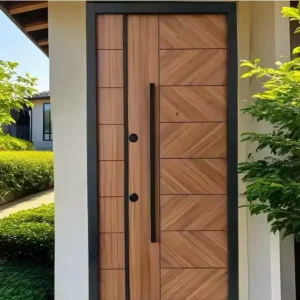
We offer customized finish selections including PPG PVDF fluorocarbon coatings, AkzoNobel exterior powder coatings, anodized architectural finishes, and wood-grain heat transfer textures rated for high UV climates.
Door units are wrapped with PE film, protected with high-density EPE foam corner guards, sealed in heavy-duty corrugated cartons, and crated in fully fumigation-free plywood crates with steel bands for safe sea container transport.
Previewing the smart glass technologies and dynamic thermal systems shaping the future of architectural fenestration.
Integrating electronically controlled glass layers that dynamically adjust tint level based on sun position and solar heat gain, eliminating the need for blinds while maximizing daylighting comfort.
Developing transparent Building-Integrated Photovoltaic (BIPV) glass units that turn modern entrance facades into clean energy generators without sacrificing light transmission.
Combining 0.3mm vacuum chambers with argon-filled low-E IGUs to deliver thermal insulation equivalent to solid masonry walls in ultra-slim frame profiles.
Direct technical answers from DERCHI’s senior engineering team to streamline your project specification workflow.
Depending on your selected frame depth and glazing configuration, DERCHI doors achieve U-values ranging from 1.8 W/(m²·K) on standard double-glazed systems down to 0.8 W/(m²·K) on triple-glazed, warm-edge, argon-filled systems certified for Passivhaus and ultra-low-energy applications.
Our IGUs utilize a dual-seal perimeter system. Primary sealing uses polyisobutylene (PIB), which provides an imperious barrier against gas migration and water vapor transmission. Secondary structural sealing uses Dow Corning 983 silicone. This dual barrier keeps gas loss under 0.5% per year, ensuring decades of thermal stability.
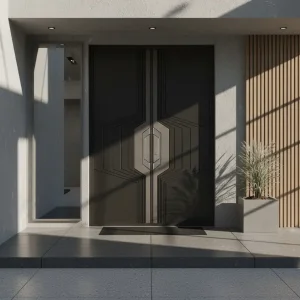
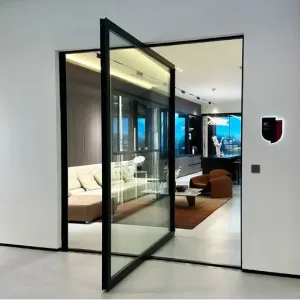
Yes. We specialize in extra-large architectural pivot doors. Standard max leaf dimensions reach up to 1600mm width by 3200mm height. For custom villa and commercial lobby projects, we engineer reinforced steel-core profiles supporting single glass leaves up to 2000mm wide by 4000mm high with floor pivots rated up to 600kg capacity.
DERCHI provides complete test report documentation with orders, including ISO 9001 factory compliance, CE EN14351-1 testing, AS2047 N6 wind and water penetration test reports for Australia, and NFRC energy performance simulation reports for North American code sign-offs.
Condensation occurs when thermal bridging allows the inner frame surface to drop below the dew point. DERCHI eliminates this issue by inserting high-performance polyamide (PA66-GF25) thermal breaks between the inner and outer aluminum extrusions, ensuring high interior frame surface temperatures even in sub-zero weather.
For high acoustic isolation, we recommend our acoustic laminated double IGUs containing PVB or SGP acoustic interlayers combined with asymmetrical glass pane thicknesses (e.g., 8mm exterior + 16A + 6mm interior). This setup disrupts sound wave resonance, achieving noise reductions up to STC 45dB.
Shop drawings and CAD details are issued within 48 hours of order confirmation. Following drawing sign-off, manufacturing takes 25 to 35 days depending on profile finishes (PVDF coating vs anodized vs wood-grain transfer). Sample doors and expedited project batches can be accommodated.
Each door panel is wrapped in protective scratch-resistant film, corner-guarded with EPE foam buffer blocks, packed in double-wall cardboard boxes, and loaded into fumigation-free wooden crates with structural steel straps. Freight damage rates are held below 0.2% across global shipments.
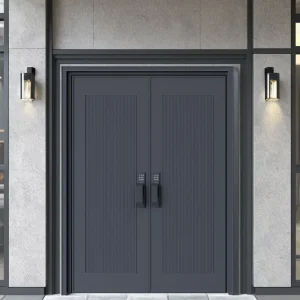
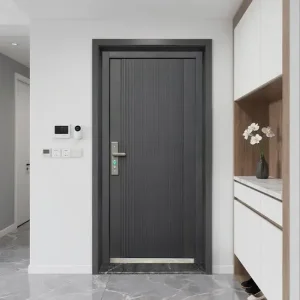
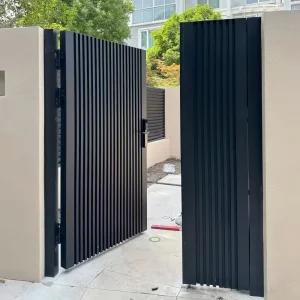
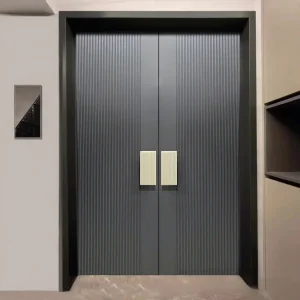
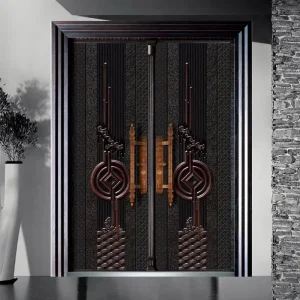
Complete project solutions from courtyard main entrance gates to armored anti-theft villa security doors.
Request comprehensive CAD shop drawings, glass sample boxes, and direct factory quotation packages tailored to your project schedule.
Contact Engineering Team