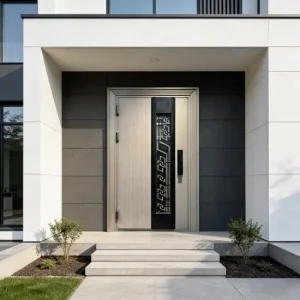
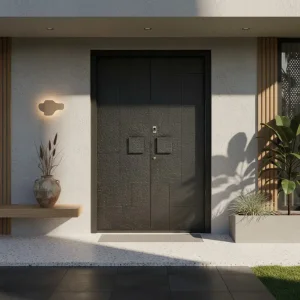
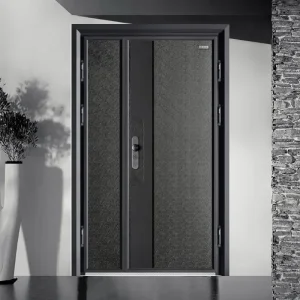
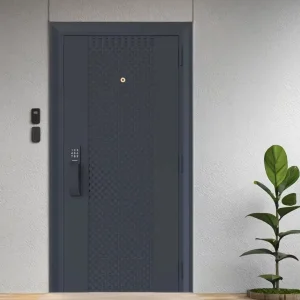
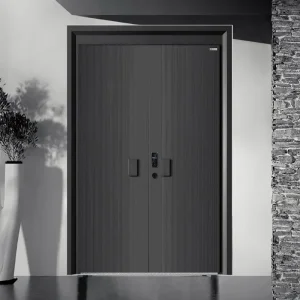
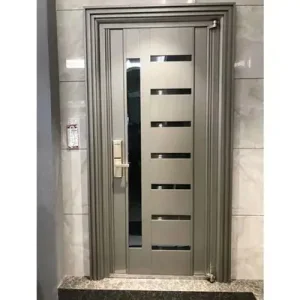
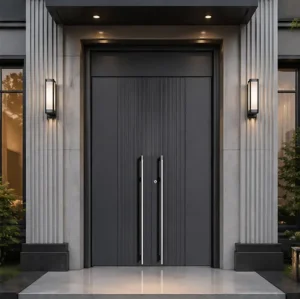
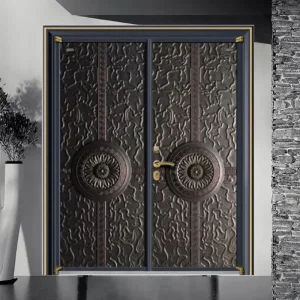
Examine our certified product lineup engineered for extreme structural stability, severe thermal isolation, and high-velocity wind-load resilience.
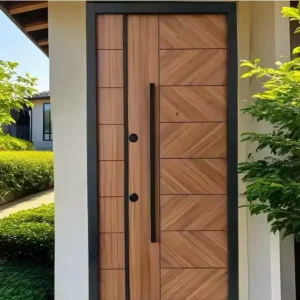
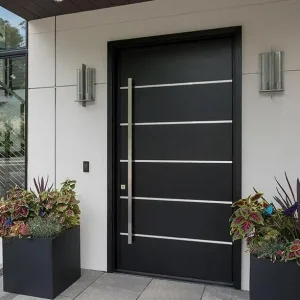
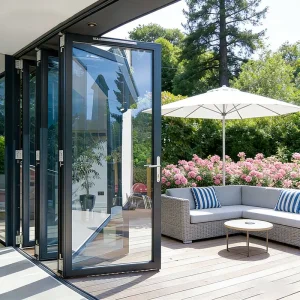
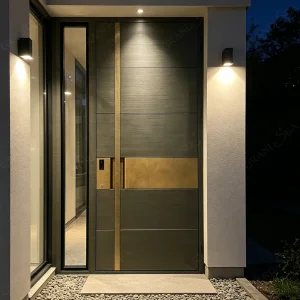
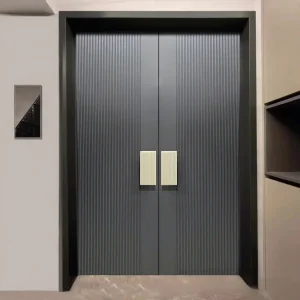
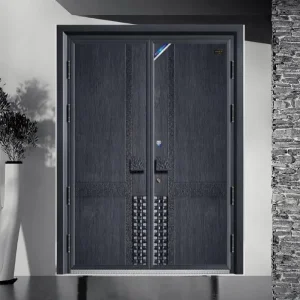
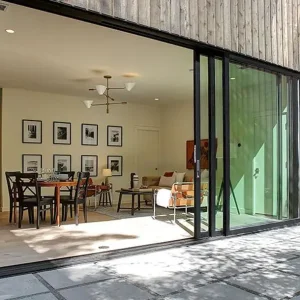
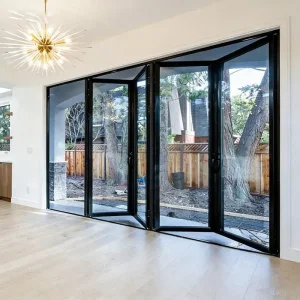
An exhaustive analysis of how decarbonization mandates, extreme climatic volatility, and architectural shifts toward massive spans are driving demand for thermally broken aluminum door systems worldwide.
The global building envelope market is experiencing an unprecedented structural transition. Modern building energy codes—such as the European Union's Energy Performance of Buildings Directive (EPBD), Australia’s NCC 2022, and North American ASHRAE 90.1 standards—have established strict U-value thresholds for external fenestrations. Legacy uninsulated aluminum profile systems are rapidly being phased out due to thermal bridging and excessive carbon penalties.
As a leading manufacturer based in Foshan, China, DERCHI Doors and Windows addresses this structural shift by embedding high-density Polyamide 66 with 25% glass fiber (PA66-GF25) thermal barrier strips into primary profile extrusions. This multi-chamber engineering reduces operational HVAC energy consumption by up to 35% in both extreme cold climates and equatorial high-heat zones.
Contemporary architectural design heavily favors ultra-slim sightlines coupled with massive continuous glass areas or heavy solid cast-aluminum decorative panels. Standard residential door hardware fails under leaf weights exceeding 200 kg, resulting in sagging, gasket degradation, and air infiltration leakage over time.
DERCHI high-performance aluminum doors incorporate heavy-duty floor pivots engineered with German stainless-steel needle bearings rated up to 500 kg per leaf. These structural mechanisms allow architects to specify grand villa entrance doors spanning up to 2,000 mm in width and 4,000 mm in height without compromising operational smoothness, air tightness, or long-term structural integrity.
Discover the precise material science, profile geometry, and surface treatment technologies behind DERCHI's high-performance door systems.
DERCHI utilizes primary architectural-grade 6063-T5 aluminum alloy for refined geometric accuracy and superior surface finishing, with structural reinforcing sub-frames employing 6061-T6 alloy where yield strengths exceeding 240 MPa are mandatory. Wall thicknesses are rigidly maintained at 2.0 mm to 3.0 mm, surpassing standard commercial door profiles by over 40%.
Our profile design incorporates imported Technoform PA66GF25 thermal breaks. By separating outer and inner aluminum skins with low-conductivity glass-fiber reinforced nylon strips (thermal conductivity $\lambda \approx 0.3 \text{ W/m}\cdot\text{K}$ compared to raw aluminum's $200 \text{ W/m}\cdot\text{K}$), we eliminate thermal condensation and reduce total heat transfer coefficient ($U_f$) down to $1.4 \text{ W/m}^2\text{K}$.
High-performance doors require multi-barrier sealing. DERCHI engineers continuous ternary EPDM (Ethylene Propylene Diene Monomer) rubber gaskets combined with magnetic soft-close perimeter seals. Combined with 6mm + 12A + 6mm double-laminated or argon-filled insulating glass, system sound insulation reaches STC 42 dB / Rw 40 dB.
Tailored technical configurations engineered to withstand specific microclimates, structural load requirements, and regional building standards.
In coastal regions exposed to saltwater mist and high-velocity wind loads, standard doors suffer from oxidation, frame distortion, and water infiltration.
Hotel lobbies, corporate headquarters, and high-end residential estates demand maximum aesthetic impact paired with heavy anti-burglary security and zero-maintenance durability.
Factory-verified physical parameters comparing profile depth, thermal performance, wind load ratings, and hardware capabilities across our material platforms.
| Door System Platform | Profile Wall & Alloy | Thermal Transmittance (U-Value) | Wind Load / Water Tightness | Acoustic Rating (STC) | Max Single Leaf Dimension |
|---|---|---|---|---|---|
| Thermally Broken Aluminum Entrance Door | 2.0 - 2.5mm / 6063-T5 + PA66GF25 Strip | 1.4 - 1.8 W/(m²·K) | AS2047 N6 / 600 Pa Water | STC 38 - 42 dB | 1400 mm × 3000 mm |
| Solid Cast Aluminum Luxury Villa Gate | 6.0 - 12.0mm Cast Panel + Steel Core Frame | 1.8 - 2.2 W/(m²·K) | Up to 3,500 Pa Wind Load | STC 40 - 45 dB | 2000 mm × 4000 mm |
| Structural Glass Architectural Pivot Door | 3.0mm Heavy-Duty Frame / 6+1.52PVB+6 Glass | 1.2 - 1.6 W/(m²·K) | ASTM E1300 / Florida HVHZ Passed | STC 36 - 40 dB | 1800 mm × 3800 mm |
| SUS304 / 316 Armor Security Entry Door | 1.5 - 2.0mm Stainless Skin + Mineral Wool Core | 1.9 - 2.4 W/(m²·K) | Class 4 Anti-Prying / Explosion Resistance | STC 42 - 46 dB | 1500 mm × 3200 mm |
Vertically integrated production capabilities guaranteeing dimensional tolerance within ±0.5 mm and strict adherence to international export schedules.
Equipped with imported German 5-axis CNC machining centers, DERCHI executes precision milling, lock-mortise slotting, and corner key crimping under computerized control. Profile joint gaps are held strictly under 0.1 mm, preventing moisture seepage and structural flexure under wind stress.
Every production batch undergoes five rigorous inspection checkpoints: raw aluminum alloy spectroscopic testing, thermal break peel-strength testing, powder coating cross-hatch adhesion checks, water/air chamber simulation testing, and 100% pre-assembly inspection before ocean crate packaging.
To prevent ocean transport damage, doors are wrapped in PE protective film, fitted with high-density EPE corner protectors, sealed in 5-layer corrugated cartons, and anchored within fumigation-free, steel-banded plywood crates. Transit damage rates are maintained below 0.2% across global shipments.
Pioneering the next generation of architectural envelope solutions through smart IoT integration, ultra-low carbon alloys, and next-gen insulation glass.
DERCHI R&D is currently integrating ultra-thin Vacuum Insulated Glass (VIG) technology into aluminum door panels. By removing gas between glass panes, center-of-glass U-values drop to an astonishing 0.6 W/(m²·K) in profile depths under 80mm. Simultaneously, aerogel-infused insulation fill is being deployed inside profile multi-chambers to satisfy Passive House (Passivhaus) certification standards globally.
In alignment with global net-zero goals, DERCHI is expanding its use of green aluminum extruded using hydroelectric power, reducing carbon intensity from $16 \text{ kg CO}_2/\text{kg Al}$ to under $4 \text{ kg CO}_2/\text{kg Al}$. Furthermore, next-generation door profiles feature hidden electro-magnetic concealed actuators, allowing real-time structural monitoring, motorized operation, and seamless linkage with automated building management systems (BMS).
Direct technical responses addressing structural design, certification verification, sample orders, and lead times.
Our hurricane impact doors utilize heavy-wall 6063-T5 aluminum extrusions (2.5mm+ wall thickness) reinforced with inner stainless steel stiffeners. Glazing consists of laminated safety glass with SentryGlas (SGP) structural interlayers. Systems are lab-tested under cyclic wind pressure up to 3,000 Pa and high-velocity missile impact tests to guarantee full compliance with Australian AS2047 and North American NFRC/Florida HVHZ requirements.
Standard production covers leaf dimensions up to 1,600 mm in width and 3,200 mm in height. For custom grand entrances (villa gates and hotel lobbies), our engineering team utilizes heavy-duty German-engineered floor pivot hardware capable of supporting single leaves up to 2,000 mm × 4,000 mm and total weights up to 500 kg without long-term deflection.
We insert high-density Polyamide PA66GF25 (25% glass fiber reinforced) thermal barrier strips between outer and inner aluminum profile chambers. Combined with multi-cavity EPDM gaskets and Low-E argon-filled insulating glass, system thermal transmittance ($U_f$) is reduced to between 1.4 W/(m²·K) and 1.8 W/(m²·K), drastically cutting energy costs.
Yes. Our in-house engineering design department issues comprehensive CAD shop drawings, elevation details, 3D section models, and BIM-ready blocks matching your exact project schedule numbers. This technical package is provided free of charge during the quotation stage to simplify building code approval.
Sample door lead time is typically 12 to 18 days. Commercial container orders take 25 to 35 days post drawing confirmation and deposit. There is no strict minimum order quantity (MOQ); single-unit sample doors for mock-up testing or showroom display are accepted and shipped in custom reinforced plywood packaging.
Explore our custom 304 stainless steel, armor security, and European classical aluminum entrance door solutions.