Direct OEM/ODM engineered pivot, cast aluminum, hurricane-rated, and multi-point lock security doors compliant with international structural & energy codes.
Examining structural supply chain shifts, decarbonization mandates, and the shift from commoditized fenestration to high-value architectural envelope systems.
Global architectural procurement has fundamentally shifted away from fragmented sub-tier sourcing toward vertically integrated manufacturing partners. Modern B2B importers, commercial general contractors, and door wholesalers require single-source accountability. By housing extrusion, precision CNC machining, surface finishing (PVDF and anodic oxidation), thermal break assembly, and architectural glass lamination inside a single 180,000 m² facility in Foshan, DERCHI eliminates sub-tier lead time padding and dimensional tolerance stack-ups.
Energy codes across North America (IECC/Title 24), Europe (EPBD directives), and Australia (NCC Section J) have mandated aggressive U-factor reductions for exterior building envelopes. High-performance aluminum doors must now deliver thermal isolation comparable to wood structural insulated panels while retaining the structural rigidity required for wind loads exceeding 3,000 Pa. Wholesale buyers must select manufacturers capable of co-extruding polyamide (PA66GF25) thermal barriers to comply with stringent local municipal inspections.
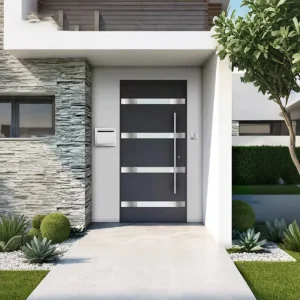
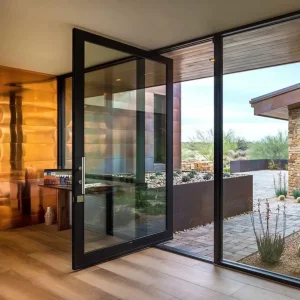
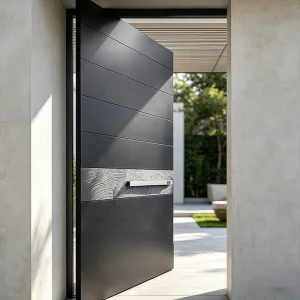
Contemporary residential and commercial architecture prioritizes grand entry statements characterized by floor-to-ceiling clear openings. Oversized pivot doors exceeding 2,000 mm in width and 4,000 mm in height present extreme structural challenges regarding dead-load deflection, hinge shear forces, and air infiltration. Wholesalers are rapidly phasing out light-gauge residential profiles in favor of heavy-wall 6063-T5/T6 structural alloys with internal steel sleeve reinforcements.
Unlike standard fenestration suppliers who utilize off-the-shelf residential extrusions, high-performance architectural aluminum doors require non-linear structural modeling to ensure leaf deflection remains below L/175 under dynamic wind forces. DERCHI's in-house engineering team calculates section modulus, moment of inertia (Ix, Iy), and thermal bridge continuity prior to extrusion die production.
Comprehensive technical breakdown of alloy selection, thermal separation physics, surface treatment chemistry, and hardware engineering.
The structural foundation of high-performance aluminum doors rests upon 6063-T5 and high-strength 6061-T6 magnesium-silicon aluminum alloys. Under controlled artificial aging (T5 temper: rapid cooling from an elevated temperature shaping process followed by artificial aging at ~175°C), the material achieves an ultimate tensile strength exceeding 200 MPa and a yield strength over 160 MPa. This provides exceptional resistance to permanent plastic deformation under hurricane wind pressure and continuous daily mechanical operation.
Aluminum exhibits an inherently high thermal conductivity (approx. 200 W/(m·K)). To prevent rapid heat transfer across exterior door frames, DERCHI engineers integrate multi-cavity Polyamide 66 reinforced with 25% structural glass fiber (PA66GF25). Featuring a thermal conductivity of just 0.3 W/(m·K), these insulating strips match the thermal expansion coefficient of aluminum (2.3 × 10⁻⁵ /K), preventing joint shear failure during seasonal temperature fluctuations between -30°C and +70°C.
For coastal and industrial environments subject to severe salt spray and UV radiation, surface protection is paramount. Aluminum profiles undergo multi-stage chemical pretreatment (chromate-free conversion) followed by Fluoropolymer PVDF (polyvinylidene fluoride) or architectural PPG powder coating. Certified to AAMA 2605 requirements, these coatings resist color fading (ΔE < 5 over 10 years), chalking, gloss retention degradation, and filiform corrosion in high-humidity littoral installations.
Standard single-latch entry doors fail under dynamic forced-entry testing and wind-driven rain pressure. High-performance aluminum assemblies incorporate multi-point gear-driven locking rods made of 304/316 stainless steel, securing the door leaf at 3 to 7 distinct structural points along the frame. For pivot doors, bottom floor oil-bath hydraulic pivots support leaf weights up to 500 kg while providing adjustable 90° hold-open, soft-closing control, and dual-axis alignment adjustment.
Engineered performance values measured across DERCHI's certified production lines. Values represent independently laboratory-tested ranges for baseline configuration scheduling.
| System Platform | Structural Core Build-Up | Thermal U-Value Range | Wind & Water Resistance Rating | Acoustic Attenuation (STC) | Primary Commercial Application |
|---|---|---|---|---|---|
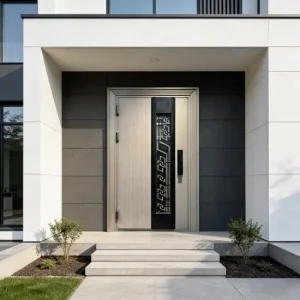
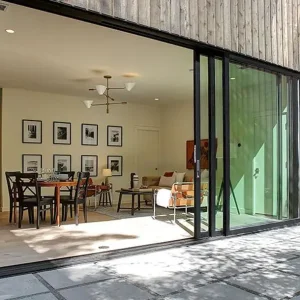
| Thermal Break Aluminum Door | 6063-T5 frame (80-120mm depth), 25mm PA66 thermal barrier, PU insulation | 1.4 – 2.0 W/(m²·K) | AS2047 N6 / ASTM E330 (3,000 Pa wind / 450 Pa water) | 35 - 42 dB | Modern coastal villas, luxury single-family, low-energy housing |
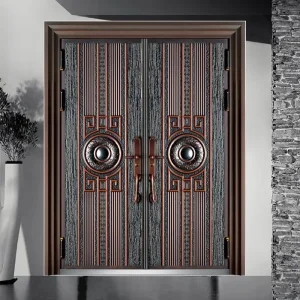
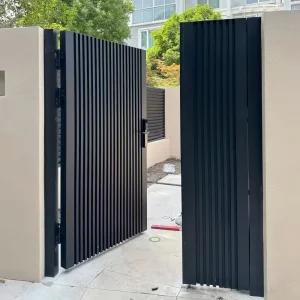
| Cast Aluminum Gate & Door | 6-12mm solid sand-cast relief panels bonded to structural aluminum frame | 2.0 – 2.6 W/(m²·K) | Up to 2,400 Pa wind load resistance | 32 - 38 dB | Villa main entrances, perimeter gates, high-end estate perimeter security |
| Structural Glass Pivot Door | Heavy-duty aluminum pivot perimeter frame, 24-42mm Low-E IGU / Laminated | 1.5 – 2.1 W/(m²·K) | ASTM E330 / DP50 - DP70 structural rating | 38 - 45 dB | Hotel grand foyers, corporate headquarters, daylight-driven luxury residences |
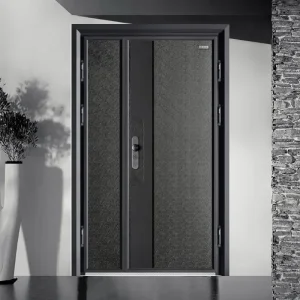
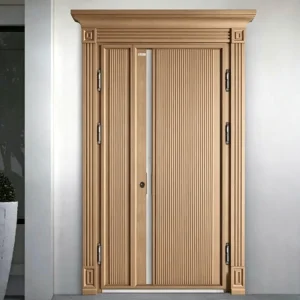
| Stainless Steel Armored Security Door | SUS304 / SUS316 skin (1.2-2.0mm) over steel anti-pry skeleton + rockwool | 2.2 – 2.8 W/(m²·K) | EN 1627 RC3 / RC4 anti-burglary certified | 36 - 40 dB | High-security residential entrances, luxury villa safe rooms, financial institutions |
Engineered adaptations for extreme climate conditions, regional building codes, and varied structural typology requirements.
In regions such as Florida, the Caribbean, and coastal Australia, exterior entry doors face destructive cyclonic wind pressures and flying debris. DERCHI’s Hurricane Impact Pivot Door series utilizes heavy-wall extruded 6063-T6 frames fitted with SentryGlas® (SG) laminated safety glass. Tested to TAS 201/202/203 and AS2047 N6 standards, these doors resist missile impacts and cycling pressure differentials up to +/- 70 PSF without seal failure or glass dislodgement.
For installations in Northern Europe, Canada, and the Northern US, condensation and thermal energy losses present major building maintenance issues. Utilizing triple-glazed argon-filled insulating units combined with dual PA66 thermal breaks and continuous EPDM weather-stripping, DERCHI thermal break entry doors maintain warm interior surface temperatures, eliminating condensation risk even when outdoor ambient temperatures drop below -25°C.
Commercial entrances at luxury hotels, corporate headquarters, and retail centers experience millions of opening cycles annually. DERCHI supplies commercial-grade aluminum entry systems equipped with heavy-duty German Geze or Dormakaba floor springs, reinforced internal steel corner cleats, and zero-threshold drop-down acoustic seals. Engineered for low maintenance and seamless integration with building automation systems (BAS).
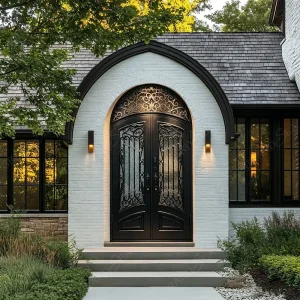
Combining aesthetic elegance with security, DERCHI cast aluminum and bulletproof armored steel door systems provide protection against forced entry (RC3/RC4 ratings). Custom hand-polished patina finishes, 3D relief casting, biometrics, facial recognition smart locks, and electrochromic privacy glass allow custom villa owners to achieve architectural elegance without sacrificing security performance.
Strategic overview of emerging technological integrations transforming the high-performance architectural aluminum door manufacturing industry.
The next frontier in energy efficiency involves replacing standard double-glazed IGUs with ultra-thin Vacuum Insulated Glass panels. Featuring a 0.2mm vacuum gap between glass panes, VIG achieves center-of-glass U-values as low as 0.6 W/(m²·K) with total glazing thicknesses under 12mm. This technology enables ultra-slim aluminum door profiles with thermal insulation performance comparable to solid insulated walls.
Modern architectural entry doors are evolving into active IoT access points. DERCHI is embedding invisible motorized multi-point lock actuators into door leaf profiles. These systems support 3D structured-light facial recognition, Bluetooth LE mesh networking, encrypted RFID, and real-time door status telemetry integrated directly with Apple HomeKit, Google Home, and KNX smart building management protocols.
In response to global Scope 3 carbon reduction mandates, DERCHI is expanding its use of certified low-carbon recycled aluminum billets. Utilizing post-industrial and post-consumer scrap melted via renewable hydro-electric energy, carbon emissions are reduced from an industry average of 18 kg CO₂ per kg of prime aluminum down to under 4.0 kg CO₂/kg—providing verifiable EPD (Environmental Product Declaration) certificates for LEED Platinum and BREEAM building certifications.
Rigorous 5-stage manufacturing quality assurance framework guaranteeing precision tolerances, structural integrity, and flawless export packaging.
Every custom project order initiates with detailed CAD shop drawings created by DERCHI’s dedicated facade engineering team. Elevation drawings, cross-sectional profile details, structural anchoring schedules, and glass spec sheets are submitted for architect and contractor stamping prior to raw material extrusion.
Aluminum extrusions are cut and routed on 5-axis CNC machining centers. Keying slots, hinge cutouts, drainage channels, and lock body pockets are machined to tolerances within ±0.2mm, ensuring zero binding or misalignments during hardware installation.
Door frames and leaves undergo corner assembly using heavy-duty crimped aluminum corner cleats injected with two-part polyurethane structural adhesive. Five dedicated quality inspection gates verify frame squareness, diagonal tolerance (≤1.5mm), gasket compression, and surface finish uniformity.
Randomly selected production units undergo mock-up testing inside DERCHI's factory air-water-structural test chamber. Doors are subjected to dynamic air infiltration (ASTM E283), static water penetration resistance (ASTM E331), and structural wind loading (ASTM E330) before batch release.
Leaves are wrapped in protective PE film, corner-guarded with EPE foam, packed in 5-layer heavy corrugated cartons, and secured inside custom-built, fumigation-free plywood crates. Every crate is labeled with opening schedule numbers to streamline jobsite distribution.
In-depth technical answers regarding certification compliance, sizing limits, lead times, structural engineering, and OEM/ODM options.
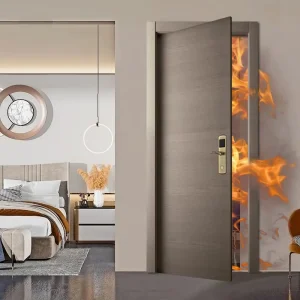
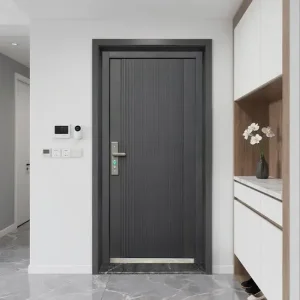
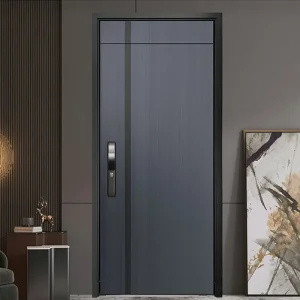
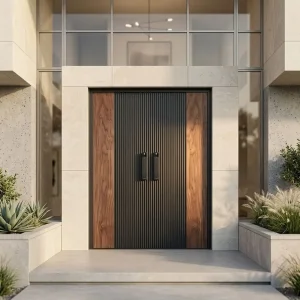
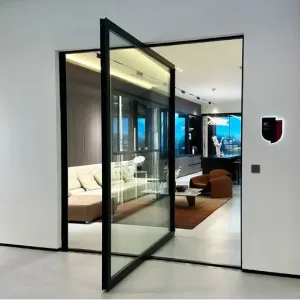
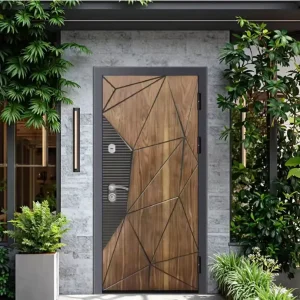
Explore our complete range of architectural entry solutions, including modern security steel, minimalist pivot, wrought iron hybrid, and interior apartment door systems.
Request comprehensive CAD shop drawings, factory-direct wholesale pricing, structural test reports, or custom sample doors for your upcoming residential or commercial development project.
