Explore our precision-engineered entrance solutions, designed for high wind load resistance, thermal breaks, and structural safety compliant with EN 12150 and ASTM C1048 standards.
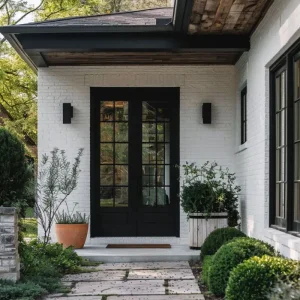
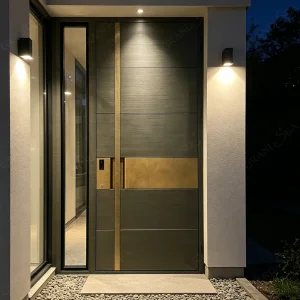
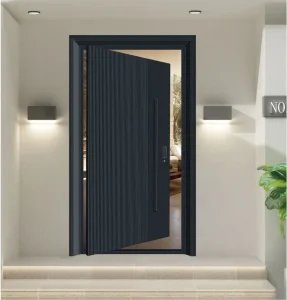
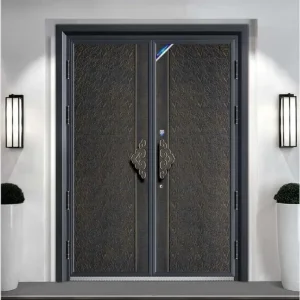
The architectural entrance landscape has experienced a fundamental shift from simple spatial demarcation to complex envelope engineering. Modern commercial developments and luxury residential estates demand high-performance fenestration systems capable of mitigating extreme microclimates while serving as statement design elements.
The acceleration of global carbon-neutral building mandates (such as the EU Energy Performance of Buildings Directive and US Title 24) has rendered single-pane toughened glass obsolete for exterior envelopes. Double tempered glass units (IGUs) incorporating soft-coat Low-E (Low Emissivity) multi-layer silver coatings and argon gas fills have become the global standard, achieving U-factors below 0.20 Btu/h·ft²·°F (1.1 W/m²K).
Modern architectural intent demands seamless indoor-outdoor visual continuity. Advanced double tempered glass door factories now engineer structural glass leaves exceeding 3.5 meters in height and 2.0 meters in width per sash. Utilizing high-tensile 6063-T6 or 6065-T6 aluminum profile sub-frames, these doors withstand heavy dead loads and continuous cycling without structural deflection.
Nickel Sulfide (NiS) inclusions represent a critical failure point in standard tempered glass. Industry-leading factories now execute mandatory Heat Soak Testing (HST) in accordance with EN 14179-1 standards. By exposing toughened panes to controlled 290°C thermal cycles for minimum 2-hour holding phases, non-destructive phase transformation forces defective panes to fail in-factory rather than post-installation.
B2B procurement directors, real estate developers, and facade consultants face complex multi-jurisdictional compliance challenges. Sourcing custom double tempered glass doors requires strict alignment with structural engineering, acoustic isolation, and life-safety metrics.
| Performance Index | Standard Commercial Grade | DERCHI Custom Double Tempered Benchmark | International Testing Standard |
|---|---|---|---|
| Glass Tempering Stress | 69–90 MPa (Surface Compression) | > 110 MPa (Fully Tempered Safety Glass) | ASTM C1048 / EN 12150-1 |
| Thermal Transmittance (U-Value) | 2.8 – 3.4 W/(m²·K) | 1.2 – 1.6 W/(m²·K) (Warm-Edge + Argon fill) | NFRC 100 / EN ISO 10077-1 |
| Acoustic Reduction Rating | 28 – 32 dB (Rw) | 38 – 44 dB (Asymmetric Glass Thickness) | ISO 717-1 / ASTM E413 |
| Design Wind Load Pressure | 1200 – 1800 Pa | Up to 4500 Pa (AS2047 N6 / Hurricane Impact) | ASTM E330 / AS 4040 |
| Hardware Cycle Durability | 50,000 Cycles | 500,000+ Cycles (Heavy Duty German Hardware) | EN 1191 / ANSI/BHMA A156.1 |
Commercial real estate developers in hurricane-prone zones (such as Florida, Australia's East Coast, and Southeast Asia) require double tempered glass configurations integrated with SentryGlas® (SGP) or PVB interlayers. Dual toughened panes combined with structural laminates prevent breach during windborne debris impact events exceeding 50 m/s wind speeds.
In extreme climate conditions—where external ambient temperatures reach 45°C while indoor spaces maintain 20°C air conditioning—standard aluminum spacer bars create severe thermal bridges. High-spec procurement requires stainless steel or thermoplastic warm-edge spacers (TPS) sealed with dual-component structural silicone to prevent condensation and perimeter seal failure.
The production of world-class custom double tempered glass doors requires a tightly integrated manufacturing cluster. China's Foshan architectural hardware and glass industrial ecosystem offers unprecedented cost-to-performance optimizations, vertical manufacturing control, and schedule reliability.
Equipped with continuous convection tempering furnaces from Glaston, raw float glass sheets undergo precise thermal treatment. Automated optical sensors monitor surface planeness and roller wave distortion (maintaining optical distortion below 0.05mm), ensuring crystal-clear clarity across large format double glazed panels.
Automated insulated glass manufacturing lines complete edge deletion, washing with deionized water, warm-edge spacer bending, automated gas flushing (achieving 90%+ argon concentration), and secondary robotic application of polysulfide or structural silicone seals in a continuous clean-room environment.
By operating internal aluminum extrusion mills, anodizing tanks, and PVDF coating lines, DERCHI eliminates sub-tier lead times. Precision 5-axis CNC machining centers route hinge mounting pockets, multi-point lock mortises, and drainage paths directly from digital CAD models with micro-level accuracy.
Custom double tempered glass door assemblies fulfill diverse architectural mandates depending on geographic location, structural loads, and building typology.
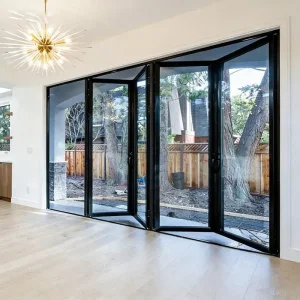
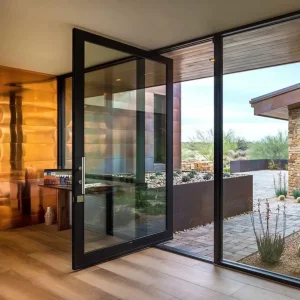
Large-format double tempered glass pivot doors and multi-slide patio systems open modern residential spaces to ambient light while maintaining low U-values. Integrated concealable hardware, heavy-duty hydraulic floor springs (supporting sashes up to 500 kg), and flush threshold tracks ensure seamless architectural transition without tripping hazards.
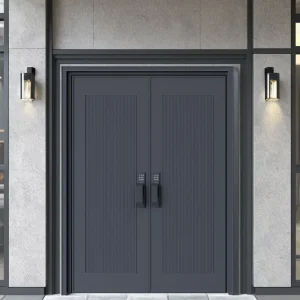
High-traffic commercial entrances require rapid opening speeds combined with exceptional structural rigidity. Double tempered glazed swing doors equipped with access control integration (biometric, card reader, or smart building automation) withstand continuous daily duty cycles while isolating interior lobbies from traffic noise and street heat.
For coastal developments exposed to salt spray and high wind speeds, marine-grade anodized profiles (25-micron coating) combined with double tempered laminated safety glass assemblies resist atmospheric corrosion, water penetration (tested to 600 Pa static water pressure), and cycling wind pressures.
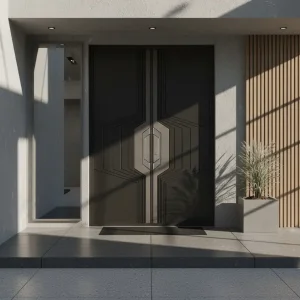
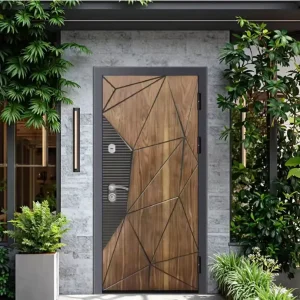
Discover our broader export portfolio featuring hurricane-impact pivot doors, bi-fold patio systems, fire-rated assemblies, and luxury security gates crafted in our Foshan production facility.
Authoritative answers directly from our senior facade engineers regarding standards compliance, manufacturing capabilities, glass science, and international logistics.
Fully tempered glass undergoes rapid air-quenching cooling, creating a surface compression stress of at least 69 MPa (10,000 psi) up to over 110 MPa. This causes the glass to break into small, blunt cubic fragments (safety glass per EN 12150). Heat-strengthened glass has a lower compression stress (24 to 52 MPa), breaking into larger fragments from edge to edge; it is not classified as safety glazing but offers higher resistance to thermal stress cracking than annealed glass. DERCHI double tempered doors utilize fully toughened safety glass sashes as standard.
Our custom entrance doors undergo comprehensive physical testing in certified third-party laboratories (NATA accredited in Australia and NFRC certified in North America). Testing protocols cover air infiltration (AS 4420.2 / ASTM E283), water penetration under static and cyclic pressure (AS 4420.3 / ASTM E331), ultimate strength wind load (AS 4420.6 / ASTM E330), and total solar heat gain coefficient (SHGC) and U-factor calculations via WINDOW/THERM software modeling.
For custom project inquiries, sample units and mock-up sashes are produced within 12–15 business days following CAD shop drawing approval. Full containerized bulk production orders typical require 25–35 calendar days. We support flexible MOQs for project-based architectural orders while providing dedicated container consolidation and fumigated solid-plywood crating.
Unlike fixed windows, entrance doors experience dynamic physical impact, torsional stress, and vibrational forces every time they are operated. Standard organic sealant bonds degrade under continuous operational shear and UV exposure. DERCHI utilizes two-component silicone structural sealants (such as Dow Corning DC 983) that form high-modulus chemical bonds between glass panes and aluminum profile channels, maintaining seal integrity for over 25 years.
Ocean transit subjects sealed container shipments to severe relative humidity fluctuations and atmospheric pressure cycles (causing expansion and contraction of IGU cavity gases). We integrate precise molecular sieve desiccant matrices inside warm-edge spacer profiles to absorb internal moisture, and package sashes with vapor-barrier protective films, corner foam bumpers, and reinforced steel-strapped wooden cases.
Access fully customized BIM/CAD details, structural engineering load calculations, and competitive OEM/ODM factory quotations for your upcoming project.
Contact Our Engineering Team