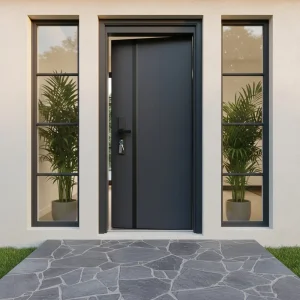
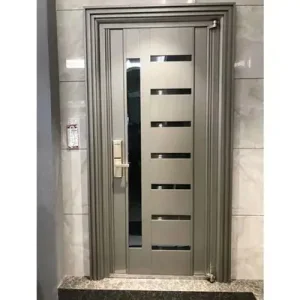
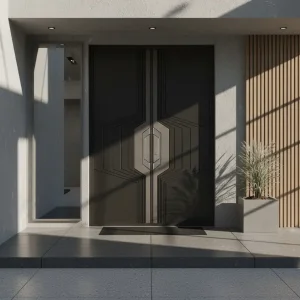
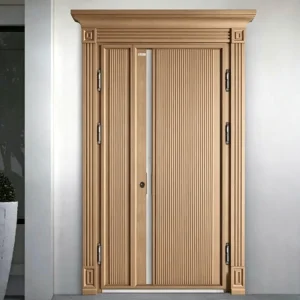
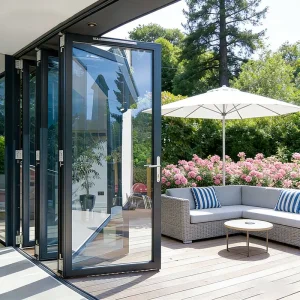
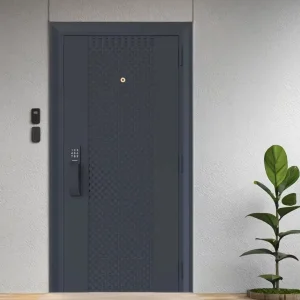
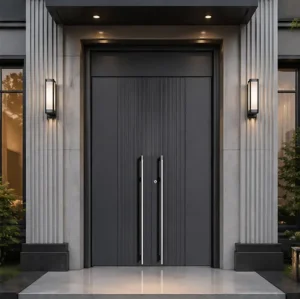
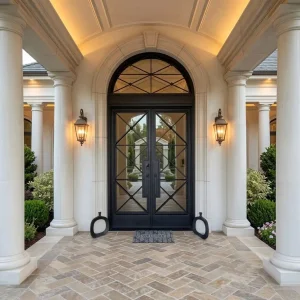
How architectural metallurgy, thermal break precision, and advanced physical security protocols converge to re-engineer modern perimeter access.
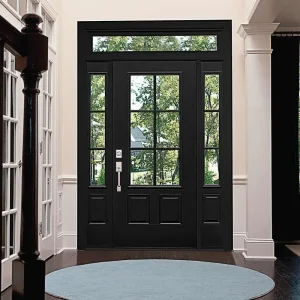
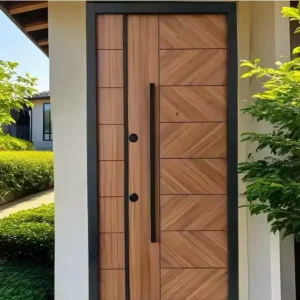
Modern architectural security demands high yield-strength alloys. Utilizing precision-extruded 6063-T6 and 6061-T6 aluminum, customized door frames deliver exceptional tensile strength exceeding 240 MPa. This structural rigidity resists mechanical forced entry while remaining lightweight enough to mitigate long-term hinge stress.
Industrial security door manufacturing incorporates multi-point hook locking systems, anti-drill manganese plates, and internal steel core reinforcements. Tested according to European Standards (EN 1627-1630 Class RC2 to RC4), these doors withstand attacks using heavy physical tools, crowbars, and powered drills.
Historically, aluminum was penalized for thermal conductivity. Today's custom security door manufacturers employ multi-cavity polyamide (PA66 GF25) thermal breaks and aerogel core infills, achieving overall assembly U-factors as low as 0.85 W/(m²·K), meeting Passive House certification benchmarks.
The global demand for high-end custom aluminum security entrance doors is experiencing a structural shift. Commercial developers, luxury residential builders, and municipal project managers no longer view doors as passive barrier components. Instead, they are evaluated as engineered envelope systems responsible for physical defense, acoustic dampening (up to STC 45), extreme climatic durability against hurricane-force winds (Florida HVHZ certified), and seamless integration into smart building automation setups.
Cross-regional requirements for heavy-duty entry systems, custom extrusion capability, and material performance metrics.
In the United States and Canada, architectural specifications prioritize High-Velocity Hurricane Zone (HVHZ) wind-load resistance alongside NFRC thermal performance compliance. Custom aluminum entrance doors destined for coastal regions like Florida, Texas, and the Eastern Seaboard must withstand cyclic wind pressures exceeding +/- 90 psf and severe missile impact tests (ASTM E1886/E1996).
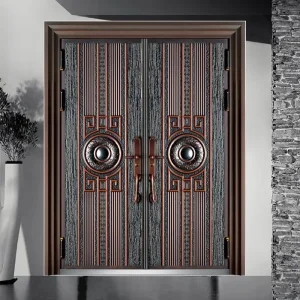
European developments focus heavily on subtle design profiles paired with strict burglar resistance (EN 1627 RC3/RC4). Conversely, Middle Eastern luxury projects (GCC region) mandate massive cast aluminum pivot doors capable of handling extreme surface temperatures exceeding 70°C without panel warping, utilizing specialized Qualicoat Class 3 fluorocarbon (PVDF) powder coatings resistant to UV degradation and sandstorm abrasion.
Factory-applied surface treatments dictate the operational life of aluminum security doors in saline or high-pollution environments. Advanced OEM/ODM factories utilize automated pre-treatment chromate-free conversion lines followed by electrostatic spraying of AkzoNobel or PPG PVDF fluorocarbon coatings. This guarantees a coating thickness of 40–80 microns capable of enduring over 3,000 hours of neutral salt spray testing (ASTM B117) without micro-blistering or delamination.
Information Gain Matrix comparing customized security door core engineering platforms for commercial, industrial, and villa applications.
| Door Platform | Core Material & Profile | Security Level Rating | Thermal U-Value Range | Acoustic Insulation (STC) | Primary Application Scenario |
|---|---|---|---|---|---|
| Thermally Broken Extruded Aluminum | 6063-T6 Aluminum (2.5mm - 3.0mm profile) + 34mm PA66 Polyamide Strip | EN 1627 RC2 to RC3 / PAS 24 | 0.85 – 1.4 W/(m²·K) | 38 dB - 42 dB | Modern Luxury Villas, Eco-Residences, High-End Commercial Entrances |
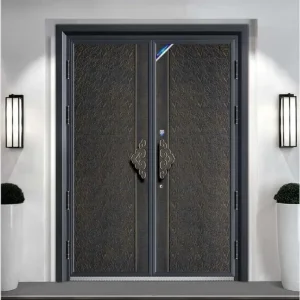
| Sand-Cast Heavy Aluminum Security Gate | Solid Cast Aluminum Panel (8mm - 15mm relief) + Steel Skeleton Frame | EN 1627 RC3 to RC4 / UL 752 Level 1 | 1.6 – 2.2 W/(m²·K) | 35 dB - 40 dB | Estate Main Gates, Classic Villa Porticos, Government Facilities |
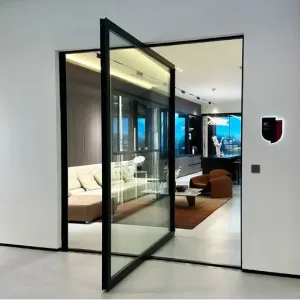
| Structural Laminated Glazing Pivot Door | Reinforced Perimeter Aluminum Profile + 12mm+1.52PVB+12mm Low-E Glass | ASTM F3038 Forced Entry / Bullet Resistant | 1.1 – 1.6 W/(m²·K) | 40 dB - 45 dB | Commercial Hotel Lobbies, Architectural Showrooms, Executive Suites |
| Armored SUS316 / Stainless Steel Composite | SUS316 Outer Sheet (1.5mm-2.0mm) + Honeycomb Core + Steel Interlock | EN 1627 RC4 / UL 752 Level 3 (Ballistic) | 1.8 – 2.5 W/(m²·K) | 42 dB - 48 dB | Bank Vault Entrances, High-Risk Corporate Infrastructure, Data Centers |
Security is only as strong as the system's weakest hinge or lock point. Factory engineering incorporates German-made Siegenia, GU, or customized heavy-duty hydraulic floor pivots rated to carry oversized leaf weights up to 600 kg. Multi-point locking mechanisms feature hardened steel anti-saw bolts with dynamic deadlocking latches.
Manufacturing facilities employ 5-axis CNC machining centers to process lock mortises, hinge pockets, and rainwater drainage channels with tolerances within ±0.1mm. Frame corners are corner-cleated, injected with two-component polyurethane structural adhesive, and seamlessly welded to mitigate frame distortion under heavy cycling.
Navigating complex international building codes, structural engineering calculations, and localized logistics support.
To eliminate site fitting errors, in-house technical drafting teams produce complete AutoCAD shop drawings, Revit BIM models, and section details keyed directly to project architectural schedules. Structural deflection analysis (FEA) reports are available for high-load pivot assemblies.
Products undergo rigorous third-party testing by accredited labs (Intertek, SGS, TUV). Testing protocols certify compliance with AS2047 (Australian Windows and External Doors standard for air infiltration, water penetration, and ultimate strength), CE marking under EN 14351-1, and ISO 9001 quality management standards.
Export door systems are packaged to survive international sea freight transit. Door leaves are wrapped in protective PE film, shielded with EPE foam corner guards, sealed inside multi-layer corrugated cartons, and crated in fully enclosed, fumigation-free plywood crates equipped with shock sensors.
Engineered entrance solutions customized for distinct architectural topographies and security profiles.
Requirement: Dramatic grand entrance aesthetic, privacy, silent hardware operation, integration with biometric smart home access control.
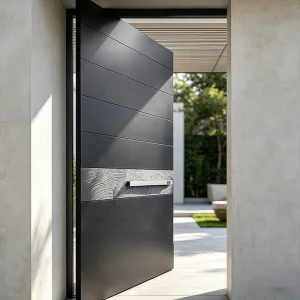
Solution: Extra-large aluminum pivot doors featuring natural timber composite cladding, motorized multi-point electronic locks (Kaba/Somfy compatible), fingerprint and facial recognition access, and concealed soft-close hydraulic dampers.
Requirement: High-traffic cycle durability (tested to 500,000 open/close cycles), high daylighting transmittivity, panic hardware compliance (EN 179/EN 1125).
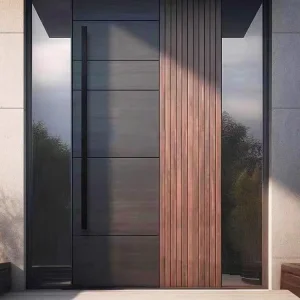
Solution: Heavy-duty narrow-stile aluminum glass doors equipped with structural silicone-glazed Low-E insulated glass, floor spring pivots, auto-drop acoustic bottom seals, and electromagnetic hold-open integration.
Requirement: Extreme wind-pressure resistance, salt spray anti-corrosion, watertight performance against driving rain.
Solution: Thermally broken aluminum door profiles with triple-gasket EPDM continuous weather seals, marine-grade SUS316 hardware components, PVDF 3-coat paint finishes, and hurricane impact-laminated glass build-ups.
Requirement: Ballistic protection, anti-pry frame construction, blast mitigation, access control auditing.
Solution: Cast aluminum and heavy gauge steel composite door assemblies with UL 752 Level 3 bullet-resistant inserts, magnetic shear locks (1200 kg holding force), and interlocking mantrap portal configurations.
How continuous R&D is transforming security doors into intelligent, sustainable structural envelope systems.
Integration of fully concealed mechatronic lock drives within aluminum stiles, allowing remote cryptographic authentication, real-time gasket pressure monitoring, and AI predictive maintenance alerts for high-frequency commercial entries.
Transitioning raw material procurement to certified low-carbon primary aluminum produced using hydroelectric power. Utilizing up to 75% post-consumer recycled aluminum alloys to significantly reduce embodied carbon (kg CO2/kg Al) for LEED Gold and BREEAM Outstanding projects.
Development of self-healing nano-ceramic powder coatings that repair micro-scratches via ambient sunlight exposure, combined with hydrophobic surface treatments that reduce maintenance cycles in harsh urban and industrial environments.
Engineering clarification on security door specifications, manufacturing lead times, and structural installation.
Aluminum security doors engineered with 6063-T6 structural alloys offer superior strength-to-weight ratios compared to standard steel doors, making oversized configurations (like giant pivot doors) smoother to operate without excessive hinge wear. Additionally, aluminum naturally forms a protective oxide layer, eliminating internal rust issues common in steel doors exposed to coastal moisture, while advanced thermal breaks deliver much lower U-values.
Standard custom manufacturing supports single pivot door leaves up to 2,000mm in width and 4,000mm in height. Engineered with reinforced steel-core sub-assemblies and floor pivot systems rated for up to 600 kg load capacity, these oversized leaves maintain perfect axial alignment, low operating force (< 20 N), and zero long-term deflection.
Factory production packages include complete certified test reports: ISO 9001 Quality Management System compliance, CE marking according to EN 14351-1, AS2047 structural wind/water penetration certificates for Australia, NFRC thermal ratings for North America, and EN 1627 RC3/RC4 forced-entry resistance reports.
Sample production and custom die-tooling take approximately 14 to 20 days. Full project manufacturing requires 25 to 35 days following CAD shop drawing sign-off and finish selection (powder coating, PVDF, or wood-grain transfer). Freight transit times vary depending on the destination port (15–30 days).
Lock housings and cylinder channels are precision-milled using 5-axis CNC machinery directly into the internal aluminum structural ribs. Steel hook deadbolts extend deep into reinforced frame strike plates at top, center, and bottom positions, resisting up to 10 kN of side-load force.