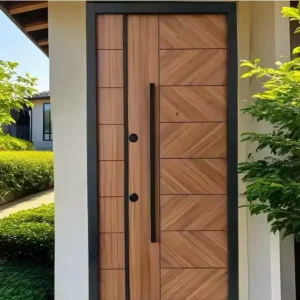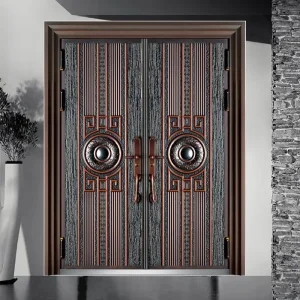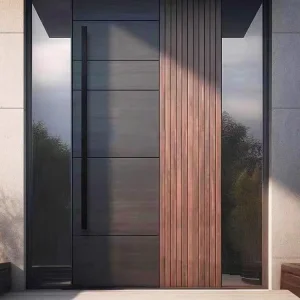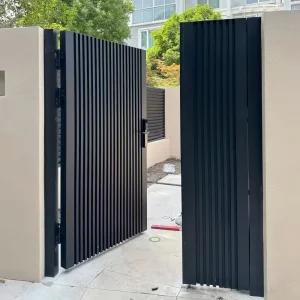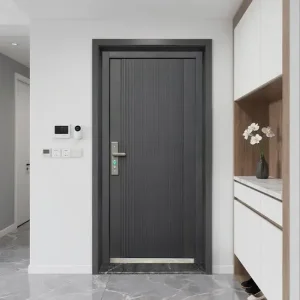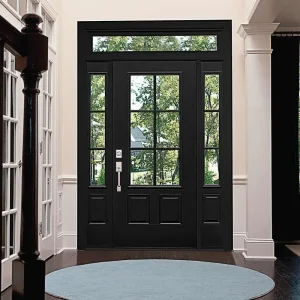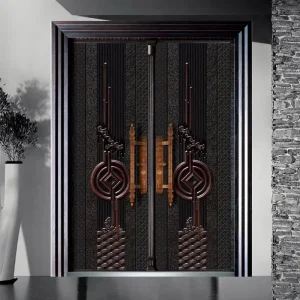
Explore our precision-engineered armored doors, bulletproof assemblies, cast aluminum main gates, and thermally broken entrance systems manufactured to international standards.
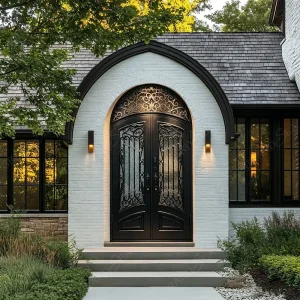
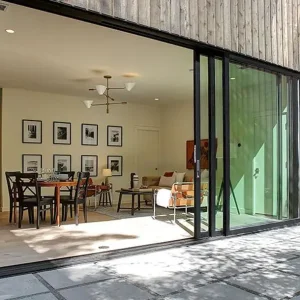
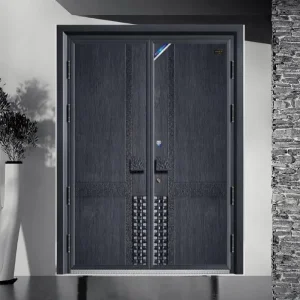
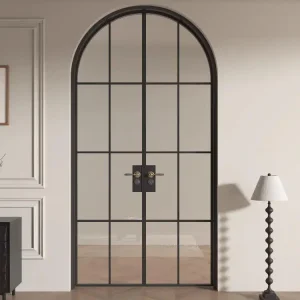
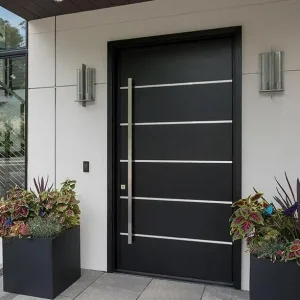
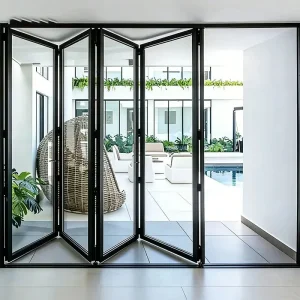
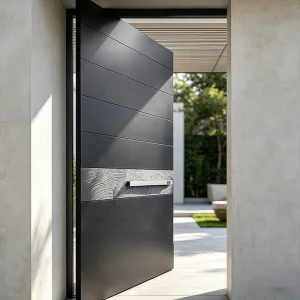
In modern international architecture, entry doors are no longer simple functional barriers; they are the critical intersection of structural engineering, building envelope energy performance, physical threat mitigation, and aesthetic branding. Traditional mild steel or timber security doors struggle with long-term structural warping, oxidation under coastal salt fog, and poor thermal isolation. Leading developers, general contractors, and architectural specifiers increasingly rely on premier China stainless steel security door manufacturers and suppliers to deliver multi-layered security engineering crafted from premium AISI 304, 316, and 316L stainless steel alloys.
Leveraging cold-rolled SUS304/SUS316 alloys with tensile strengths exceeding 520 MPa. Engineered to resist mechanical prying, dynamic impacts, and forced intrusion under EN 1627 RC3 to RC5 ratings.
Incorporating multi-chamber polyamide PA66 thermal breaks and high-density aerogel core insulation to achieve thermal U-values as low as 1.2 W/(m²·K) and STC ratings up to 46 dB.
Physical Vapor Deposition (PVD) titanium ion sputtering provides anti-fingerprint, UV-stable, and 3000-hour salt spray tested corrosion barriers ideal for coastal, humid, and desert climates.
While standard commercial security doors rely on superficial powder-coated zinc plates, DERCHI’s advanced stainless steel entrance manufacturing integrates structural reinforcement grids, anti-drill manganese steel lock armor plates, motorized multi-point deadbolts (rated for 2,000 kg shear force), and continuous heavy-duty concealed 3D adjustable hinges capable of supporting door leaf weights up to 600 kg without sag or misalignment over a 25-year service life.
Pioneering tomorrow's security infrastructure through smart IoT integration, advanced thermal isolation alloys, ballistic composite matrices, and sustainable nanotech finishes.
The era of manual physical keys is rapidly giving way to embedded cyber-physical access ecosystems. Future-ready stainless steel entrance doors incorporate zero-visible-hardware geometry featuring:
Historically, steel’s high thermal conductivity created cold bridges that resulted in condensation, frosting, and thermal loss in cold climates. Our next-generation design roadmap includes:
Addressing expanding global demand for high-threat defensive infrastructure without sacrificing architectural elegance or excessive weight:
Advancing surface durability while eliminating hazardous liquid chemical electroplating residues through modern green manufacturing:
How Foshan’s integrated industrial ecosystem enables DERCHI to deliver precision custom stainless steel security doors at scale with unmatched lead-time reliability and cost efficiency.
China’s advanced manufacturing transformation has repositioned top-tier door factories from high-volume assemblers into high-precision technology powerhouses. Operating out of a state-of-the-art 180,000 square meter production campus in Foshan, DERCHI utilizes automated CNC fiber laser cutting, 5-axis robotic seam welding, and fully enclosed PVD coating lines. By eliminating manual error and sub-tier outsourcing, we maintain strict dimensional tolerances within ±0.5 mm on door leaves exceeding 4 meters in height.
Ultra-high-power fiber laser systems cut complex lock cutouts, hinge mortises, and custom decorative panels directly from CAD drawings with zero heat-affected warping and smooth edge finishes requiring no manual grinding.
Automated 6-axis robotic arms ensure continuous, deep-penetration weld seams along door frame corners and structural stiles, eliminating micro-gaps, thermal distortion, and structural stress points.
From inserting high-density rockwool and fireproof cores to setting laminated hurricane-impact safety glass, our single-roof production process guarantees 100% quality traceability from raw mill sheet to final packing.
Customized architectural door engineering tailored to the specific regulatory, physical security, and environmental demands of diverse building typologies.
High-end homeowners demand monumental visual impact combined with uncompromised family protection. Our villa entry solutions deliver:
Commercial developments require continuous heavy-cycle operation, fast access integration, and forced-entry deterrence:
Standard steel doors deteriorate rapidly under tropical ocean winds and airborne salt mist. DERCHI’s specialized coastal build-up includes:
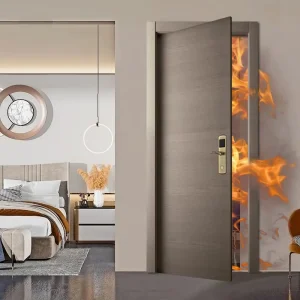
Data centers, government buildings, and utility hubs require certified fire barriers combined with high security:
Use this factory benchmark matrix to evaluate physical properties, security ratings, and environmental performance across key stainless steel door platforms.
| Performance Parameter | SUS304 Standard Commercial | SUS316 Coastal / Marine | Armored Ballistic Series | Thermal Break Stainless |
|---|---|---|---|---|
| Alloy Composition | AISI 304 (18% Cr / 8% Ni) | AISI 316 (16% Cr / 10% Ni / 2% Mo) | Reinforced Armored Steel + SUS skin | SUS304 / SUS316 with PA66 Break |
| Sheet Thickness Range | 1.2 mm – 1.5 mm skin | 1.5 mm – 2.0 mm skin | 2.0 mm skin + 4.0mm armor plate | 1.5 mm skin + Structural thermal break |
| Forced Entry Security Grade | EN 1627 RC2 / RC3 | EN 1627 RC3 / RC4 | EN 1627 RC4 / RC5 / Ballistic Level 3-8 | EN 1627 RC3 |
| Thermal U-Value W/(m²·K) | 2.2 – 2.8 W/(m²·K) | 2.0 – 2.5 W/(m²·K) | 1.8 – 2.4 W/(m²·K) | 0.8 – 1.4 W/(m²·K) |
| Acoustic Sound Reduction (STC) | 35 dB – 38 dB | 38 dB – 42 dB | 42 dB – 48 dB | 38 dB – 44 dB |
| Salt Spray Corrosion Test | 1,000 Hours (ASTM B117) | 3,000+ Hours (ASTM B117) | 1,500 Hours (ASTM B117) | 2,000 Hours (ASTM B117) |
| Recommended Applications | Urban Residential & Office | Coastal Resorts & Beach Villas | Banks, Embassies & Safe Rooms | Cold Climate Eco-Villas & Net-Zero |
When requesting quotations from China stainless steel door suppliers, ensure your technical bid package includes:
Navigating international building codes and cross-border transport with factory-direct technical assistance and ultra-rugged ocean export packaging.
Our dedicated engineering office generates full 2D CAD shop drawings, section details, anchoring schedules, and Revit BIM blocks within 48 hours of drawing submission, ensuring 100% design sign-off accuracy before cutting metal.
DERCHI door assemblies hold verified certification packages including ISO 9001:2015 quality control management, CE marking for European safety compliance, AS2047 N6 certification for Australian wind/water tightness, and UL fire labels.
Each door leaf is wrapped in peelable protective film, corner-guarded with high-density EPE foam, sealed in moisture-vapor barriers, and secured inside fumigation-free, steel-banded plywood crates. Transit damage rates are kept below 0.2% worldwide.
Answers to key technical questions frequently raised by architects, facade consultants, general contractors, and global door importers.
The primary metallurgical difference lies in the addition of 2% to 3% Molybdenum (Mo) in SUS316 stainless steel, which significantly improves resistance to localized chloride pitting and crevice corrosion compared to standard SUS304 (18% Chromium / 8% Nickel). While SUS304 is ideal for inland urban residential and commercial installations, SUS316 or SUS316L is strongly recommended for coastal resorts, beachside villas, and marine environments exposed to salt fog spray within 5 km of the ocean coastline.
Top-tier manufacturers like DERCHI utilize thermal break profile technology. We structurally isolate the interior and exterior stainless steel profiles using high-strength polyamide PA66 GF25 (25% glass-fiber reinforced) thermal strips. Combined with non-conductive internal cavity cores (such as hydrophobic rockwool or aerogel sheets) and triple-gasket perimeter weather seals, thermal break stainless doors achieve total U-values between 0.8 and 1.4 W/(m²·K), preventing surface condensation, frosting, and interior heat loss during harsh winters.
Our engineered security door assemblies can be configured to meet European forced-entry resistance classes EN 1627 RC2, RC3, RC4, up to RC5 for specialized bank vaults and panic rooms. For anti-ballistic and high-threat requirements, internal armor plates can be integrated to satisfy UL 752 Level 1 through Level 8 handgun and high-power rifle bullet resistance standards, complete with third-party laboratory test certification.
For oversized architectural pivot doors (e.g., 1.5m to 2.0m wide by 3.0m to 4.5m high), standard butt hinges are inadequate. We incorporate heavy-duty floor-recessed stainless steel pivot hardware rated to support 500 kg to 800 kg leaf weights. The internal door leaf features continuous internal steel tensioning rods (anti-deflection tensioners) that allow fine-tuning of leaf straightness over time, preventing bowing caused by seasonal thermal expansion differentials between indoor and outdoor surfaces.
The standard lead time for custom engineering orders is 15-20 days for sample/mockup units and 25-35 days for full container project volumes following CAD shop drawing approval and deposit receipt. We do not enforce rigid minimum order quantities (MOQ)—single-unit sample orders are accepted for prototype review. All shipments are packed in heavy-duty, fumigation-free, steel-reinforced plywood crates with clear opening tags to enable rapid sorting on site.
Yes. Our engineering shop pre-wires internal door stiles with flexible electrical wire-conduit channels and power-transfer electric hinges. This allows seamless plug-and-play integration with any third-party commercial control hardware, including smart building automation systems, motorized concealed multi-point locksets, fingerprint access pads, keycard sensors, and facial recognition cameras from brands like Dormakaba, Salto, HID, or custom BMS networks.
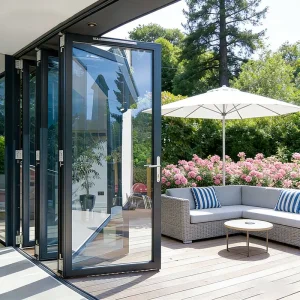
Explore additional certified entry systems including noise reduction Turkish steel doors, energy-saving aluminum bi-fold patio systems, villa courtyard gates, and custom wood-sidelight entry combinations.