An authoritative evaluation of material science, mechanical durability, and ergonomic integration in contemporary entrance door handle systems manufactured in China.
In contemporary architectural design, the entry hardware serves as the primary physical tactile touchpoint between human users and structural spaces. A Modern Front Door Knob is no longer merely a mechanical latching instrument; it is an engineered component of building security, environmental isolation, and aesthetic synergy. For global architects, procurement directors, and master builders sourcing from China, understanding the underlying metallurgical standards, surface engineering technologies, and lock-body kinematics is crucial for ensuring project longevity and code compliance.
China's door hardware and entrance system manufacturing sector—headquartered in industrial centers such as Foshan, Guangdong—has undergone a massive technological shift from OEM volume production to high-precision engineering aligned with international standards such as ANSI/BHMA Grade 1, CE EN 1906, and ISO 9001. Leading Chinese manufacturers leverage state-of-the-art multi-axis CNC machining, pressure die-casting, and robotic PVD (Physical Vapor Deposition) coating lines to produce front door knobs and handle sets capable of surviving extreme atmospheric conditions, heavy mechanical cycle loads, and severe security threats.
When specifying door hardware for luxury villas, commercial lobbies, or multi-family residential developments, technical buyers must balance tribological performance (wear and friction resistance) with structural yield strength. Premium door knobs manufactured by top-tier suppliers like DERCHI utilize high-density solid forged brass, SUS316 marine-grade stainless steel, or aviation-grade 6063-T5 aluminum alloy substrates. These materials eliminate micro-porosity defects common in low-cost zinc die-castings, preventing structural fatigue and premature finish degradation over decades of continuous operation.
How industrial synergy, advanced metallurgy, and strict quality assurance make Chinese manufacturers the preferred global partners.
Located in the heart of Foshan's architectural hardware cluster, factories benefit from an end-to-end local supply chain spanning raw ingot casting, precision tooling, electroplating, and acoustic seal integration.
Utilizing high-speed 5-axis German CNC milling units, Chinese manufacturers hold mechanical tolerances within ±0.01mm, ensuring seamless spindle fitment and zero handle wobble.
Advanced Physical Vapor Deposition creates an atomic bond layer that offers superior hardness (over 2000 HV), preventing scratches, tarnish, UV discoloration, and coastal salt-air pitting.
By eliminating multi-tier distribution markups, global B2B buyers gain access to premium architectural grade door hardware at 35% to 50% lower unit costs without compromising certified quality.
Analyzing the convergence of biometric smart locking, antimicrobial surface treatments, and high-load pivot mechanics.
Modern entrance door knobs now seamlessly incorporate semiconductor capacitive fingerprint sensors, 3D facial recognition modules, and encrypted BLE/Zigbee communication protocols directly inside sleek metallic handles.
Incorporating internal dual-way heavy-duty spring cassettes and acoustic damper bushings, providing ultra-smooth rotary actuation, automatic return alignment, and zero latch rattle under wind pressure.
Infusing copper-ion and silver-titanium nanostructures into the PVD matrix effectively destroys 99.9% of surface bacteria and viruses, a essential specification for luxury hospitality and high-density commercial real estate.
| Hardware Material / Platform | Tensile Strength (MPa) | Corrosion Resistance (ASTM B117) | ANSI/BHMA Cycle Rating | Optimal Application Scenario |
|---|---|---|---|---|
| Solid Forged Brass (C37700) | ≥ 440 MPa | 200+ Hours Neutral Salt Spray | Grade 1 (1,000,000 Cycles) | Luxury Villa Main Gates, High-End Residential Outward Swing Doors |
| SUS316 Marine Stainless Steel | ≥ 620 MPa | 1,000+ Hours CASS Salt Spray | Grade 1 (1,200,000 Cycles) | Coastal Oceanfront Estates, High-Salinity Resorts, Chemical Processing Facilities |
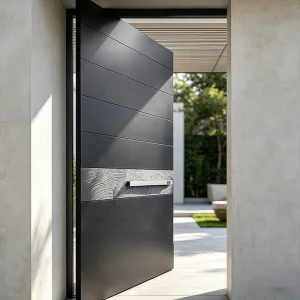
| Aviation Aluminum (6063-T5) | ≥ 230 MPa | 480+ Hours Acidified Salt Spray | Grade 2 (500,000 Cycles) | Minimalist Oversized Pivot Entrance Doors, Modern Thermally Broken Systems |
| High-Density Zinc Alloy (ZAMAK 3) | ≥ 280 MPa | 96 Hours Standard Salt Spray | Grade 3 (200,000 Cycles) | Interior Passage Doors, Budget Multi-Family Residential Projects |
Engineered door handle configurations designed to withstand diverse climate challenges and building function demands worldwide.
Oceanfront properties require hardware that resists salt mist oxidation. Utilizing passivated SUS316 stainless steel with multi-layer PVD finish guarantees zero pitting or color fading in aggressive marine environments.
For hotel entrances, office towers, and public institutions, door knobs must endure millions of operations. Fitted with heavy-duty mortise lock bodies and anti-panic exit features for maximum public safety.
In storm-prone regions (e.g., Florida, Caribbean, Southeast Asia), front door knobs must integrate with multi-point locking systems capable of holding lock pins securely under wind loads up to 3,000 Pa (AS2047 N6 rating).
Paired with thermally broken aluminum entry doors and drop-down acoustic bottom seals, engineered door handles maintain airtight compression against perimeter weather-stripping to eliminate energy loss.
A comprehensive roadmap for real estate developers, EPC contractors, and hardware importers sourcing door hardware from China.
Procuring door knobs and entry hardware internationally requires a robust Quality Assurance (QA) protocol to mitigate supply chain risks, dimensional discrepancies, and finish inconsistencies. Global buyers partnering with premium Chinese manufacturers should insist on a structured five-stage engineering audit process:
Raw metal ingots must undergo X-ray fluorescence (XRF) spectrometry to verify chemical composition, ensuring brass alloys contain no illegal lead traces and stainless steel meets exact SUS316 chromium-nickel ratios.
Coordinate Measuring Machines (CMM) audit critical dimensions—such as lock cylinder bore diameters, spindle squareness, and mounting hole centers—to guarantee zero site modification during installation.
Randomly selected batch samples undergo neutral and acidic salt spray testing (ASTM B117), thermal shock cycling (-40°C to +80°C), and UV exposure to simulate 20 years of real-world weathering.
Furthermore, logistically sound packaging protocols—such as individual anti-static film wrapping, high-density EPE foam cradling, and fumigated multi-layer plywood export crates—ensure hardware arrives at international project sites in pristine condition, ready for immediate installation.
Expert responses to critical engineering, manufacturing, and procurement inquiries from international clients.