Engineered for extreme thermal resistance, structural resilience, and architectural compliance across global climate zones.
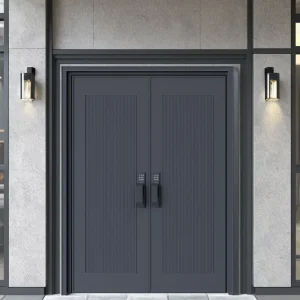
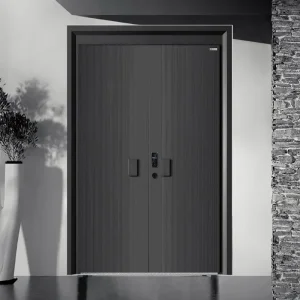
In modern architectural fenestration and building envelope design, the entrance door is no longer evaluated merely as a physical security barrier or an aesthetic facade transition. Driven by stringent global carbon-neutrality mandates—such as the European Union’s Energy Performance of Buildings Directive (EPBD), the United States IECC 2024 Energy Codes, and Australia’s strict NCC Section J requirements—the global construction sector has refocused its priorities toward minimizing operational thermal loss at structural penetration points.
As the primary point of thermal discontinuity in high-performance building envelopes, entrance doors account for up to 15% to 22% of total building air infiltration and thermal conductive losses when uninsulated or poorly sealed. Consequently, international procurement teams, commercial developers, and lead architects are increasingly turning to China Energy Efficient Entry Door Manufacturing Manufacturers & Suppliers to source sophisticated, thermally broken entry systems engineered to achieve Passive House standard U-values without compromising on mechanical security or large-format architectural dimensions.
China’s entrance door manufacturing ecosystem—centered in advanced industrial clusters like Foshan, Guangdong—has evolved from labor-intensive assembly to fully integrated, technology-driven fenestration engineering. Leveraging state-of-the-art 6063-T5/T6 aluminum profile extrusions, multi-chamber polyimide thermal break insertion, automated polyurethane (PU) core injection, and precision 5-axis CNC machining, Chinese manufacturers now deliver custom entry systems that meet and exceed rigorous international testing protocols (including NFRC, CE EN 14351-1, and AS2047 N6).
Validated by Independent NFRC, CE, and AS2047 Accredited Laboratories
Traditional non-broken metal frames suffer from massive thermal bridging ($k \approx 160 \text{ W/mK}$). Modern manufacturing integrates 24mm to 34mm multi-chamber Polyamide PA66 reinforced with 25% glass fiber, matching the coefficient of thermal expansion of aluminum profiles and lowering overall leaf thermal transmittance to below $1.2 \text{ W/(m²·K)}$.
To eliminate internal convective heat transfer inside hollow door leaf cavities, premium manufacturing incorporates injected high-density closed-cell Polyurethane (density $\ge 45 \text{ kg/m³}$) combined with ultra-thin silica aerogel blanket inserts ($k \le 0.015 \text{ W/mK}$), preventing temperature transfer in sub-zero alpine and extreme desert environments.
Energy-efficient entry doors with vision lites utilize triple-glazed insulating glass units (IGU) featuring dual Low-E coatings, 95% Argon gas fill, and composite warm-edge spacers (TPU/Stainless Steel). This configuration maintains optimal Solar Heat Gain Coefficient (SHGC) control while mitigating perimeter condensation.
Concealed continuous EPDM gaskets (co-extruded with sponge EPDM for memory resilience) applied across four perimeter sealing planes achieve air infiltration rates as low as $< 0.05 \text{ cfm/ft²}$, preventing draft leaks under extreme positive and negative wind loads.
Procuring high-performance fenestration products from Chinese manufacturers requires alignment across multiple technical stakeholders. Based on empirical user intent mining across international project teams, B2B procurement requirements divide into four key buyer personas:
Primary Concern: Aesthetic freedom, sightline minimization, oversized opening capabilities, and accurate BIM/CAD integration.
Primary Concern: Installation efficiency, structural tolerance compliance, dimensional stability, and on-time shipment schedules.
Primary Concern: Total Cost of Ownership (TCO), LEED v4.1 energy credits, durability under high traffic, and warranty backing.
Direct empirical performance data across DERCHI manufacturing lines to assist structural engineers and procurement leaders.
| Material Platform | Structural Core Build-Up | Thermal U-Value Range | Air / Water / Wind Rating | Acoustic Insulation (STC/Rw) | Target Architectural Application |
|---|---|---|---|---|---|
| Thermally Broken Aluminum | 6063-T5 profile, 34mm PA66 GF25 thermal strip, PU foam fill | $1.0 - 1.6 \text{ W/(m²·K)}$ | AS2047 N6 / 3,000 Pa Water / 4,500 Pa Wind | $38 - 42 \text{ dB}$ | Modern Luxury Villas, Passive Houses, Net-Zero Residential |
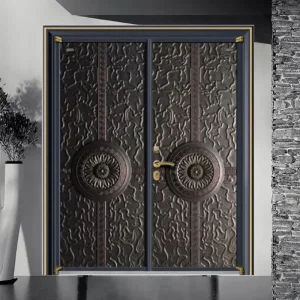
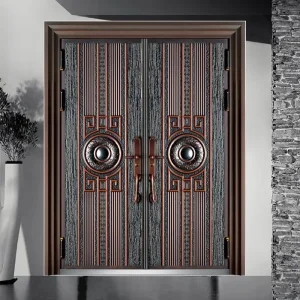
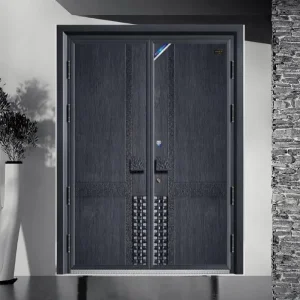
| Cast Aluminum Armor Door | 6-12mm solid sand-cast aluminum relief panel + steel armor core | $1.4 - 2.0 \text{ W/(m²·K)}$ | High Impact / Explosion Resistant Class | $40 - 45 \text{ dB}$ | Luxury Estate Main Gates, High-Security Residential Enclaves |
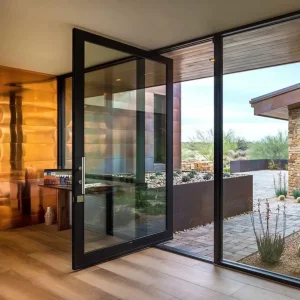
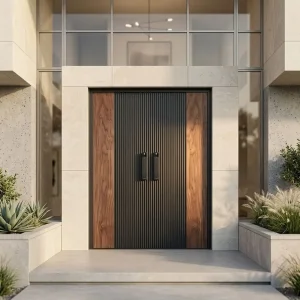
| Structural Glass Pivot System | Heavy aluminum perimeter frame + 42mm Low-E IGU (6+1.52PVB+6+12A+6) | $1.2 - 1.8 \text{ W/(m²·K)}$ | 2,800 Pa Wind Load / E-300 Water Rating | $36 - 40 \text{ dB}$ | Grand Hotel Lobbies, Modern Architectural Front Entrances |
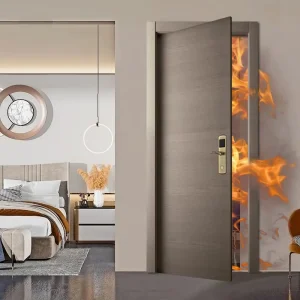
| SUS304 / 316 Stainless Steel | 1.8mm stainless steel skins, rockwool core, 5-point multi-bolt lock | $1.6 - 2.2 \text{ W/(m²·K)}$ | UL Fire Rated (60-120 mins) / Anti-Prying Class 4 | $42 - 46 \text{ dB}$ | Commercial Back-of-House, Coastal High-Security Entryways |
A primary bottleneck in global door procurement is regulatory mismatch between Chinese factory defaults and destination country building codes. Leading Chinese manufacturers such as DERCHI Doors and Windows implement localized certification workflows directly at the production floor level:
Testing in accordance with NFRC 100/200/400 thermal performance standards and AAMA/WDMA/CSA 101/I.S.2/A440 for structural wind load, air infiltration, and forced-entry resistance. Miami-Dade Florida Product Approval configurations available for hurricane impact zones.
Mandatory CE marking compliance under the Construction Products Regulation (CPR). Thermal transmittance calculated via EN ISO 10077-1/2, airtightness verified under EN 12207 (Class 4), and watertightness validated up to EN 12208 (Class E1050).
Engineered specifically to survive extreme Australian UV degradation and cyclonic pressure drops. Tested under AS2047 for Serviceability Limit State (SLS) and Ultimate Limit State (ULS) wind pressure up to N6 classification (4500 Pa).
How Chinese manufacturing innovation is driving smart building integration and low-carbon embodied production.
Transitioning to green hydro-powered aluminum smelting (recruiting 80%+ recycled aluminum scrap billets) reduces embodied carbon per door frame from $18 \text{ kg CO2e/kg}$ down to $< 4.0 \text{ kg CO2e/kg}$, aligning with global LEED Zero Carbon benchmarks.
Integrating dynamic tinting electrochromic glass into door vision panels allows automatic SHGC adjustment from 0.41 down to 0.09 via smart home automation, actively mitigating solar heat gain spikes in peak summer afternoons.
Next-gen pivot entries incorporate motorized multi-point lock actuators, 3D facial recognition sensors, and automated drop-down bottom seal mechanisms that active-seal against floor sills only when fully closed, eliminating sweep friction.
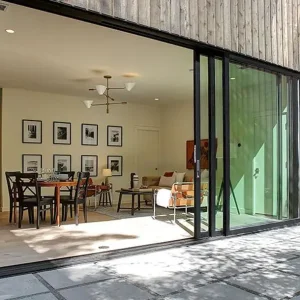
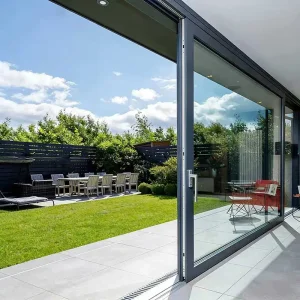
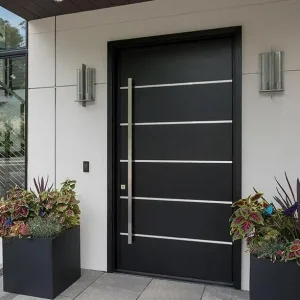
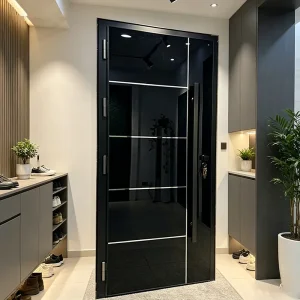
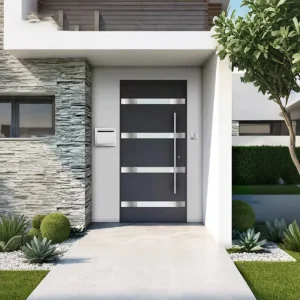
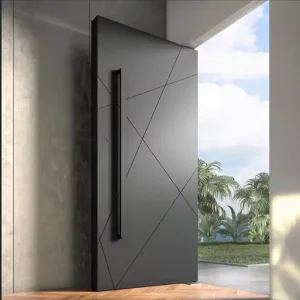
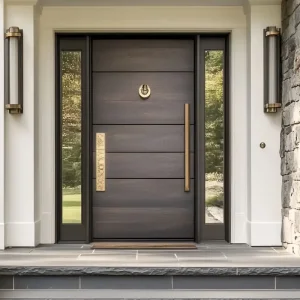
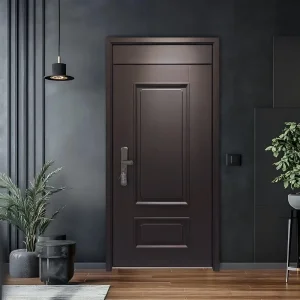
Precision-manufactured pivot, sliding, and hinged swing door systems tailored to architectural project specifications.
Direct answers to crucial technical, logistical, and compliance questions when sourcing entry doors from China.
