Explore precision-engineered exterior entry door assemblies manufactured under rigid ISO 9001, AS2047, and CE certified quality standards.
An authoritative analysis of structural fenestration trends, environmental mandates, and the shift toward heavy-duty architectural aluminum-glass main entry assemblies.
The global market for high-performance architectural entry doors is undergoing a seismic structural transition. Driven by stringent global energy compliance protocols (such as Europe’s EPBD directive and North America’s ASHRAE 90.1 standards), traditional timber and un-insulated steel doors are rapidly being phased out. Modern commercial and high-end residential real estate developments heavily prioritize extruded aluminum alloy frames paired with low-emissivity (Low-E) double or triple structural glazing.
China has established itself as the dominant global hub for aluminum fenestration manufacturing, accounting for over 45% of total structural aluminum extrusions worldwide. Chinese manufacturers have evolved beyond basic fabrication into advanced engineering partners capable of delivering customized, thermal-break entrance systems with integrated multi-point locking mechanisms and hurricane-impact ratings.
Environmental, Social, and Governance (ESG) mandates have elevated structural entry doors into key operational assets for achieving LEED Platinum and BREEAM certifications. Architectural aluminum offers an unparalleled circular economy profile—over 75% of all aluminum ever produced remains in active use due to infinite recyclability without structural degradation.
Leading Chinese manufacturers leverage prime 6063-T5 and 6060-T66 aluminum extrusions treated with low-VOC PVDF (Polyvinylidene Fluoride) coatings and non-toxic powder coats. The thermal performance of integrated polyamide structural breaks (PA66 GF25) mitigates thermal bridging, driving structural door U-values down below 1.2 W/(m²·K).
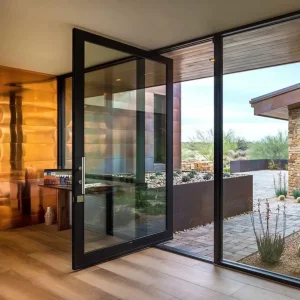
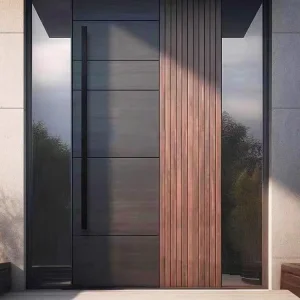
Modern architectural language emphasizes seamless indoor-outdoor transition, leading to unprecedented demand for single-leaf oversized pivot doors reaching up to 2,000 mm in width and 4,000 mm in height. Managing the deadweight (often exceeding 400 kg per panel) while guaranteeing effortless zero-resistance operation requires heavy-duty German-engineered hydraulic floor springs and internal steel matrix reinforcements.
Chinese OEM/ODM export facilities have specialized in solving these complex physical engineering challenges, delivering pre-tested, unitized entry door systems direct to global job sites with fully customized CAD shop drawings.
Technical specification parameters governing commercial entry door durability, thermal isolation, wind load deflection, and acoustic attenuation.
The structural backbone of high-tier Chinese entry doors relies on prime Grade 6063-T5 or 6060-T66 aluminum extrusions. Wall thickness ranges from 2.0 mm to 3.0 mm for heavy-duty structural frames. T6 heat treatment yields an ultimate tensile strength exceeding 205 MPa and yield strength over 170 MPa, preventing frame distortion under sustained dynamic wind loads.
Unbroken aluminum profile conducts energy quickly. To decouple interior thermal zones from exterior weather, manufacturers integrate 24 mm to 34 mm Polyamide 66 reinforced with 25% Glass Fiber (PA66 GF25). This composite strip matches the coefficient of thermal expansion of aluminum, preventing structural delamination during severe thermal cycling.
Architectural glass panels utilize double or triple insulated glass units (IGUs) incorporating SentryGlas® (SGP) or PVB laminated interlayers. Standard configurations feature Low-E coatings with Argon gas fill (90%+ concentration), offering visible light transmittance (VLT) up to 70% while reflecting over 85% of infrared thermal energy.
| Door System Platform | Extrusion Profile & Wall Thickness | Glazing Specification | Thermal Transmittance (U-Value) | Acoustic Rating (STC/Rw) | Structural Load Rating |
|---|---|---|---|---|---|
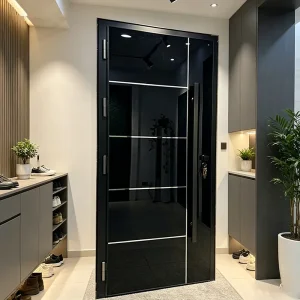
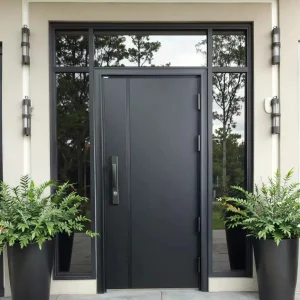
| Thermally Broken Pivot Door | 6063-T6 Aluminum / 3.0 mm Wall | 8mm Low-E + 12A + (6mm + 1.52SGP + 6mm) | 1.1 – 1.4 W/(m²·K) | STC 42 / Rw 41 dB | ASTM E330 4,500 Pa |
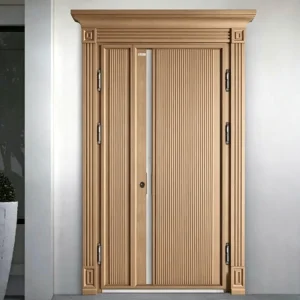
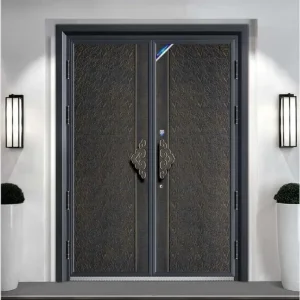
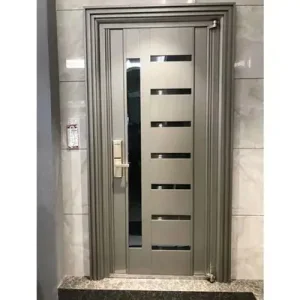
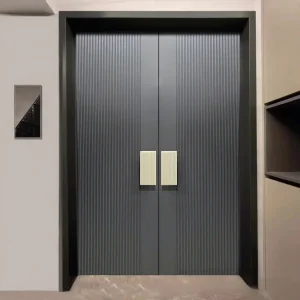
| Cast Aluminum Security Armour Entry | 6-12mm Cast Relief + 2.5mm Subframe | Bulletproof Laminated Triple IGU | 1.4 – 1.8 W/(m²·K) | STC 45 / Rw 44 dB | PAS 24 / EN 1627 RC3 |
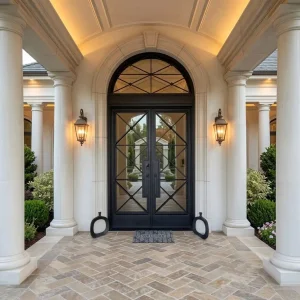
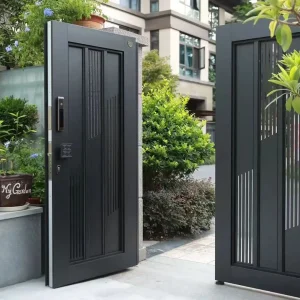
| Structural Glass Commercial Swing | 6060-T66 Ultra-Slim / 2.0 mm Wall | 6mm Low-E + 16Argon + 6mm Tempered | 1.3 – 1.6 W/(m²·K) | STC 38 / Rw 37 dB | AS2047 N6 Rating |
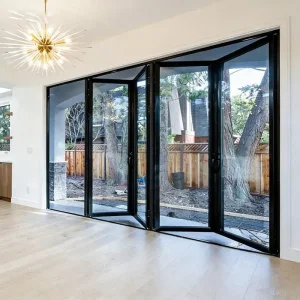
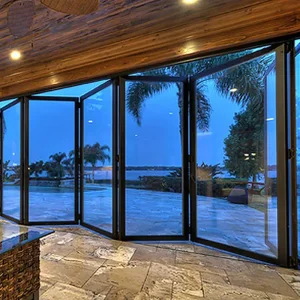
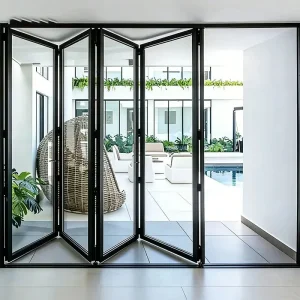
| Heavy-Duty Bi-Fold Entrance | 6063-T5 Multi-Chamber / 2.2 mm Wall | 6mm + 12A + 6mm Double Tempered | 1.5 – 1.9 W/(m²·K) | STC 36 / Rw 35 dB | NFRC / Florida HVHZ |
Deploying custom Chinese aluminum entry doors across distinct global climatic zones requires precise structural adaptation to pass regional building authority inspections.
Primary Compliance: NFRC Certification, Florida HVHZ (High-Velocity Hurricane Zone), California Title 24.
Projects in coastal Florida or Texas demand missile-impact resistant glass (SGP interlayers) capable of surviving wind speeds exceeding 170 mph. Frame extrusions must incorporate reinforced structural steel tubes inside the aluminum chambers and double EPDM gasket seals to withstand cyclic wind pressure tests (ASTM E1886/E1996).
Primary Compliance: CE Marking, EN 14351-1, UKCA, German Passive House Standards.
European design intent favors ultra-minimalist sightlines combined with aggressive thermal insulation targets (Uw ≤ 0.8 W/(m²·K)). Systems utilize multi-chambered polyamide breaks infused with aerogel insulation foam, coupled with continuous perimeter compression gaskets and European multi-point lock systems (e.g., GU, Winkhaus, or HOPPE).
Primary Compliance: AS2047 (Windows & Doors in Buildings), AS1288 Glazing Code, BAL-40 Bushfire rating.
The Australian climate demands exceptional UV resistance and strict water penetration thresholds under cyclonic wind conditions (AS2047 N6 rating). Surface coatings must undergo 3,000-hour salt spray testing (Qualicoat Class 2 anodizing or PVDF), while seals require high-grade silicone weatherstripping resistant to extreme temperature fluctuations.
Primary Compliance: Dubai Municipality Standards, Civil Defense Fire-Rated Directives.
In hot, arid climates like Saudi Arabia or the UAE, exterior aluminum surfaces can reach temperatures over 80°C. Entry doors require specialized thermal expansion joints to prevent profile bowing, along with dust-proof IP65 perimeter sealing brush combinations to block micro-sand ingress into hydraulic pivot bearings.
Emerging technical paradigms redefining intelligent entrance solutions, dynamic solar management, and sustainable manufacturing.
Integration of Vacuum Insulated Glass (VIG) technology into standard door panels. VIG replaces gas-filled cavities with a 0.2 mm vacuum gap, achieving center-of-glass U-values of 0.4 W/(m²·K) in a slim profile. Concurrently, Building-Integrated Photovoltaics (BIPV) embedded within semi-transparent door glass yield autonomous power generation for onboard electronics.
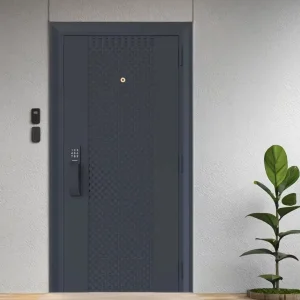
Smart entry doors evolving into interactive home automation hubs. Neural-network-powered 3D facial recognition, biometric palm-vein scanners, and automated motor-driven pivot actuators interface directly with building management systems (BMS). Integrated IoT sensors monitor seal compression loss and frame stress in real time.
Widespread adoption of 80%+ post-consumer recycled aluminum billets extruded using 100% renewable hydroelectric power. Glass units will feature solid-state electrochromic dynamic tinting, adjusting light VLT and solar heat gain coefficient (SHGC) dynamically based on real-time solar intensity data.
Bridging the architectural design gap with end-to-end engineering support, BIM integration, and rapid OEM/ODM customization protocols.
Leading Chinese entry door manufacturers offer full Building Information Modeling (BIM) object libraries in .RFA and .IFC formats. Architects can drop highly accurate structural door models—complete with thermal expansion parameters, glass U-values, structural load vectors, and hardware clearance profiles—directly into architectural plans.
Before production commences, factory engineers issue comprehensive 2D CAD cross-section detailing, anchorage calculations, and wind load deflection simulations. For large-scale multi-unit commercial developments, independent structural engineering stamps are available to accelerate municipal building permit approvals.
Overseas shipping risks are mitigated through precision factory packaging protocols. Door assemblies are encased in EPE foam wrap, reinforced with steel corner protectors, and sealed in fumigation-free plywood crates. Every component is tagged with opening schedule barcodes, enabling seamless sorting on-site.
Deep engineering answers addressing structural integrity, finishes, warranty parameters, and international procurement workflows.
Browse our extended product portfolio engineered for luxury villas, commercial developments, and high-security architectural entrances.