China’s top modern front door frosted glass manufacturers are reshaping residential and commercial entrances. Their products combine privacy, daylight, security, and architectural appeal. Modern Front Door Frosted Glass can turn a plain doorway into a softly illuminated threshold.
Louis Kahn, a respected architect known for his understanding of light, said, “The sun never knew how great it was until it hit the side of a building.” This idea explains why frosted glass matters. It diffuses harsh sunlight across a hallway, while reducing direct visibility from the street. The surface may appear quiet, but its performance depends on careful engineering.
Reliable Chinese manufacturers usually offer tempered, laminated, low-E, and acid-etched glass options. Buyers should examine the glass structure, not only the decorative pattern. A laminated panel can help retain fragments after breakage. A properly tempered panel can improve impact resistance. However, no glass door is completely risk-free. Frame strength, hinges, locks, drainage, and installation quality also affect safety.
Experienced suppliers provide drawings, sample panels, color options, and production photos. Some can match a narrow black frame with grey satin glass. Others produce oversized panels with subtle white gradients. These details influence the final result. They also expose weaknesses when specifications remain vague.
For international projects, buyers should request test reports, quality-control records, packing details, and clear warranty terms. Factory experience matters, but communication matters too. A supplier may offer an attractive price and still miss a critical measurement. Careful review is necessary. This guide compares leading Chinese manufacturers through design capability, material quality, customization, delivery performance, and practical project experience.
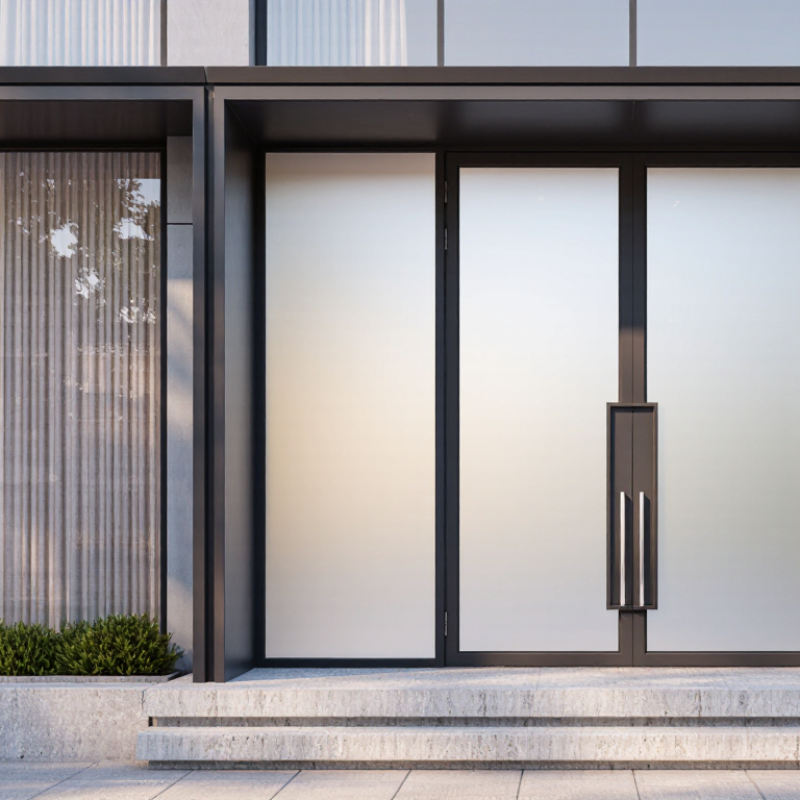
A modern frosted glass front door balances privacy, daylight, security, and clean design. Its surface may use acid-etched, ceramic-fritted, or laminated glass. Each method creates a different texture and light pattern. Acid-etched glass feels soft and architectural. Laminated glass can improve impact resistance and acoustic comfort. Slim frames, concealed hardware, and flush thresholds strengthen the contemporary appearance.
Performance matters more than appearance alone. The U.S. Department of Energy estimates that windows account for about 25–30% of residential heating and cooling energy use. A glazed entry door deserves similar attention. Low-emissivity coatings, insulated frames, and careful weather sealing can reduce unwanted heat transfer. The Global Status Report for Buildings and Construction states that buildings consume approximately 30% of global final energy. This makes thermal detailing a design responsibility, not an optional upgrade. NFRC rating methods also help buyers compare U-factor and solar heat gain performance. Still, ratings can vary by configuration.
Ask for documented U-factor, visible transmittance, and air-leakage results. Check the door under morning and evening light. Privacy is not absolute. Dense frosting may reduce daylight too much, while light frosting can reveal movement indoors. A thoughtful manufacturer should explain these compromises clearly. The perfect specification does not exist. Some designs look impressive in drawings but feel cold or exposed after installation. Researching samples, seals, hinges, and local climate conditions prevents expensive hesitation later.
China’s top frosted glass door manufacturers combine practical experience with controlled production. Many have dedicated teams for glass cutting, edge polishing, tempering, and hardware fitting.
Their workshops should show clean work areas and traceable inspection records. Details matter.
Reliable manufacturers usually provide technical drawings before production. They confirm glass thickness, frosting depth, door size, hinge position, and frame tolerance.
Each choice affects privacy, light transmission, maintenance, and cost. Samples reveal flaws.
Quality control should cover more than appearance. Experienced teams inspect surface uniformity, edge smoothness, drilling accuracy, and hardware alignment.
They may also check impact resistance and packing strength through documented procedures. Buyers should request relevant test reports and verify whether they match destination-market requirements.
A polished catalog is not proof.
Strong manufacturers communicate clearly about lead times, replacement policies, installation guidance, and container loading.
They use corner protection, moisture-resistant separators, and labeled cartons to reduce transport damage.
Custom projects benefit from small sample orders before full production. Not every factory handles complex designs equally well. That is worth admitting.
Even a minor measurement error can delay installation, so careful confirmation remains essential.
Modern frosted glass doors combine privacy, daylight, and controlled street visibility. Acid-etched glass offers a smooth, consistent haze. Sandblasted glass creates a softer texture but may need protective sealing. Laminated frosted glass adds a safety layer between two panes. Decorative films cost less, although their edges can lift over time.
Design choices should match the entrance, not only the showroom. Full frosting creates strong privacy. A clear border keeps hardware visible and improves orientation. Reeded, fluted, and geometric patterns bring depth to flat metal or timber doors. Low-iron glass produces a cleaner white appearance. Tinted glass changes the mood, but it can reduce indoor brightness. Small details matter.
According to the 2023 Global Status Report for Buildings and Construction, buildings consumed about 30% of global final energy. Better glazing selection can support broader efficiency goals, but frosted glass alone cannot solve heat gain. Low-emissivity coatings, warm-edge spacers, and correct frame design deserve equal attention. The International Energy Agency also identifies windows as important parts of building energy performance.
Custom manufacturers in China can adjust thickness, panel size, edge finishing, hole positions, and frosting density. Ask for tested U-value, visible transmittance, and safety-glass documentation. One common mistake is choosing a pattern before checking morning glare. It looks attractive in a sample room. The entrance may feel dim at home. Sample it outdoors first.
Reliable Chinese manufacturers treat a modern frosted-glass front door as a tested safety assembly, not a decorative panel. Production begins with traceable glass sheets, controlled cutting, and edge polishing. Many projects specify tempered glass, while higher-risk configurations may require laminated glass. The correct choice depends on local codes, door size, exposure, and hardware loads. Experienced engineers check these conditions before approving drawings. Details matter.
Quality inspection should continue through every stage. Inspectors verify thickness, dimensions, surface clarity, frosting uniformity, and edge quality. Small chips can become serious stress points. Tempering checks include visual review and documented fragmentation testing. Laminated units need examination of interlayer bonding, especially near corners. Factory teams also test hinges, locks, seals, and closing performance on assembled doors. Water and air infiltration checks can reveal weak seals. Not every defect is obvious.
A dependable supplier provides batch records, inspection photographs, test results, and corrective-action reports. Independent laboratory testing adds useful confidence, but paperwork cannot replace factory discipline. Safety glass markings should remain readable after installation. Packaging must protect corners and finished surfaces during transport. In practice, rushed approvals create avoidable problems. Attractive samples can still fail when final hardware changes the load path. Manufacturers should review changes honestly, even when rework costs more. No inspection system is flawless; consistent records and open communication make failures less likely.
The chart presents the standardized pendulum impact-test drop heights used to classify safety glazing under EN 12600. Higher drop heights represent more demanding impact-resistance classifications. These are industry-standard test levels, not company or brand performance data.
Common references include EN 12150 for thermally toughened glass, EN 14449 for laminated glass, and ASTM C1048 or ASTM C1172 for applicable North American projects.
EN 12600 classifies safety glazing according to pendulum impact performance. Class 1 is tested at the highest drop height shown in this chart.
Final inspection should verify dimensions, glass thickness, surface appearance, edge condition, frosting uniformity, safety markings, and test documentation against the project specification.
Choosing among China’s modern front door frosted glass manufacturers requires more than comparing catalog photos. Ask for factory audit records, glass certificates, and recent project references. ISO Survey 2022 recorded more than 1.26 million ISO 9001 certificates worldwide, but certification alone cannot prove consistent door quality. Inspect the production line if possible. Check cutting accuracy, edge finishing, tempering records, spacer assembly, and sealant storage. A reliable manufacturer should explain each process clearly.
Request performance evidence for the exact door system, not generic glass data. ASTM C1048 and EN 12150 references can support tempered-glass evaluation, while EN 1279 documentation helps verify insulated glass durability. The U.S. Department of Energy estimates that windows may cause 25–30% of residential heating and cooling energy use. Frosted glass still needs suitable low-emissivity coatings, airtight frames, and correct installation. Ask for U-value, solar heat gain, visible transmittance, and acoustic ratings. Numbers matter.
Test the sample yourself. Touch the frame corners. Inspect the frosting under angled light. Uneven opacity is easy to miss in photographs. Confirm hardware load testing and replacement procedures. Delivery records also reveal practical experience. One uncomfortable lesson is that the cheapest quotation may exclude packaging, installation tolerances, or warranty handling. Another is that a perfect sample may not represent mass production. Request an unannounced batch inspection when feasible, and record defects before approving shipment.
| Evaluation Dimension | Reliable Industry Data or Reference Range | Recommended Selection Target | How to Verify the Manufacturer | Priority |
|---|---|---|---|---|
| Glass Safety Type | Front-door glazing is commonly produced with tempered safety glass or laminated safety glass. Tempered glass is heat-treated for increased mechanical and thermal resistance, while laminated glass retains fragments after breakage. | Use tempered glass for general impact and thermal-safety requirements. Consider laminated or tempered-laminated glass where security, fall protection, or improved post-breakage retention is required. | Request test reports and production records referring to applicable standards such as EN 12150, EN 14449, ASTM C1048, or equivalent project requirements. | High |
| Glass Thickness | Common architectural door-glass thicknesses include 6 mm, 8 mm, 10 mm, and 12 mm. The correct thickness depends on pane size, support conditions, wind load, impact risk, and door-system design. | Select thickness through a documented glass-sizing calculation rather than choosing only by appearance. For many standard door applications, 8–10 mm may be considered, subject to engineering confirmation. | Provide the intended panel dimensions, hole locations, edge distances, fixing method, and design loads. Check the manufacturer’s calculation or technical recommendation. | High |
| Frosting Method | Main methods include acid-etched glass, sandblasted glass, ceramic-frit surface treatment, and decorative films. Acid etching generally provides a more uniform permanent matte surface. | Prefer a permanent etched or ceramic-based finish for exterior-facing doors. Use film only when removability, low initial cost, or temporary design changes are important. | Compare physical samples under direct light and touch. Ask for information on stain resistance, cleaning chemicals, scratch resistance, outdoor durability, and coating warranty. | High |
| Privacy Level | Frosted glass reduces clear visibility, but privacy varies with etching density, pattern, lighting, viewing distance, and whether silhouettes can be seen through the panel. | Define the required privacy level using a physical sample or visual mock-up. For high privacy, use dense uniform frosting or a pattern with limited transparent areas. | Test samples from both sides in daylight and nighttime conditions. Review visible-light transmission data when available and inspect the panel at typical viewing distances. | High |
| Light Transmission | Frosted glazing usually transmits diffused daylight while obscuring detailed views. Actual visible-light transmission depends on glass thickness, base glass color, frosting density, pattern, and any interlayer. | Specify a desired daylight effect instead of relying only on the word “frosted.” Request a measured visible-light-transmission value when lighting performance is critical. | Ask for an optical performance report or test data for the exact glass build-up, not only for an unrelated clear-glass sample. | Medium |
| Thermal Performance | Single glazing generally provides lower insulation than insulated glass units. A double insulating glass unit normally consists of two panes separated by a sealed cavity and can be filled with air or an inert gas. | For conditioned buildings, evaluate double glazing, low-emissivity coating, spacer type, gas filling, and whole-door performance instead of assessing the frosted pane alone. | Request center-of-glass U-value and, where available, whole-door thermal data. Confirm cavity thickness, coating position, spacer specification, and seal design. | Medium |
| Edgework and Fabrication | Door glass may require polished edges, arrised edges, drilled holes, notches, cut-outs, corner processing, or CNC shaping. Fabrication accuracy affects installation and hardware fit. | Select a manufacturer able to control dimensional tolerances and edge quality for the complete hardware drawing, especially for pivot doors, patch fittings, locks, and handles. | Submit approved CAD drawings and request a dimensional inspection report covering overall size, hole diameter, hole position, diagonals, edge finish, and corner radius. | High |
| Dimensional Tolerance | Tolerances vary according to the applicable glass standard, product type, processing method, and manufacturer’s quality system. Tight hardware interfaces require tighter control than ordinary framed glazing. | Agree on written tolerances before production. Tolerances should cover thickness, length, width, squareness, hole position, cut-outs, and frosting alignment. | Review the approved shop drawing, inspection plan, measuring equipment records, and a pre-shipment inspection report for the actual order. | High |
| Color and Surface Uniformity | Differences in base glass, etching depth, coating density, lighting, and viewing angle can create visible variation between samples and production panels. | Approve a signed reference sample and define acceptable variation for color, haze, transparency, pattern alignment, edge zones, and surface marks. | Compare production pieces with the approved sample under consistent lighting. Request batch identification and photographs before packing. | High |
| Weather and UV Resistance | Exterior doors are exposed to sunlight, moisture, temperature changes, airborne particles, and repeated cleaning. Surface films and some decorative finishes may age differently from the glass substrate. | Use a finish specifically documented for exterior use when the door is exposed to weather. Confirm resistance to moisture, UV exposure, temperature cycling, and normal cleaning. | Request durability test information, installation limitations, cleaning instructions, and written warranty coverage for the complete finish system. | High |
| Quality Management | A documented quality system should control incoming glass, cutting, tempering, frosting, inspection, packing, nonconforming products, and traceability. | Prefer a factory with a documented quality-management process, batch traceability, defined inspection checkpoints, and corrective-action records. | Request quality certificates where relevant, process flow charts, inspection checklists, calibration records, and anonymized examples of corrective-action reports. | High |
| Sampling and Prototype Process | A physical sample can reveal optical appearance, edge quality, frosting uniformity, color, hardware compatibility, packaging risks, and installation problems before mass production. | Approve a production-representative sample using the same glass type, thickness, frosting method, edge treatment, and fabrication process planned for the final order. | Record sample dimensions, finish, tolerances, approval date, and revision number. Do not approve production solely from digital renderings. | High |
| Packaging and Damage Prevention | Large glass panels are vulnerable to edge impact, abrasion, moisture, and movement during transport. Suitable packaging normally requires separators, corner protection, rigid crates, labeling, and moisture control. | Require custom packing based on panel size and shipping route, with clear identification of crate contents, orientation, glass type, quantity, and handling requirements. | Review packing photographs, crate specifications, loading procedures, insurance terms, and the process for documenting damage at delivery. | High |
| Production Lead Time | Lead time varies with glass availability, customization, sample approval, production capacity, inspection, packaging, and shipping. Customized etched and fabricated panels normally require more time than standard clear panes. | Obtain a written schedule covering drawing approval, sampling, production, inspection, packing, and dispatch. Include contingency time for remake or replacement panels. | Compare the quoted schedule with documented capacity, current production loading, raw material availability, and the manufacturer’s order milestone process. | Medium |
| Order Minimum and Customization | Minimum order quantities differ by glass type, thickness, finish, color, size, and production process. Custom patterns and special dimensions may increase setup costs. | Choose terms that match the project quantity and clarify charges for samples, tooling, special patterns, small batches, replacement pieces, and design revisions. | Request a detailed quotation separating glass, processing, frosting, hardware cut-outs, packing, inspection, and logistics costs. | Medium |
| Technical Communication | Accurate communication is essential for translating door-system drawings into glass dimensions, tolerances, hardware holes, safety requirements, and installation details. | Prefer a supplier that provides clear technical drawings, responds with measurable specifications, identifies design risks, and confirms assumptions in writing. | Use a pre-production checklist and evaluate the response quality to technical questions, drawing revisions, sample feedback, and nonconformity handling. | High |
| Warranty and After-Sales Support | Warranty coverage may differ for glass breakage, seal failure, frosting defects, scratches, discoloration, installation damage, and incorrect cleaning. | Require written warranty terms that define coverage period, exclusions, claim evidence, response time, replacement responsibilities, and shipping arrangements. | Review the warranty before placing the order and confirm whether it covers the exact glass construction, finish, fabrication, and intended installation environment. | Medium |
They should provide technical drawings and confirm glass thickness, door size, frosting density, hinges, and frame tolerance. Details prevent delays. Ask for approval samples before full production.
Common choices include tempered glass, laminated glass, acid-etched glass, and patterned glass. Laminated glass adds a safety layer. Decorative films usually cost less, but their edges may lift over time.
Full frosting offers strong privacy but may reduce visibility and indoor brightness. A clear border can keep handles and hinges easier to see. Sample the door outdoors, not only under showroom lights.
Check frosting uniformity, pattern depth, edge smoothness, drilling positions, and hardware alignment. Look under angled light. Small flaws become obvious there.
Frosted glass alone cannot control heat gain. Ask about low-emissivity coatings, frame insulation, airtightness, and tested thermal values. Glass choice matters, but installation matters too.
Request safety-glass certificates, thermal data, visible-light transmission, solar-performance values, and acoustic ratings. Also request inspection records. A polished catalog is not proof.
Inspect cutting, edge polishing, tempering records, sealant storage, and hardware fitting. Clean work areas are useful signs. They are not complete evidence.
A sample can reveal uneven opacity, poor corners, inaccurate holes, or unsuitable brightness. A perfect sample may not represent mass production. That risk deserves honest attention.
Confirm corner protection, moisture-resistant separators, labeled cartons, loading methods, lead times, and replacement procedures. Record defects before shipment approval. One small measurement error can delay installation.
A modern frosted glass front door combines clean architectural lines, privacy, natural light, and practical performance. The ideal Modern Front Door Frosted Glass design may use acid-etched, sandblasted, laminated, or patterned glass, with options for different transparency levels, textures, colors, frame materials, hardware, and dimensions. These features allow homeowners, architects, and developers to create entrances that match contemporary residential or commercial styles while maintaining comfort and visual privacy.
China’s top frosted glass door manufacturers are distinguished by advanced production capabilities, skilled workmanship, reliable customization, and consistent quality control. When evaluating a supplier, buyers should review glass safety standards, thermal and weather performance, frame durability, surface finishing, inspection procedures, production capacity, lead times, packaging, and after-sales support. Clear technical specifications, sample approval, transparent communication, and documented testing can help ensure that the selected manufacturer delivers a secure, attractive, and long-lasting entrance solution.
