China has become a major sourcing destination for modern architectural doors, including the increasingly popular Black Frame Door. Manufacturers in Foshan, Guangdong, and other industrial centers often combine aluminum fabrication, glass processing, powder coating, and assembly under one roof. This production structure can support competitive pricing and flexible customization. However, factory capability varies widely.
This guide introduces leading Chinese Black Frame Door manufacturers and suppliers through practical evaluation criteria. It considers product quality, engineering experience, export history, material traceability, and communication reliability. Attention should be given to aluminum wall thickness, thermal-break design, glass specifications, hinge strength, sealing systems, and coating performance. A well-finished frame should show even color, clean corner joints, and smooth hardware movement. Small details matter.
Samples tell a clearer story.
Professional buyers should also review factory audits, test reports, project references, warranty terms, and quality-control procedures. Product claims should be checked against current documentation, not accepted automatically. Some suppliers may present impressive catalogs while lacking consistent production standards. Others may offer excellent workmanship but limited support for complex projects. That difference is easy to miss during online sourcing. Lead times, packaging methods, replacement-part availability, and installation guidance deserve equal attention.
No supplier is perfect.
The purpose of this overview is not to promote one factory blindly. It is to help architects, contractors, distributors, and homeowners compare suitable partners with greater confidence. Careful verification remains essential, especially when appearance, weather resistance, security, and long-term maintenance affect the final result. A realistic assessment may take more time, but it can prevent expensive revisions later.
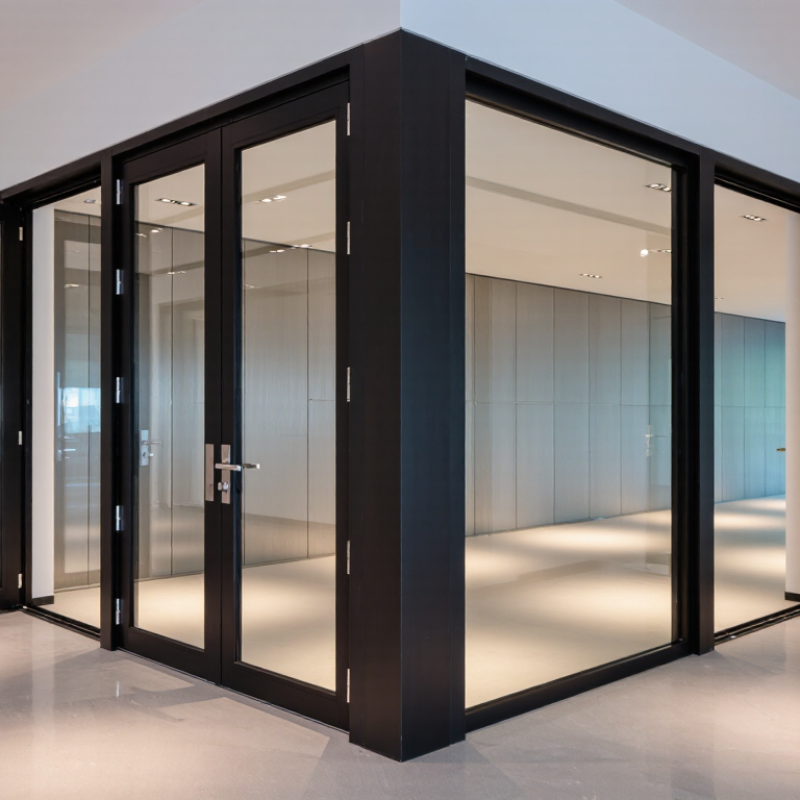
Chinese manufacturers make black frame doors in several practical configurations. Slim aluminum framed glass doors suit apartments, offices, and retail interiors. Their narrow profiles preserve daylight while creating strong grid lines. Hinged versions work well for bedrooms and study rooms. Sliding doors save floor space near kitchens, balconies, and compact corridors. Black powder-coated aluminum resists routine scratches better than untreated painted surfaces. Details matter. Buyers should confirm coating thickness, glass composition, and hardware load ratings before production.
Steel black frame doors offer a heavier appearance and better impact resistance. They are often selected for entrances, workshops, and industrial-style interiors. Thermal-break aluminum systems add an insulating barrier between inner and outer profiles. This design can reduce heat transfer around large glazed openings. Chinese factories also produce pivot doors, double French doors, and concealed-frame options. Laminated glass improves safety because its layers remain bonded after breakage. Tempered glass is stronger, but it still needs correct edge treatment and installation.
During factory inspections, check corner joints, weld finishing, gasket continuity, and drainage paths. Open each sample repeatedly. Listen for rubbing or loose hinges. Color consistency can vary between batches, especially under different lighting. This is easy to overlook. Request physical samples, approved drawings, and test reports before confirming a bulk order. Some suppliers may promise slim frames without explaining structural limits. A careful specification should state dimensions, glass thickness, opening direction, finish code, and replacement responsibilities. That discipline prevents expensive adjustments later.
Black frame doors depend on material choices that affect strength, appearance, and service life. Aluminum profiles are light and resist corrosion, while steel offers greater rigidity for larger openings. For better insulation, manufacturers can add a thermal break between the inner and outer profiles. This reduces heat transfer through the frame. The black finish should use a durable powder coating with consistent coverage, especially around corners and drainage holes. Scratches are easier to notice on dark surfaces.
Glass selection also matters. Tempered glass improves impact resistance, while laminated glass helps retain the pieces after breakage. Reliable production includes accurate cutting, clean welding, stable frame dimensions, and properly fitted seals. Inspectors should check hinge alignment, gasket compression, coating adhesion, and drainage performance. Standards such as EN 12150 or ASTM C1048 may guide glass quality, but local building requirements still deserve attention. A certificate alone cannot replace a physical inspection.
Tips: Request a sample corner before ordering. Check the coating under natural daylight. Measure frame diagonals; uneven readings can cause difficult installation. Ask suppliers for material records, test reports, and production photographs. Small gaps often become large problems. I have found that rushed finishing leaves marks around screw holes, even when the main surface looks excellent. Suppliers should record these defects honestly and explain their correction process.
When evaluating China’s black frame door manufacturers, inspect more than photographs. Ask whether the frame uses aluminum, steel, or another declared material. Confirm the alloy grade, wall thickness, surface treatment, and color consistency. A deep black finish should remain even around corners, welds, and screw holes. Request a physical sample.
Check how the factory controls production. Reliable suppliers should provide drawings, tolerance records, glass specifications, and inspection photographs. Ask about powder coating or anodizing tests, including adhesion, humidity, and abrasion resistance. Test the hinges, rollers, seals, and locks repeatedly. They should move smoothly without scraping. Small details matter.
Communication also reveals manufacturing discipline. Can the supplier explain lead times, packaging methods, replacement procedures, and quality responsibilities clearly? Ask for recent project references and destination-market compliance documents. Do not accept generic certificates without matching product details. A polished sample can still hide uneven drilling or weak packaging. My own checklist is not flawless; I once focused on finish quality and overlooked a door’s opening direction. That mistake changed how I review drawings. Before placing an order, compare approved samples with mass-production controls, carton labels, and final inspection records. Keep every revision in writing.
Use these internationally recognized performance classifications when reviewing a supplier’s test reports. EN 12207 uses air-permeability Classes 1–4, EN 12208 uses watertightness Classes 1A–9A, and EN 12210 uses wind-resistance Classes 1–5. The class numbers are reference limits within each standard and should not be treated as a direct comparison between different standards.
China Top Black Frame Door Manufacturers and Suppliers
Selecting a black frame door supplier requires more than comparing catalog photos. Inspect aluminum or steel profiles, weld quality, corner alignment, and powder-coating thickness. Ask for finished samples under daylight and warm indoor lighting. Black surfaces can reveal scratches, orange peel, and uneven gloss quickly. Request test records for water resistance, air leakage, hardware cycles, and glass performance. A credible supplier should explain its inspection process clearly, not hide behind general certificates.
Pricing needs careful examination. Compare landed cost, not only the quoted door price. Check packaging, tooling, sample fees, delivery terms, taxes, and replacement policies. A low quote may exclude essential hardware or use thinner profiles. That creates trouble later. Ask for a line-by-line quotation with fixed validity dates. In practical sourcing, small savings can disappear through damaged cartons or inconsistent dimensions. I have found that buyers sometimes overvalue the cheapest offer and undercheck finishing details. That judgment deserves reconsideration.
Capacity affects reliability during project peaks. Confirm monthly output, current workload, standard lead time, and maximum custom size. Request production photos, inspection records, and a realistic shipment schedule. A factory may claim high capacity but rely on subcontracted coating or glass processing. Verify these steps. Start with a controlled sample order before releasing a large batch. Measure frame diagonals, coating uniformity, gasket fit, and hardware operation. Keep written approval records for every change. Mistakes still happen. Clear records make correction faster.
Ordering black frame doors from China requires more than comparing catalog prices. Define the door schedule before contacting manufacturers or suppliers. Record opening sizes, frame material, glass thickness, swing direction, hardware, finish, and fire-rating requirements. Powder-coated aluminum suits many interior projects, while steel may provide a heavier appearance. Ask for finish samples and a complete technical drawing.
Request a production sample before approving a large order. Check corner joints, hinge alignment, glass edges, surface consistency, and packaging protection. Black finishes can show scratches easily. Small details matter. A sample may look excellent, yet reveal weak foam protection during transport. This is where careful inspection becomes valuable, even when the supplier seems experienced. Confirm minimum order quantity, production time, replacement terms, and payment milestones in writing.
Calculate the landed cost, not only the factory price. Include inland delivery, export handling, ocean freight, insurance, customs charges, and local transportation. Confirm the correct product classification with a qualified customs broker. Import documents should match the invoice, packing list, shipping terms, and country requirements. Use a pre-shipment inspection for larger orders, especially when dimensions differ across units. I would not rely on photographs alone. They can miss warped frames and uneven coating. Clear communication, measurable acceptance standards, and realistic delivery buffers make the buying process more reliable.
| Data Dimension | Typical Product or Market Data | Key Technical Details | Ordering and Importing Considerations |
|---|---|---|---|
| Product Category | Black frame interior doors, exterior entry doors, patio doors, sliding doors, French doors, pivot doors, and shower doors | Configuration may include single leaf, double leaf, fixed sidelight, transom, folding, or multi-panel systems | Confirm whether the quotation covers the door leaf, frame, hardware, glass, screens, threshold, and installation accessories |
| Main Frame Materials | Aluminum, galvanized steel, stainless steel, or engineered steel profiles | Aluminum is commonly selected for corrosion resistance and lower weight; steel is selected for strength and a traditional industrial appearance | Request the material grade, profile thickness, reinforcement method, and surface-treatment specification before placing an order |
| Black Surface Finishes | Powder coating, anodized black, electrophoretic coating, or painted steel finish | Common appearance options include matte black, satin black, textured black, and semi-gloss black | For exterior use, verify coating pretreatment, coating thickness, color reference, UV resistance, and salt-spray test requirements |
| Common Glass Options | Clear tempered glass, laminated glass, low-E insulating glass, frosted glass, fluted glass, reeded glass, and wired-look decorative glass | Tempered glass provides improved impact resistance; laminated glass helps retain fragments after breakage; insulating glass improves thermal performance | Specify glass thickness, make-up, color, transparency, edge treatment, safety requirements, and whether the glass is factory-installed |
| Typical Glass Thickness | Single glass commonly ranges from 5 mm to 12 mm; insulated units are often approximately 20 mm to 32 mm overall | Final thickness depends on door size, wind load, safety requirements, framing system, and local building regulations | Large panels may require thicker or laminated glass. Obtain engineering confirmation for oversized doors and exterior applications |
| Typical Door Width | Single doors commonly range from approximately 700 mm to 1,000 mm; double-door openings commonly range from approximately 1,200 mm to 2,400 mm | Custom widths are available, subject to profile strength, hardware capacity, glass size, and production tooling | Provide finished opening dimensions, wall thickness, handing, reveal requirements, and tolerance information |
| Typical Door Height | Common finished door heights range from approximately 2,000 mm to 2,400 mm; taller custom systems may be available | Height affects frame deflection, glass weight, hinge selection, transportation, and installation requirements | Confirm whether dimensions refer to the door leaf, frame outer size, or rough opening size |
| Door Opening and Handing | Left-hand or right-hand opening, inward or outward opening, center-hung pivot, sliding, folding, or fixed-panel combinations | Hardware position, hinge side, lock side, and sliding direction must be shown on an approved shop drawing | Never rely only on verbal descriptions. Approve a dimensioned drawing before production begins |
| Hardware Options | Hinges, locks, pull handles, lever handles, rollers, pivots, floor springs, closers, cylinders, magnetic catches, and seals | Hardware can be supplied in black, stainless steel, brass, or other finishes depending on the design | Check hardware load rating, corrosion resistance, replacement availability, keying requirements, and compatibility with local standards |
| Thermal Performance | Performance varies significantly between single-glazed, thermally broken, and insulated-glass systems | Important factors include frame material, thermal break design, glass configuration, spacer, weather seals, and installation quality | For exterior projects, request U-value or U-factor data, air leakage information, water penetration data, and thermal calculations where required |
| Weather Sealing | EPDM, silicone, wool pile, brush seals, compression gaskets, and threshold seals may be used | Sealing details are especially important for exterior doors, sliding systems, and doors exposed to driving rain | Confirm seal material, replaceability, drainage design, threshold height, and compatibility with the installation environment |
| Fire-Rated Applications | Fire-rated steel or glazed doors may be available for projects requiring certified fire performance | Fire rating depends on the complete tested assembly, including frame, glass, seals, hardware, and installation method | Do not assume a black frame door is fire-rated. Request valid test reports and certification applicable to the destination market |
| Acoustic Performance | Sound reduction depends on glass type, seals, frame construction, and installation; laminated or insulated glazing generally performs better than basic single glazing | Acoustic results should be expressed using a recognized rating such as Rw or STC where applicable | Request laboratory test data for projects near roads, offices, hotels, bedrooms, or other noise-sensitive areas |
| Customization Scope | Custom colors, grid patterns, mullions, glass types, panel layouts, handles, thresholds, screen doors, and opening directions | Custom tooling or special profiles may affect price, sample approval, and production time | Submit a complete technical schedule and obtain a signed quotation showing all inclusions and exclusions |
| Typical Minimum Order Quantity | Small projects may be accepted from one complete door set; standard products may have higher quantity requirements | MOQ is influenced by product type, profile availability, glass procurement, finish, packaging, and customization | Ask whether the MOQ applies per model, per color, per size, or per shipment. Confirm any sample or setup charges |
| Sample and Approval Process | Typical process: technical drawing review, finish sample, hardware confirmation, prototype or sample door, then mass production | Samples help verify color, frame proportions, glass appearance, handle position, and operating performance | Record all approved specifications in the purchase contract and require production to follow the approved sample or drawing |
| Typical Production Lead Time | Approximately 20 to 45 calendar days after drawing approval and deposit for many standard or moderately customized orders | Complex systems, special glass, large quantities, custom tooling, holidays, and quality inspections can extend the schedule | Request a production timeline with milestones for drawing approval, material procurement, assembly, inspection, and shipment |
| Quality Inspection Points | Dimensions, squareness, frame joints, coating appearance, glass condition, hardware operation, seals, packaging, and accessories | Inspection should compare actual products with approved drawings, specifications, samples, and quantity records | Consider pre-shipment inspection before the balance payment, especially for customized or high-value orders |
| Packaging Method | Protective film, foam, corner guards, cartons, wooden frames, pallets, or export-grade crates | Glass and assembled frames require protection against impact, abrasion, moisture, and movement during transport | Specify packaging marks, crate dimensions, gross weight, lifting points, moisture protection, and replacement-parts packaging |
| Shipping Considerations | Sea freight is commonly used for larger or heavier orders; air freight may be used for samples or urgent small shipments | Shipping cost depends on volume, weight, destination port, delivery terms, season, and whether doors are shipped assembled | Compare FOB, CIF, and DAP quotations carefully and confirm who handles export clearance, insurance, import clearance, duties, and local delivery |
| Required Commercial Documents | Commercial invoice, packing list, sales contract, bill of lading or air waybill, and certificate of origin when required | Additional documents may include insurance documents, fumigation records for wooden packaging, test reports, or conformity documents | Check destination-country customs and building-product requirements before shipment, including tariff classification and import permits |
| Payment Structure | Common arrangements include a deposit before production and the balance before shipment or against agreed shipping documents | Payment terms depend on order value, customization, supplier relationship, inspection arrangements, and trade risk | Use a written contract covering specifications, tolerances, delivery date, warranty, claims procedure, and payment milestones |
| Warranty Scope | Warranty terms may cover manufacturing defects, hardware operation, coating problems, or insulated-glass seal failure for a stated period | Coverage often excludes incorrect installation, improper maintenance, impact damage, unauthorized modification, and normal wear | Obtain the warranty period and exclusions in writing, and confirm how replacement parts or defective units will be handled |
| Installation Requirements | Installation may require a level and plumb opening, approved anchors, compatible sealants, drainage provisions, and correct adjustment of hardware | Poor installation can cause air leakage, water infiltration, binding, glass stress, or premature hardware wear | Request installation manuals, fixing details, maintenance instructions, and technical support for local installers |
| Recommended Buyer Checklist | Verify dimensions, materials, finish, glass, hardware, performance requirements, packaging, documents, delivery terms, and warranty | All project-specific requirements should be consolidated into a technical specification and approved shop drawing | Use the same specification when comparing quotations so that suppliers are evaluated on equivalent products and services |
Common options include hinged, sliding, pivot, French, and concealed-frame doors. Aluminum suits lighter interiors, while steel creates a heavier appearance.
Aluminum offers lighter weight and slim profiles. Steel provides greater impact resistance. Thermal-break aluminum can reduce heat transfer near large glass openings.
Laminated glass remains bonded after breakage. Tempered glass offers higher strength but needs proper edge treatment and careful installation.
Inspect samples under daylight and warm indoor lighting. Look for scratches, orange peel, uneven gloss, and inconsistent color around corners.
Check corner joints, weld finishing, gasket continuity, drainage paths, and frame alignment. Open the sample repeatedly. Listen for rubbing.
Test hinges, rollers, seals, and locks several times. They should move smoothly, without scraping or loose movement. This check is easy to skip.
State dimensions, glass thickness, opening direction, finish code, hardware ratings, and replacement responsibilities. Written details reduce costly changes later.
Compare total delivered cost, including packaging, tooling, samples, transport, taxes, and replacements. A low quote may exclude important hardware.
Ask about monthly output, current workload, custom size limits, and realistic shipping dates. Check whether coating or glass processing uses outside contractors.
No. Begin with a controlled sample order. Measure diagonals, coating consistency, gasket fit, and hardware operation before approving mass production.
Request approved drawings, physical samples, inspection records, test reports, compliance documents, and packaging details. Keep every revision in writing.
Buyers may focus on appearance and overlook opening direction, packaging strength, or profile thickness. My checklist is not flawless. Recheck practical details.
China’s black frame door industry offers a wide range of options, including aluminum-framed glass doors, steel doors, interior room dividers, entrance doors, and custom architectural systems. Manufacturers typically use powder-coated aluminum, galvanized steel, tempered glass, laminated glass, and corrosion-resistant hardware to achieve durability, safety, and a modern appearance. Buyers should review material specifications, surface treatment, dimensional accuracy, testing procedures, and production standards before placing an order. A reliable Black Frame Door manufacturer should also demonstrate stable quality control, clear technical communication, flexible customization, and consistent delivery performance.
When selecting a supplier, compare product quality, pricing, manufacturing capacity, lead times, packaging methods, and after-sales support rather than focusing only on the lowest quotation. It is advisable to confirm drawings, finishes, glass configurations, hardware details, minimum order quantities, and inspection requirements in writing. For importing from China, buyers should also prepare accurate shipping documents, understand applicable customs procedures, and coordinate production, inspection, transportation, and installation planning in advance. A structured evaluation process can help ensure the selected doors meet project requirements and arrive safely and efficiently.

