Buying an Aluminum Security Door is not simply a choice between colors, prices, and decorative patterns. It is a decision about measured resistance, daily usability, and installation quality. The FBI Crime Data Explorer recorded more than 800,000 burglary offenses in the United States during 2023. That figure does not predict risk at your home, but it explains why door strength deserves careful attention.
Industry reports also show a growing focus on residential security and durable building materials. MarketsandMarkets identifies access control, stronger entry systems, and connected protection as continuing physical-security trends. Grand View Research reports sustained demand for aluminum in construction because it resists corrosion and reduces structural weight. These reports combine several product categories, however. They should guide questions, not replace product testing or professional inspection.
Security consultant Bruce Schneier has often stated, “Security is a process, not a product.” His point applies directly to an Aluminum Security Door. A heavy frame means little if the strike plate uses short screws. A multi-point lock cannot compensate for a poorly aligned threshold. Small details matter.
This guide examines seven practical buying points, including frame thickness, hinge design, lock standards, glazing, drainage, certification, and installation. Look closely at the sample. Test the latch. Notice the gaps around the frame.
Some choices are easy to overlook. I would also question marketing claims that use “burglar-proof” language without independent test evidence. No residential door offers absolute protection. The better goal is a tested, correctly installed barrier that slows forced entry and supports safer everyday living.
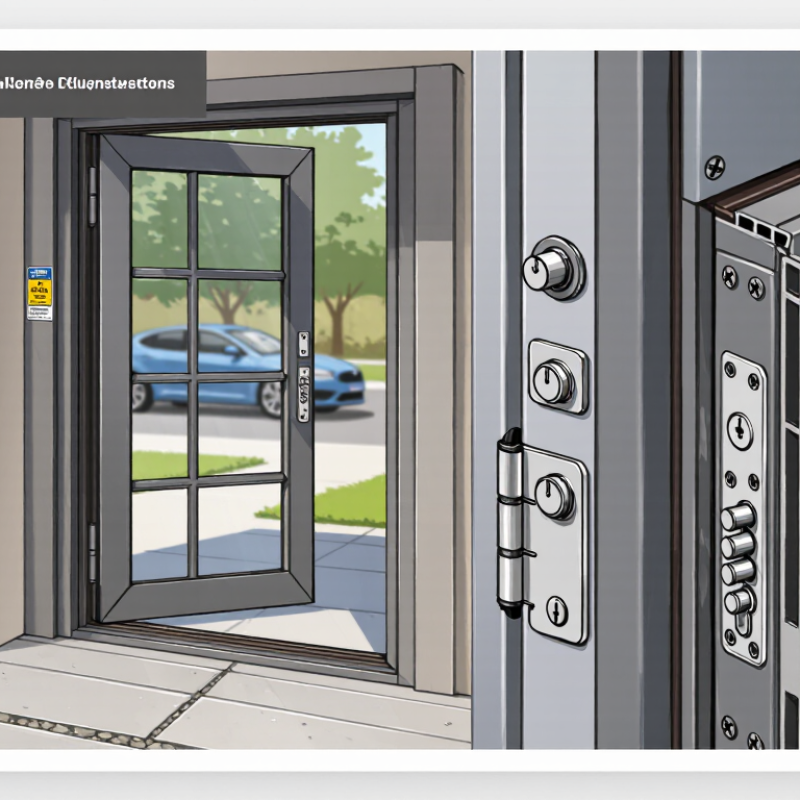
When buying an aluminum security door, define the threat level before comparing finishes or handles. EN 1627:2021 places doors into resistance classes, including RC2 and RC3. These ratings do not promise an unbreakable entrance. They measure tested resistance against defined attack methods.
RC2 represents resistance to basic tools, such as screwdrivers, pliers, and wedges. The test includes three minutes of active attack time. RC3 raises the challenge to five minutes and adds heavier tools, including a crowbar and hand drill. That difference sounds small. It is not. A determined intruder may exploit weak glazing, exposed hinges, or a poorly fitted frame before testing the door panel itself.
The European standard also stresses the complete doorset, not aluminum alone. Ask for certification covering the frame, lock, cylinder, hinges, glazing, and installation method. According to the Office for National Statistics, England and Wales recorded 191,490 domestic burglary offences in the year ending March 2024. That figure does not identify your personal risk, but it supports a practical assessment of location, visibility, and entry points. RC3 may suit isolated homes, rear entrances, or properties containing valuable equipment. RC2 can be reasonable for apartments with controlled access. A common mistake is choosing RC3 hardware while accepting ordinary glass. The protection becomes uneven. Check the certificate carefully, and question vague claims about “high security.”
| Tip | Buying Decision | EN 1627 RC2 | EN 1627 RC3 | What to Check on an Aluminum Security Door |
|---|---|---|---|---|
| 1 | Define the likely threat level |
Designed for resistance against an opportunist attacker using basic tools such as screwdrivers, pliers and wedges. |
Designed for resistance against a more determined attacker using additional tools, including a crowbar, hand drill or hammer. |
Consider the location, property value, exposure, neighborhood risk and whether the door protects a primary entrance, side entrance or a less accessible opening. |
| 2 | Verify the complete door-set rating | The rating should apply to the tested door assembly, not only to the aluminum profile or panel. | The same principle applies, with stricter resistance requirements for the complete assembly. | Ask for documentation covering the door leaf, frame, hinges, lock, cylinder, glazing, hardware and fixing method as one tested configuration. |
| 3 | Compare resistance time correctly | EN 1627 classification is associated with a higher resistance requirement than unclassified construction; the standard includes resistance criteria for manual attack testing. | RC3 requires a more demanding attack scenario and higher resistance performance than RC2. | Do not treat the rating as a guaranteed time against every real-world burglary. Test conditions, tools and installation quality affect actual performance. |
| 4 | Examine the locking system | A suitable multi-point locking system can help the door meet the tested configuration. | RC3 configurations generally require stronger protection against forced manipulation and more robust interaction between the lock, frame and door leaf. | Check the number and position of locking points, cylinder protection, escutcheon strength, anti-drill features and whether the lock was included in the certification test. |
| 5 | Assess glazing and vision panels | Glass and glazing beads must not create a weak point in an otherwise rated door. | Glazing, bead retention and surrounding framing must withstand the more demanding RC3 test conditions when included in the rated door-set. | Confirm the security classification of the complete glazed section, the glass-retention method and whether the glazing specification matches the tested design. |
| 6 | Inspect the frame and installation requirements | Performance depends on correct anchoring, suitable wall construction and installation in accordance with the tested design. | The stronger RC3 door can lose its intended performance if the frame, fasteners or surrounding wall are inadequate. | Request approved fixing details, minimum substrate requirements, anchor spacing and installation instructions. Use qualified installers where required. |
| 7 | Balance protection, operation and compliance | Often appropriate where moderate security is needed without the additional weight, cost and operational demands of a higher class. | More appropriate for higher-risk locations, valuable contents or entrances that require stronger resistance and can accommodate the additional specification. | Compare door weight, accessibility, emergency egress, weather performance, maintenance, warranty conditions and local building or fire-safety requirements. |
Check frame corners, fasteners, and visible movement. Clean joints matter. Measure the opening carefully. Small gaps can affect sealing and locking.
Test it with the door open. Hooks or bolts should move smoothly without scraping. Turn the key several times. It should not feel gritty or loose.
A higher grade usually indicates stronger resistance to drilling, pulling, and forced rotation. Request the grade and written test details. Appearance proves little.
Look for anti-lift protection behind the hinges. It should prevent the door from being lifted. Confirm that hinges support the door’s actual weight.
Inspect the strike plates and frame reinforcement. The locking points need strong material behind them. Also check anchor spacing and wall condition.
A lower U-factor usually means better insulation. Confirm that the report includes the glass, frame, and hardware. Otherwise, performance may look better than reality.
Compare tests using the same pressure and door size. Check whether thresholds and locking points were included. Review water pressure, test duration, and recorded leakage.A pass at low pressure is not storm protection. Not necessarily.
Request the complete laboratory report. It should identify the tested frame, lock, hinges, glass, and mounting method. The tested assembly must match your planned installation.
Check coverage for the frame, finish, hinges, lockset, glass, and labor. Ask about exclusions, response times, maintenance, and replacement parts. Require written installation instructions and a final latch test.A rushed installation can ruin good hardware. I may be overly cautious, but appearance can mislead.
Choosing an Aluminum Security Door requires more than comparing appearance and price. Start by defining the level of protection your property needs, then compare EN 1627 RC2 and RC3 ratings to understand resistance against different attack methods. Inspect the frame specifications carefully, including the use of 6063-T5 aluminum and a minimum wall thickness of 1.6 mm. The locking system should also receive close attention: look for reliable 3-point locks, appropriately graded cylinders, and hinge-side anti-lift protection.
Security should be balanced with weather performance and long-term value. Review independent test results for U-factor, air leakage, and water resistance to assess insulation and durability. It is also important to confirm ASTM F1233 testing, clear warranty terms, and professional installation standards. By evaluating these technical details together, buyers can select a door that provides dependable security, improved energy performance, and lasting everyday convenience.

