2026 Best Courtyard Gate Types for Global Buyers

Time:2026-10-21 Author:Isabella
0%

Choosing the right Courtyard Gate in 2026 requires more than attractive photographs or popular design trends. Global buyers must consider climate, property layout, daily traffic, maintenance, privacy, and local building requirements. A gate that performs well in a dry Mediterranean courtyard may fail quickly in a humid coastal environment.

This guide compares major courtyard gate types, including swing gates, sliding gates, folding gates, and pedestrian access gates. It examines steel, aluminum, wrought iron, timber, and mixed-material construction. Each option has practical strengths. Steel offers strong protection, while aluminum reduces corrosion concerns and operating weight. Timber provides warmth, but it needs regular sealing, especially during wet seasons. Details matter. Hinges, drainage, locks, posts, and surface finishes often decide long-term performance.

The recommendations reflect common supplier practices, installation experience, and buyer concerns across different markets. However, no universal design fits every property. Local wind exposure, soil movement, automation standards, and emergency access rules can change the final choice. Buyers should confirm measurements with qualified installers and request material specifications before ordering. Product images can also be misleading. A beautiful gate may hide weak frames or poor welds.

Some assumptions may need reconsideration. The most expensive gate is not always the most reliable. Likewise, a simple manual gate may outperform automation in remote areas with unstable power. This overview aims to support informed comparison, not replace professional site assessment. Careful planning prevents expensive changes later. A courtyard gate should protect, welcome, and continue working through ordinary weather and daily use.
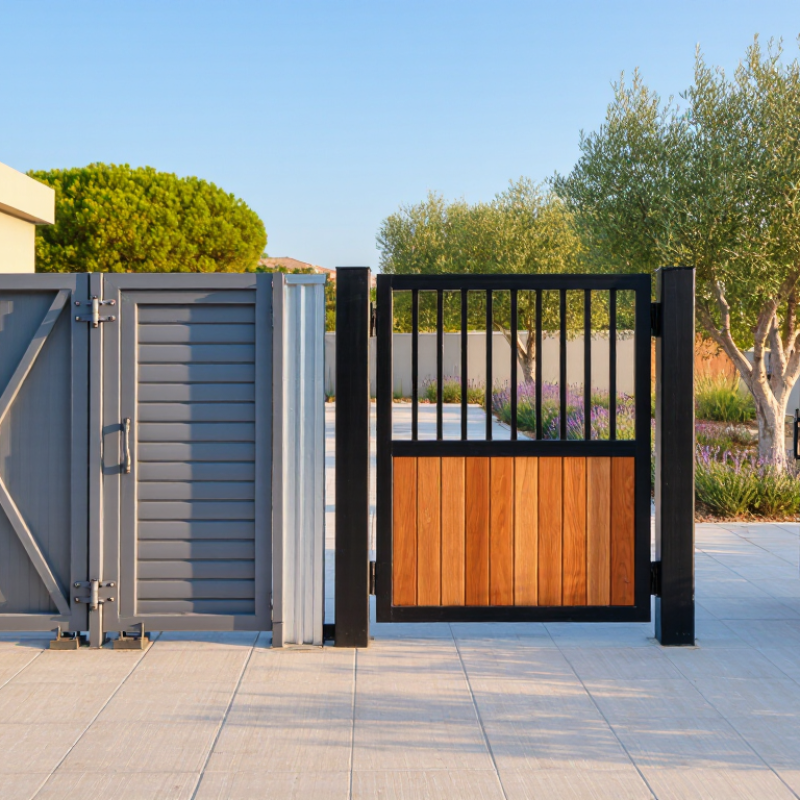
2026 Best Courtyard Gate Types for Global Buyers

Courtyard Gate Types and Their Main Design Differences

Courtyard Gate Types and Their Main Design Differences

Courtyard gates shape privacy, access, and the first impression of a property. Swing gates use hinged leaves that open inward or outward. They suit wide entrances with clear ground space. Sliding gates move along a track, making them practical for short driveways or sloped approaches. Space matters. Each type creates a different visual rhythm.

Folding gates divide into several narrow leaves and stack beside the entrance. They open faster than many swing designs, but their hinges and guides require careful adjustment. Pedestrian gates are smaller and often match the main gate’s frame, infill, and finish. A solid metal panel offers privacy and blocks wind, while vertical bars improve airflow and make the courtyard feel more open. Perforated panels can balance both needs.

Material changes the design further. Steel supports slim, rigid frames and detailed patterns. Aluminum reduces weight and resists corrosion in many climates. Timber brings warmth, but it needs regular sealing, especially in humid regions. From practical planning, drainage, hinge strength, track protection, and local wind exposure deserve equal attention. A beautiful gate can still be inconvenient. Oversized swing leaves may scrape paving, while poorly protected sliding tracks can collect sand, leaves, or ice. Gate automation also needs safe clearance, manual release access, and maintenance space. Regional climate data and installer experience should guide the final selection, not appearance alone.

How to Choose Gate Materials for Climate and Security Needs

2026 Best Courtyard Gate Types for Global Buyers

Gate material should match local climate before appearance. In humid or coastal areas, powder-coated aluminum and hot-dip galvanized steel resist moisture better than untreated mild steel. The NACE IMPACT study estimated global corrosion costs at about US$2.5 trillion annually, equal to 3.4% of global GDP. Small coating failures can become expensive repairs.

For high-wind regions, avoid oversized solid panels. They can behave like sails during storms. ASCE/SEI 7-22 requires wind-load design based on location, exposure, height, and panel geometry. A slatted steel or aluminum gate may reduce pressure while preserving privacy. In flood-prone courtyards, FEMA P-55 recommends corrosion-resistant materials and keeping vulnerable hardware above expected flood levels. That detail is easy to overlook.

Security needs layered decisions, not only heavier metal. CISA’s Physical Security Performance Goals emphasize controlled entry, visibility, lighting, and protective barriers. A tall gate with hidden hinges can improve resistance, but poor sightlines may create blind spots. Solid steel is not always safer. Timber offers warmth, yet it needs regular sealing and can swell around damp hinges. Materials also expand under strong sun, causing alignment problems. Leave suitable movement gaps.

The best choice is rarely perfect. Local installers should verify wind loads, drainage, fasteners, and maintenance access before fabrication. A gate that looks premium on delivery day may age badly in salty air. That risk deserves an honest check.

Key Gate Opening Systems for Residential and Commercial Courtyards

Choosing the right courtyard gate opening system starts with movement, space, and daily use. Swing gates suit many residential courtyards with clear space behind the entrance. They open quietly and offer a familiar appearance. However, heavy doors need strong hinges, accurate posts, and regular alignment checks. In narrow driveways, their arc can obstruct vehicles or walkways.

Sliding gates travel beside the fence, saving valuable interior space. They work well for apartment courtyards, warehouses, and shared commercial entrances. Ground-track systems need a clean, level rail. Dirt, leaves, or winter ice can interrupt movement. Cantilever systems avoid a ground rail, but their supporting posts require deeper foundations and careful structural planning. Bi-fold gates open quickly and reduce the required side space. Their folding joints, however, deserve closer inspection over time.

Opening systems should match the gate’s weight, traffic frequency, and local weather. Manual operation may suit a small home with occasional vehicle access. Automated operation is more practical for busy commercial courtyards. Include pedestrian access where possible, so people do not share vehicle lanes unnecessarily. Sensors, emergency release controls, warning signals, and obstacle detection improve everyday safety. Yet automation is not maintenance-free. Installers should test stopping distances, drainage, hinges, rollers, and electrical protection during commissioning. A gate can look impressive and still perform poorly if measurements are rushed. This is where site experience matters: observe delivery vehicles, walking routes, rainwater flow, and nighttime visibility before selecting the final opening design.

2026 Best Courtyard Gate Types for Global Buyers - Key Gate Opening Systems for Residential and Commercial Courtyards

Gate Type / Opening System How It Opens Typical Clear Opening Space Requirement Driveway and Ground Conditions Best Applications Automation Compatibility Security and Privacy Key Advantages Main Limitations Overall Suitability
Single Swing Gate One leaf rotates inward or outward around side hinges. Usually suitable for pedestrian entrances and narrow vehicle openings; the practical width depends on the leaf weight, hinges, and post structure. Requires a clear arc equal to approximately the gate-leaf depth on the opening side. Best on level, well-drained surfaces with sufficient clearance for the swing arc. Private homes, garden courtyards, pedestrian entrances, and small service access points. Compatible with underground, articulated-arm, and linear swing operators when the structure is correctly reinforced. Can provide high privacy and security when fitted with solid infill, a lock, and controlled access hardware. Simple layout, familiar operation, broad design flexibility, and relatively easy maintenance. Unsuitable where vehicles must stop close to the gate or where the swing arc conflicts with walls, parked cars, or public walkways. Very good for residential courtyards
Double Swing Gate Two leaves rotate from the centerline toward the property or street side. Common for wider vehicle entrances; each leaf is lighter than a single leaf of the same total opening. Needs swing clearance on both sides of the centerline and adequate space behind or in front of the gate. Works best on level driveways; the two leaves should be aligned and supported on stable posts. Residential driveways, villas, farms, schools, and low- to medium-traffic commercial courtyards. Can use two coordinated swing operators with synchronized opening and closing sequences. Strong security potential, especially with a center lock, drop bolt, access control, and closed-panel construction. Suitable for wide openings, balanced appearance, and lower leaf loads compared with one very wide leaf. Requires more entrance clearance and careful coordination of the two leaves; wind can affect solid panels. Excellent for wide residential and light-commercial entrances
Tracked Sliding Gate One gate panel rolls sideways along a fixed ground track. Well suited to wide vehicle entrances; the required opening is determined by the available panel size and structural design. Requires a straight side-running zone at least comparable to the gate panel length. Needs a straight, level, clean track and a firm foundation; leaves, grit, snow, and ice can affect rolling performance. Residential courtyards, apartment compounds, warehouses, schools, and commercial properties. Well suited to rack-and-pinion or chain-driven operators with safety sensors and access control. High security and privacy are possible with a tall, solid panel and anti-lift protection. Does not swing into the driveway, handles wide openings efficiently, and is practical where front-to-back space is limited. Track contamination, drainage problems, and uneven foundations can increase maintenance and operating resistance. Excellent for space-efficient vehicle access
Cantilever Sliding Gate The gate panel moves sideways while suspended above the ground by a counterbalanced frame and support rollers. Suitable for medium and wide vehicle openings, subject to structural calculations and available side room. Needs a side pocket longer than the clear opening because the counterbalance frame extends beyond the opening. Useful on uneven, sloped, wet, or debris-prone surfaces because there is no ground track across the vehicle path. Commercial courtyards, industrial sites, apartment entrances, logistics yards, and premium residential driveways. Highly compatible with automatic operators, safety edges, photocells, loops, and access-control systems. Offers strong perimeter control and can accommodate solid privacy panels, security mesh, or vertical bars. Clear vehicle path, no track across the entrance, and better tolerance of snow, water, and surface debris. Requires substantial side clearance, a strong foundation, accurate alignment, and higher structural material than a tracked gate. Excellent for demanding commercial entrances
Bi-Fold Speed Gate Two pairs of hinged leaves fold toward the sides as the gate opens. Suitable for medium and wide openings where fast vehicle access is important. Requires less front-to-back swing depth than a conventional swing gate, but needs side clearance for the folded leaves. Best on level, stable surfaces with accurately positioned hinges, guides, and safety equipment. Apartment complexes, office campuses, emergency access routes, parking areas, and busy commercial courtyards. Designed for powered operation with synchronized motors, safety sensors, warning signals, and access control. Can provide good security, although the greater number of hinges and moving parts requires careful protection and inspection. Fast opening cycle, reduced driveway obstruction, and good throughput for frequent vehicle movement. More complex to install and maintain than basic swing gates; moving joints and controls need regular inspection. Excellent for high-frequency access
Vertical Lift Gate The gate panel rises vertically between guide posts or within a supporting frame. Can serve wide vehicle entrances when the supporting structure and overhead clearance are adequate. Requires substantial vertical clearance above the opening and space for the lifting structure. Useful where side-running space is unavailable; the foundation and guide structure must be accurately engineered. High-security commercial facilities, restricted compounds, transport sites, and locations with very limited side space. Normally powered and integrated with photocells, induction loops, intercoms, and access-control systems. Can provide a high security level with robust panels, controlled operation, emergency release, and monitored safety devices. Uses minimal side space and leaves the full driveway width available when open. Higher installation complexity, structural requirements, and safety-management needs than conventional gate systems. Best for specialized commercial security applications
Vertical Pivot Gate The gate leaf pivots upward from one side, typically lifting clear of the driveway. Can accommodate a broad vehicle opening when the pivot structure is designed for the gate mass and dimensions. Needs overhead clearance and sufficient space beside the opening for the pivoting leaf and counterbalance system. Useful on sloped or obstructed driveways where a normal swing path is impractical, subject to engineering review. Architectural residential courtyards, restricted-access sites, and locations requiring a distinctive entrance solution. Generally requires a dedicated powered mechanism, safety controls, and a reliable emergency release system. Can deliver strong visual privacy and security with solid or partially solid panels. Solves unusual clearance problems and creates a clear ground-level passage when open. Specialized design, higher equipment cost, and more demanding maintenance compared with standard swing or sliding gates. Best for unusual site constraints
Pedestrian Wicket Gate A narrow single leaf swings on side hinges for pedestrian passage. Normally designed for one-person access and local accessibility requirements. Needs a small swing arc and clear approach area; the final width should reflect local building and accessibility rules. Suitable for paved paths, garden entrances, and controlled pedestrian routes. Residential courtyards, apartment compounds, schools, offices, and mixed vehicle-and-pedestrian entrances. Can use electric locks, card readers, keypads, intercoms, or automatic pedestrian operators. Security depends on the lock, hinges, frame, infill, access-control equipment, and surrounding fence. Low space demand, convenient daily access, and easy separation of pedestrian and vehicle circulation. Not intended for vehicle traffic; the opening should not be obstructed by gate leaves, thresholds, or hardware. Essential for mixed-access courtyard layouts

Note: Actual gate dimensions, operator selection, foundation design, safety devices, and accessibility details must be confirmed by a qualified installer in accordance with local building, electrical, fire-safety, and machinery-safety requirements.

Global Standards, Safety Features, and Installation Requirements

2026 Best Courtyard Gate Types for Global Buyers

For global buyers, a courtyard gate must meet local rules before it meets a style brief. The WHO and UNICEF Global Report on Assistive Technology estimates that 2.5 billion people need assistive products today. This supports wide clear openings, low thresholds, and controls reachable from a wheelchair. Swing, sliding, and folding gates can work, but the site decides. A narrow drive often favors sliding leaves, while a sloped path needs drainage and careful swing clearance.

Safety design should follow recognized benchmarks, not seller claims. EN 12453 addresses safe use of powered gates, while ASTM F2200 covers automated vehicular gate construction in North America. Local electrical codes still control wiring, grounding, and isolation. Photo eyes, pressure-sensitive edges, manual release systems, and visible warning signs reduce foreseeable harm. The U.S. Consumer Product Safety Commission has repeatedly identified moving gates as potential crushing and entrapment hazards. Sensors are useful. They are not magic.

Installers should verify foundation loads, wind exposure, earthing, drainage, and escape routes. In cold climates, frost heave can shift posts. Coastal air accelerates corrosion. Commissioning should test reversal force, sensor response, manual release, and power-failure operation. Keep records. Drawings rarely show children, delivery carts, or muddy shoes. That gap deserves site testing, not optimism. Local inspection remains necessary, even when imported equipment carries familiar certifications.

2026 Buying Criteria: Cost, Maintenance, Customization, and Durability

For global courtyard gate buyers, cost should be measured beyond the purchase invoice. Grand View Research’s 2024 fencing market analysis projects steady market growth through 2030, driven partly by residential renovation and security upgrades. This trend encourages cheaper products, but thin sections may deform under wind or repeated use. Ask for material grade, frame thickness, hinge capacity, coating method, installation cost, and replacement-part availability. A low quote can become expensive.

Maintenance depends heavily on climate. Coastal buyers should require corrosion protection suitable for salt-laden air, while humid regions need sealed joints and effective drainage. ISO 12944 classifies protective paint systems by corrosivity, but classification is not a lifetime promise. ASTM B117 salt-spray results also need careful interpretation; laboratory hours rarely equal real outdoor years. Inspect welds, drainage holes, fasteners, and bottom clearances before ordering. Small details matter.

Customization should serve performance, not decoration alone. Measure opening width, slope, vehicle clearance, pedestrian access, and local wind exposure. Powder coating offers a clean finish, yet damaged areas still need prompt repair. The 2023 World Steel Association data shows global crude steel production exceeded 1.8 billion tonnes, supporting broad material availability, though regional quality varies. My practical mistake was trusting a beautiful sample without checking its hinge design. Do not repeat it. Request drawings, load assumptions, coating specifications, warranty conditions, and maintenance instructions in writing. No specification is perfect. Recheck it.

2026 Best Courtyard Gate Types for Global Buyers

2026 buying criteria: cost, maintenance, customization, and durability

The chart uses an indicative 1–5 buyer suitability score, where 5 represents the strongest performance. Galvanized steel offers a balanced combination of cost and durability, aluminum requires the least routine maintenance, wrought iron provides the highest customization potential, and hardwood offers a traditional appearance but generally needs more frequent care. Actual results vary by climate, coating quality, installation, and local material prices.

FAQS

Which courtyard gate suits a short or sloped driveway?

Sliding gates need less front clearance and suit short driveways. Slopes still require drainage and careful clearance. Protected tracks resist sand, leaves, and ice. Measure twice.

When are swing gates a practical choice?

Swing gates work well beside wide entrances with clear ground space. Check hinge strength, paving levels, and opening direction. Oversized leaves may scrape the surface. Looks can mislead.

What are the main advantages of folding gates?

Folding gates use several narrow leaves that stack beside the entrance. They can open quickly in restricted areas. Hinges and guides need regular adjustment. Small alignment errors matter.

How can a gate support wheelchair access and daily movement?

Provide a wide clear opening, a low threshold, and reachable controls. Test the gate with a wheelchair, delivery cart, and muddy shoes. Drawings may miss these obstacles. That matters.

Which infill design balances privacy and airflow?

Solid panels provide stronger privacy and block wind. Vertical bars improve airflow and create a more open feeling. Perforated panels can balance both needs. No option is perfect.

Which materials suit different climates?

Steel supports slim, rigid frames and detailed patterns. Aluminum reduces weight and resists corrosion in many climates. Timber adds warmth but needs regular sealing. Humidity is unforgiving.

What safety features should an automated gate include?

Use photo eyes, pressure-sensitive edges, visible warnings, and a manual release. Test reversal force and sensor response during commissioning. Sensors help. They are not magic.

How should buyers compare gate prices?

Compare frame thickness, material grade, hinge capacity, coating, installation, and replacement parts. A cheap quote may hide future costs. Request every specification in writing. Recheck it.

What maintenance issues deserve attention before installation?

Inspect welds, fasteners, drainage holes, and bottom clearances before ordering. Coastal air accelerates corrosion, while frost can shift posts. Keep maintenance space accessible. I would not trust appearance alone.

Conclusion

Choosing the right Courtyard Gate in 2026 requires balancing design, climate, security, and long-term value. Common options include swing, sliding, folding, and cantilever gates, each offering different benefits for space planning, traffic flow, and architectural style. Material selection is equally important: steel and aluminum provide strength and security, while treated wood and composite materials can deliver warmth with suitable weather resistance. Buyers should consider local humidity, rainfall, wind, salt exposure, and temperature changes before making a decision.

Opening systems may be manual or automated, with residential and commercial courtyards requiring different levels of access control and operating speed. Safe installation should include stable foundations, protective sensors, emergency release functions, clear operating zones, and compliance with applicable local standards. For a smart 2026 purchase, compare total cost, maintenance needs, customization options, corrosion resistance, expected service life, and installation requirements. A durable gate should match the property’s appearance while providing reliable daily performance and practical security.


Isabella

Isabella

Isabella is a dedicated marketing professional with a sharp focus on driving brand growth and engagement through strategic content creation. With an extensive background in digital marketing, she combines her passion for storytelling with her keen understanding of industry trends to deliver......